Table of Contents
- What is the PPWR, and why does it matter now?
- What Article 15 requires from packaging manufacturers
- The real challenge: static labels in a dynamic regulatory world
- Digital labelling as a practical solution
- How PackIntelX makes it work
- PackIntelX at Interpack 2026
- About PackIntelX
- Conclusion
In less than 100 days, the first obligations of the EU Packaging and Packaging Waste Regulation (PPWR) will come into effect. For packaging manufacturers and brand owners, the clock is already ticking. Article 15 of the PPWR introduces specific labelling and identification requirements that must be in place by August 12, 2026. This blog breaks down what those requirements mean, why so many companies are underprepared, and how PackIntelX is turning compliance digitalisation into a practical advantage.
What is the PPWR, and why does it matter now?
The EU Packaging and Packaging Waste Regulation (PPWR) is the most sweeping overhaul of packaging legislation in Europe in decades. It sets binding requirements across recyclability, packaging minimisation, recycled content, and labelling. The regulation applies to all packaging placed on the EU market, meaning manufacturers, brand owners, and importers are all within scope.
What makes 2026 especially critical is that Article 15 obligations are already becoming enforceable this year, well before the full August 12 deadline. Companies that have not yet assessed their packaging labelling practices are running out of time to make the necessary changes without costly redesigns.

What does Article 15 require from packaging manufacturers?
Article 15 of the PPWR introduces a specific set of manufacturer obligations that go beyond what most companies currently put on their packaging. The requirements are straightforward in principle but demanding in practice. Here is a summary of what Article 15 mandates:
| Requirement | What it means | Deadline |
| Identification markings | A type designation and batch number must be affixed to each packaging unit | August 12, 2026 |
| Manufacturer name and address | The name and registered address of the manufacturer must be clearly visible on the packaging | August 12, 2026 |
| Accessibility and accuracy | All information must be clear, legible, and kept up to date at all times | Ongoing |
| EU conformity declaration | Manufacturers must be able to demonstrate that their packaging meets all applicable PPWR requirements | August 12, 2026 |
It is also worth noting that Article 15 is just the start. Over the coming years, additional data fields will be required on packaging, including information on chemical substances, material composition, symbols related to extended producer responsibility (EPR), and consumer sorting instructions. Companies that build a digital infrastructure now will be far better positioned to handle those future requirements without starting from scratch.
The real challenge: static labels in a dynamic regulatory world
On paper, the requirements sound manageable. In practice, most companies are facing a real operational problem: their current labelling is static.
“Many companies underestimate the administrative effort or are not even aware of the obligation under Article 15. Especially for packaging that is not yet properly labelled, a redesign will be necessary before August 12’’
- Siddharth Bagri, Managing Director, PackIntelX
Printed information on packaging cannot be changed without a physical intervention. That means every time a manufacturer’s address changes, a batch number needs updating, or a new regulatory field is added, the entire packaging artwork needs to be revised and reprinted. This creates several real problems:
- Reprinting is expensive and time-consuming, particularly for companies managing hundreds of SKUs
- Outdated information can remain in circulation on packaging that has already been produced and shipped
- Inconsistencies across packaging variants increase the risk of non-compliance
- Manual update processes do not scale well as regulatory requirements expand over time
For many packaging developers, the available space on packaging is already limited. Adding more printed information is not always physically possible. That is why digital labelling using QR codes has emerged as the most practical and future-proof route to compliance.
Digital labelling is the practical solution now
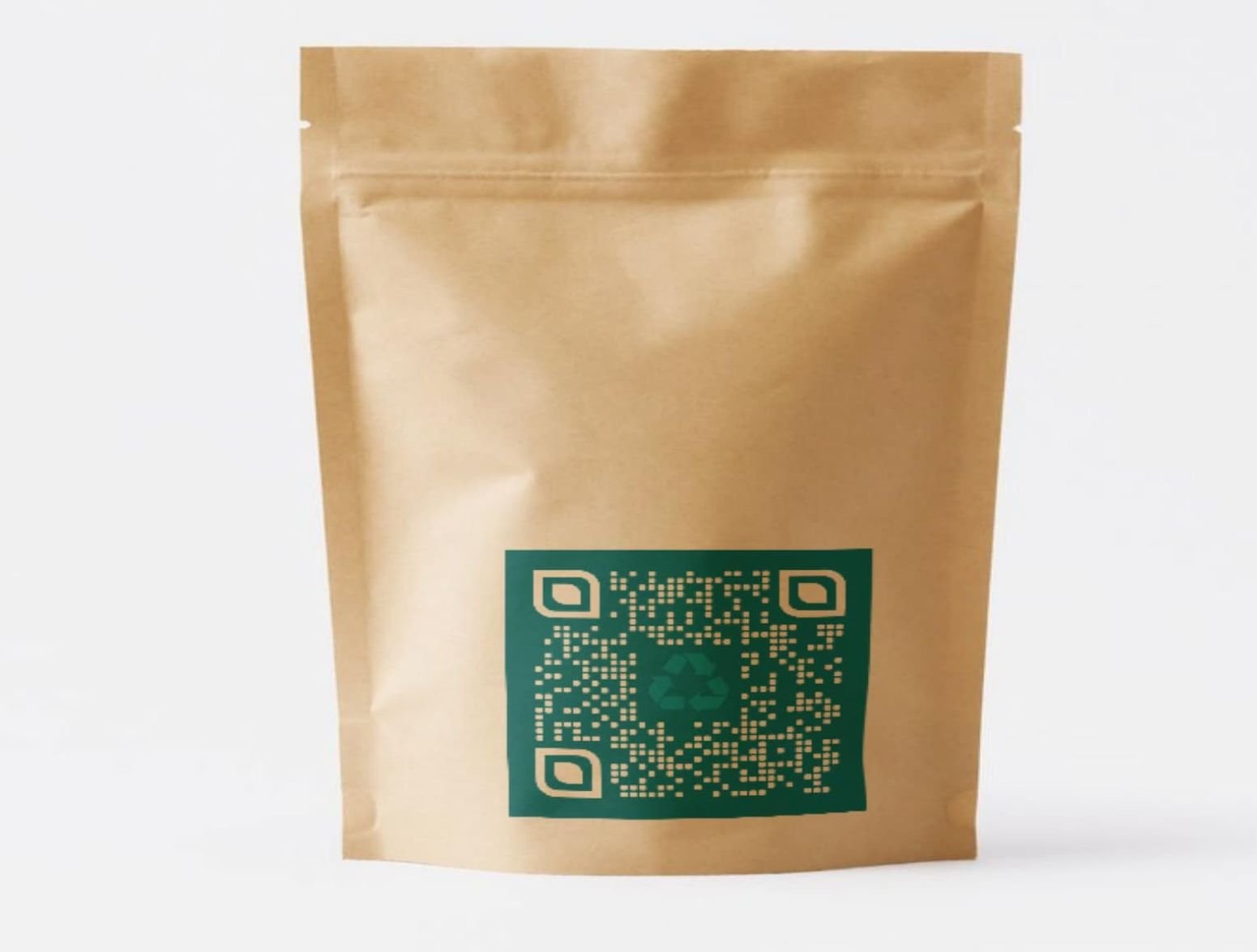
A QR code placed on packaging can carry far more information than any printed label. More importantly, the data behind the QR code can be updated at any time without touching the packaging itself. This single capability solves the core problem that static printed labels create.
The concept is simple: print the QR code once, and update the underlying data as often as needed. This approach aligns neatly with the PPWR’s requirement that manufacturer information must be accurate and up to date at all times, not just at the point of production.
Why QR codes work for PPWR compliance?
- A single QR code can store the manufacturer name, address, type designation, and batch number in one place
- When regulatory requirements expand, new data fields can be added to the linked record without changing the packaging
- Information is always current, reducing the risk of outdated details circulating in the market
- The same QR code can serve multiple regulatory purposes, from recyclability information to sorting instructions
- Supports both the EU conformity declaration process and future extended producer responsibility data requirements
How PackIntelX Builds a Future-Ready PPWR Compliance System?
PackIntelX has built a digital platform designed specifically to help companies manage their PPWR obligations in a structured and scalable way. Rather than treating compliance as a documentation exercise, the platform turns regulatory requirements into an operational workflow that runs in the background without burdening internal teams.
The platform supports the full Article 15 compliance journey, from generating the EU conformity declaration to creating and managing the QR codes that carry manufacturer information. Here is how the key features come together:
- Centralized product and manufacturer data management: All packaging-related information is stored in one place, making it easy to keep records consistent and up to date across all packaging types and variants.
- Automated EU conformity declaration: Rather than completing declarations manually for each packaging unit, the platform generates them automatically based on the data already in the system. This significantly reduces administrative workload and lowers the risk of errors.
- Stable, unique QR codes per packaging unit: The platform generates a permanent QR code for each packaging item. The code is linked to the manufacturer record and can be updated any time without changing the code itself.
- Real-time data updates: Because the QR code points to a cloud-based record rather than static printed text, any changes to manufacturer information, batch numbers, or regulatory data are reflected immediately for anyone who scans the code.
- Scalable for future PPWR requirements: As new obligations around recyclability, material composition, and EPR symbols come into force, the same digital infrastructure can absorb those requirements without requiring a packaging redesign.
‘’A QR code turns every package into a digital access point. Companies can not only meet regulatory requirements but also simplify their processes and reduce costs, in line with the principle: Print once, update anytime’’
- Siddharth Bagri, Managing Director, PackIntelX
The result is packaging that becomes part of a living digital infrastructure rather than a static printed object. This matters not just for PPWR compliance today, but for every regulatory update that follows.
PackIntelX at Interpack 2026
Interpack 2026, held in Düsseldorf from May 7 to 13, 2026, is one of the world’s most important trade fairs for the packaging industry. It brings together manufacturers, brand owners, technology providers, and regulators under one roof, making it the ideal setting for discussions about how the industry is adapting to the PPWR.
PackIntelX is presenting its full digital compliance solution at Interpack 2026, with a specific focus on the new manufacturer obligations under Article 15. Visitors to the stand will be able to see how the platform works in practice, from the generation of the EU conformity declaration to the creation and management of QR-code-based digital labels.
If you are attending Interpack and want to understand what Article 15 means for your business, or if you are looking for a practical compliance digitalisation solution, this is the right conversation to have.
About PackIntelX
PackIntelX is a digital all-in-one platform for companies across the entire packaging value chain. The platform connects manufacturers, brand owners, and waste management organisations by translating complex regulatory requirements, particularly those arising from the PPWR, into structured and automated digital processes.
| What PackIntelX covers | Details |
| PPWR compliance management | End-to-end support for Article 15, recyclability assessments, and EPR obligations |
| EU conformity declaration | Automated declaration generation and documentation management |
| Digital labelling | QR code generation, management, and real-time data updates |
| Regulatory intelligence | Built-in expertise from EPR specialists, recycling engineers, and packaging law advisors |
| Scalable software infrastructure | Designed to absorb new regulatory requirements as the PPWR rolls out through 2030 |
PackIntelX was founded by Siddharth Bagri, an engineer with international experience in recycling and the circular economy. The team includes software developers, EPR and recycling experts, and specialised legal advisors from the packaging industry. Together, they have built PackIntelX as an operational bridge between packaging regulations, circular economy goals, and compliance digitalisation.
Final Thoughts
The PPWR is not a future concern anymore. Article 15 obligations are already here, and the August 12 deadline is approaching fast. For packaging manufacturers, the question is no longer whether to act, but how to act efficiently without creating new operational problems in the process.
Static printed labels are not built for the regulatory environment that packaging is now entering. The volume of required information is growing, the accuracy requirements are strict, and the penalties for non-compliance are real. Digital labelling, powered by a platform that automates EU conformity declarations and manages manufacturer data centrally, is the most practical path forward.
PackIntelX has built exactly that platform. It is designed for companies that want to move from reactive compliance firefighting to a proactive, scalable approach that keeps packaging ready for whatever the PPWR requires next. Whether you are just starting to map your Article 15 obligations or you are looking to replace a fragmented manual process, PackIntelX gives you the structure, the automation, and the expertise to get there.
Ready to get compliant before August 12?
Book a demo with the PackIntelX team and see how compliance digitalisation works in practice. From the EU conformity declaration to digital QR-code labelling, discover what Article 15 compliance looks like with PackIntelX.
Schedule a consultation with PackIntelX today!