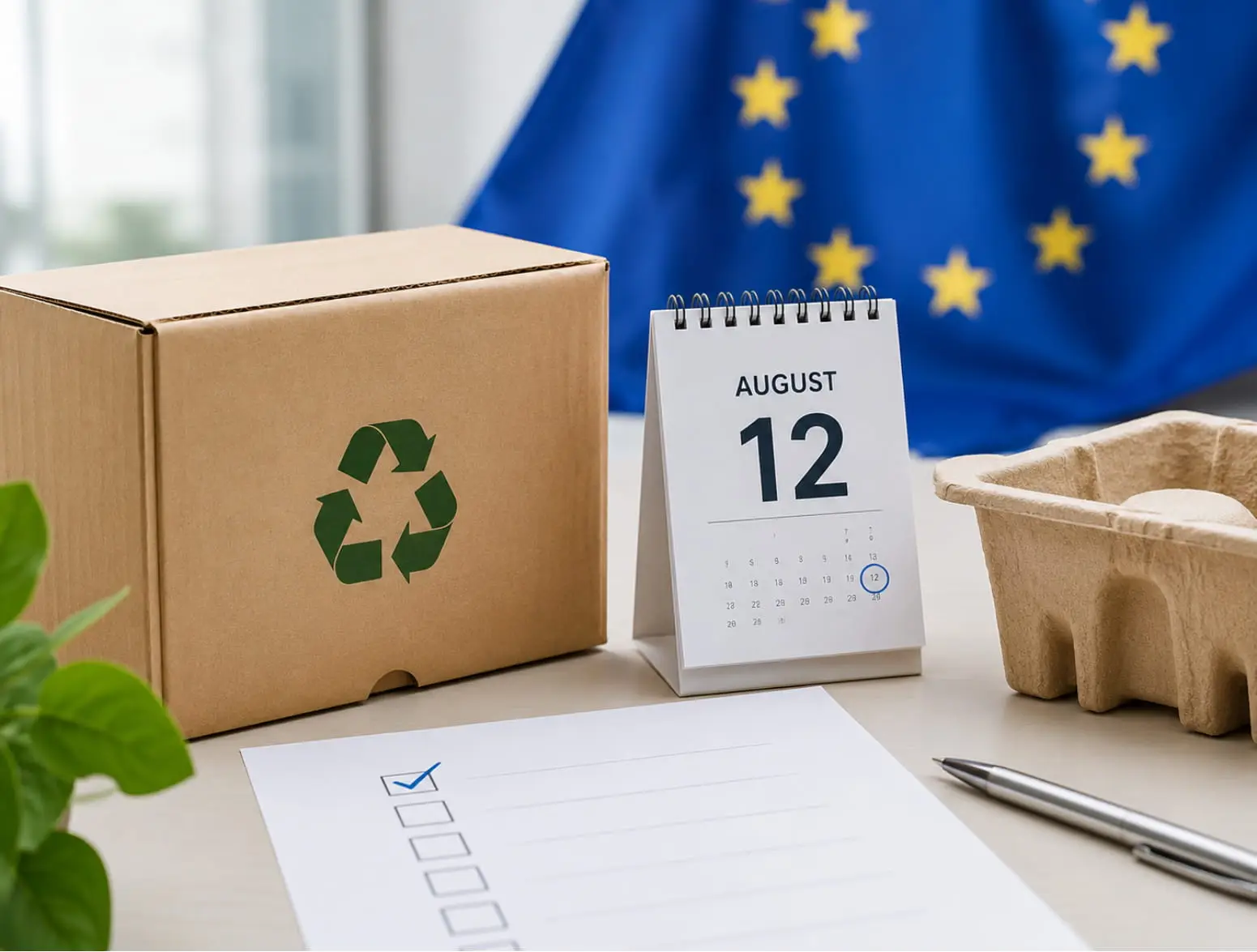
The Packaging and Packaging Waste Regulation (PPWR) has now reached its application date. From 12 August 2026, the regulation applies across the European Union, marking a major shift in how packaging compliance is managed by manufacturers, importers, distributors, brand owners and other economic operators.
However, 12 August should not be viewed as the end of the PPWR compliance journey. It marks the beginning of a new phase in which businesses need to demonstrate compliance, maintain supporting documentation, respond to regulatory requirements and prepare for additional obligations that will become applicable over the coming years.
The PPWR introduces requirements covering packaging sustainability, substances of concern, recyclability, recycled content, packaging minimisation, reusability, labelling, technical documentation and conformity assessment. While some requirements apply from the start of the regulation, others have later implementation dates extending towards 2030 and beyond.
For businesses, understanding what happens after the PPWR deadline 2026 is therefore essential for maintaining market access and preparing for the next stages of European packaging regulations.

What Changes After 12 August 2026?
After 12 August 2026, businesses placing packaging on the EU market should focus on the following key changes:
- PPWR becomes applicable across the EU: Unlike a directive, the PPWR does not require national transposition. It establishes a common legal framework that applies directly across Member States.
- Businesses must demonstrate compliance: Companies placing packaging on the EU market need to demonstrate that their packaging meets the applicable PPWR requirements.
- Technical documentation becomes critical: Businesses need to maintain the technical documentation and conformity evidence required to support their packaging compliance.
- Requirements depend on the business and packaging: The obligations that apply will vary depending on the type of packaging, the role of the business and the specific PPWR requirements involved.
- Not all requirements apply immediately: Businesses should distinguish between obligations that apply from 12 August 2026 and requirements that have later implementation dates.
- Future requirements require early planning: Major requirements relating to recyclability, recycled content and reuse have later implementation dates and should form part of the longer-term PPWR compliance roadmap.
PPWR Compliance Becomes an Ongoing Responsibility
The application of the PPWR does not mean that businesses can simply complete a compliance exercise and move on.
Manufacturers are expected to maintain procedures that ensure series production continues to comply with the regulation. Where packaging design, characteristics or technical specifications change in a way that could affect conformity, businesses may need to reassess compliance.
Technical documentation must also remain available and up to date. Manufacturers and importers may be required to provide relevant information and documentation to authorities when requested.
Packaging identification is another important part of this process. Depending on the applicable requirements, packaging needs to carry information that allows it to be identified and linked to the relevant manufacturer and conformity documentation.
This makes packaging data management, traceability and document control increasingly important for businesses operating across multiple products and suppliers.
What Happens If Packaging Is Not Compliant?
The PPWR gives market surveillance authorities powers to investigate packaging that may not comply with applicable requirements.
Where non-compliance is identified, businesses may be required to take corrective action. Depending on the nature and seriousness of the issue, this could involve bringing packaging into conformity, withdrawing it from the market or recalling affected packaging.
For companies operating across multiple European markets, the consequences can extend beyond one product or one market. Packaging documentation, supplier information and conformity records therefore need to be organised in a way that allows businesses to respond quickly when questions arise.
Common areas that can create compliance risks include:
- Incomplete technical documentation
- Missing or outdated supplier information
- Incorrect manufacturer identification
- Unsupported EU Declarations of Conformity
- Inadequate packaging traceability
- Failure to meet applicable sustainability requirements
- Gaps in EPR registration or reporting
- Inability to provide compliance evidence when requested
The practical impact is that PPWR compliance needs to be integrated into normal business processes rather than treated as a one-time regulatory project.
What Are the Penalties for PPWR Non-Compliance?
There is no single EU-wide PPWR fine that applies to every infringement. The regulation requires Member States to establish their own rules on penalties for infringements. These penalties must be effective, proportionate and dissuasive, with national frameworks developing alongside PPWR implementation.
This means businesses should be cautious about relying on generic claims about a specific PPWR fine or penalty amount. The consequences of non-compliance can also extend beyond financial penalties. Depending on the circumstances, businesses may face corrective measures, packaging withdrawal or recall, additional conformity work and disruption to normal operations.
The commercial consequences can therefore be significant even where the immediate issue is a documentation or compliance gap.
How Can PPWR Non-Compliance Affect Businesses?
For many businesses, the biggest impact of non-compliance may not be the penalty itself. Operational disruption can create additional costs across procurement, packaging development, logistics and regulatory teams.
Businesses may need to:
- Redesign packaging
- Replace non-compliant materials
- Obtain additional testing or evidence
- Update technical documentation
- Rework EU Declarations of Conformity
- Request missing information from suppliers
- Withdraw affected packaging
- Manage customer or market requirements
- Repeat conformity assessments
For companies selling packaged products across several EU countries, these activities can become particularly complex because packaging portfolios often involve multiple suppliers, materials and packaging formats.
This is why businesses should continue strengthening their PPWR compliance processes even after the application date.
The PPWR Roadmap Continues Beyond 2026
The PPWR deadline 2026 is only the beginning of a longer regulatory transition. Several important requirements have later deadlines, particularly around recyclability, recycled content and reusable packaging. Businesses that focus only on the requirements applicable in 2026 may find themselves unprepared for the next stage of the regulation.
The PPWR aims to make packaging increasingly recyclable and reusable while reducing unnecessary packaging and increasing the use of recycled materials. This means packaging decisions made today can have implications for future compliance.
Businesses should therefore consider their longer-term packaging strategy alongside immediate compliance requirements.
| PPWR Area | What Businesses Should Monitor |
| Recyclability | Packaging design and future recyclability performance |
| Recycled content | Supplier data, certifications and traceability |
| Reusability | Reuse systems and applicable transport packaging requirements |
| Packaging minimisation | Weight, volume and unnecessary packaging components |
| Labelling | Applicable harmonised labelling requirements |
| Substances of concern | PFAS, heavy metals and other relevant substances |
| Technical documentation | Evidence supporting packaging conformity |
| EU Declaration of Conformity | Accuracy, completeness and ongoing updates |
| EPR | Registration, reporting and national producer obligations |
What Should Businesses Focus on After the Deadline?
With the PPWR now applicable, businesses should move from deadline preparation towards continuous compliance management.
Priority areas include:
- Review packaging currently placed on the EU market
- Confirm the correct legal role for each packaging activity
- Verify manufacturer and importer responsibilities
- Maintain complete technical documentation
- Ensure EU Declarations of Conformity are properly supported
- Strengthen supplier data collection
- Review substances of concern information
- Monitor recyclability and recycled content requirements
- Assess future reuse and packaging minimisation obligations
- Maintain EPR registration and reporting processes
- Track new guidance and implementing measures
- Establish processes for responding to regulatory requests
Businesses should also regularly review their packaging portfolios as products, materials and suppliers change.
PPWR Compliance Requires a Long-Term Approach
The introduction of the PPWR changes the way businesses need to think about packaging compliance. Regulatory readiness can no longer depend only on completing a checklist before a single deadline.
Packaging information needs to remain accurate. Supplier evidence needs to be updated. Technical documentation needs to reflect current packaging specifications. EU Declarations of Conformity need to remain aligned with the applicable requirements.
At the same time, businesses need to prepare for future changes as additional PPWR obligations become applicable.
A structured compliance process can help organisations maintain visibility across packaging portfolios while reducing the risk of discovering gaps only when a regulatory or customer request arises.

How PackIntelX Can Support Businesses After the PPWR Deadline?
As the PPWR moves into its application phase, businesses may need continued support with packaging assessments, technical documentation, EU Declaration of Conformity preparation, supplier coordination, recyclability analysis and compliance management.
PackIntelX supports businesses through PPWR consulting, PPWR Check, technical documentation, supplier collaboration, recyclability analysis and digital compliance solutions.
These capabilities help organisations understand their current compliance position, identify gaps and establish structured processes for managing packaging requirements as the regulation continues to evolve.
Contact PackIntelX to review your PPWR compliance position and identify the next priorities for your packaging portfolio.
Conclusion
The PPWR deadline 2026 marks an important milestone, but it is not the end of the compliance journey. From 12 August 2026, businesses need to focus on maintaining conformity, managing documentation, responding to regulatory requirements and preparing for future obligations.
Non-compliance can result in corrective measures and, depending on the circumstances, withdrawal or recall of packaging. National penalty frameworks will also continue to develop as Member States implement their enforcement rules.
At the same time, requirements extending towards 2030 and beyond mean that businesses need to look beyond immediate compliance and consider how packaging design, materials, supplier data and documentation will support future requirements.
The organisations best prepared for the next stage will be those that treat PPWR compliance as an ongoing business process rather than a one-time deadline.
FAQs
1. What happens after the PPWR deadline of 12 August 2026?
The PPWR becomes applicable from 12 August 2026. Businesses must comply with the requirements applicable at this stage while preparing for additional obligations that will become applicable over the following years.
2. Can businesses be fined for PPWR non-compliance?
Yes. However, there is no single EU-wide PPWR fine. Member States establish their own penalty rules, which must be effective, proportionate and dissuasive. The consequences can also include corrective measures, withdrawal or recall of non-compliant packaging.
3. What happens if packaging does not comply with PPWR?
Market surveillance authorities can require businesses to take corrective measures where packaging does not meet applicable requirements. Depending on the circumstances, this may include bringing packaging into conformity, withdrawing it from the market or recalling it.
4. Does PPWR compliance end after 12 August 2026?
No. PPWR compliance is an ongoing responsibility. Businesses need to maintain technical documentation, conformity evidence, packaging traceability and supplier information while preparing for future requirements covering areas such as recyclability, recycled content and reuse.
5. What should businesses do after the PPWR deadline?
Businesses should review their packaging portfolios, verify their legal responsibilities, maintain technical documentation, ensure EU Declarations of Conformity are properly supported, strengthen supplier data management and monitor future PPWR requirements.
6. How does PPWR affect EPR compliance?
PPWR and EPR are connected but involve different responsibilities. Businesses need to manage technical conformity under the PPWR alongside applicable national EPR registration, reporting and financing obligations.