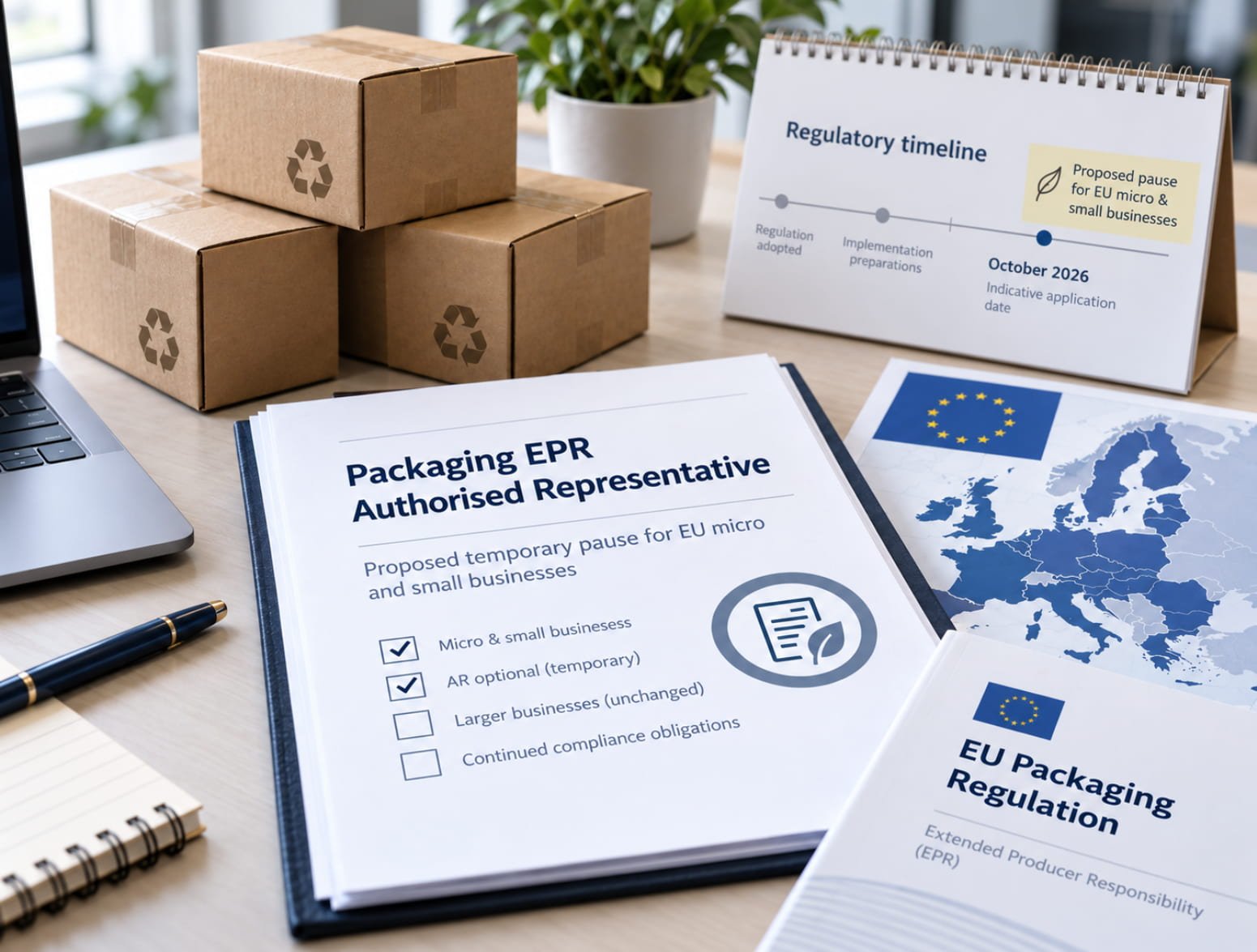
On 5 October 2026, the EU Parliament’s environment committee (ENVI) voted to pause one EPR rule for small firms. The rule says a packaging producer in one EU country must name an authorised representative (AR) in each other EU country. This applies when it sells straight to end users there. ENVI wants to pause this rule for EU micro and small companies only. The vote was 74 for, 0 against and 4 abstentions. It is not law yet.
Key takeaways
- ENVI backs a pause on the AR rule for EU-based micro and small producers only.
- The pause would run until 1 January 2035, or until the new EU Circular Economy Act applies, whichever is first.
- For these firms, an AR would be a choice, not a duty.
- Producers outside the EU would still need an AR.
- All other EPR duties stay, such as registration, reporting and fees.
- The plenary vote is planned for later in October 2026. Talks with the Council follow.
What is the AR rule today?
EPR means producers pay for the collection and recycling of their packaging. Each country runs its own EPR system. Under the EU Packaging and Packaging Waste Regulation (PPWR), a producer from one EU country must appoint an AR in another EU country. This applies if it sells packaging or packaged goods straight to end users there. The AR takes over the producer’s EPR duties in that country. The PPWR has applied since 12 August 2026.
Today, the rule does not depend on company size. A small online shop and a large brand face the same duty.
What did the European Commission propose?
In December 2025, the European Commission proposed a pause for all EU-based battery and packaging producers. The pause would last until 1 January 2035. The goal is less red tape. A firm that sells in many countries may need an AR in up to 26 Member States. That is costly, most of all for small firms.
What exactly does ENVI propose?
ENVI keeps the pause but makes it narrower. Rapporteur Ingeborg Ter Laak led the work. The table shows the main changes. The same pause covers battery producers.
| Topic | Commission proposal | ENVI position |
|---|---|---|
| Who is covered | All EU-based producers of batteries and packaging | Only EU-based micro and small enterprises |
| End date | 1 January 2035 | 1 January 2035, or the day the EU’s planned Circular Economy Act framework for EPR applies, whichever is first |
| Producers outside the EU | Member States could use other ways to track them | The AR rules stay as they are |
| Safeguards | None | Other EPR duties stay. No splitting up a firm to qualify |
| Choice | The AR becomes a choice. Existing ARs can stay | Same, for the covered firms |
Who counts as a micro or small business?
ENVI uses the standard EU definition.
| Size | Staff | Turnover or balance sheet |
|---|---|---|
| Micro | Fewer than 10 | Up to €2 million |
| Small | Fewer than 50 | Up to €10 million |
A company above these limits is medium or large. It would still need an AR.
Which businesses are affected?
| Business | Today | If ENVI’s text becomes law |
|---|---|---|
| EU micro or small producer that sells across EU borders | AR required | AR optional |
| EU medium or large producer | AR required | AR still required |
| Producer outside the EU, any size | AR as national rules require | No change |
Check where your company is based first. This matters most. A firm outside the EU gets no relief under ENVI’s text.
What stays the same?
- Registration in each country.
- Reporting of packaging data.
- Payment of EPR fees.
- Guarantees and membership of EPR schemes.
- Duties for waste prevention, collection, reuse and recycling.
The text also bans splitting or restructuring a business just to qualify for the pause. Firms that already have an AR may keep it.
Why does ENVI want a narrower pause?
ENVI notes that micro and small firms are most of the companies on the EU market. But they put a small share of the total volume on the market. The pause targets the firms for which the burden is biggest. Medium and large firms are generally better able to comply with the AR rule. Outside the EU, it is harder for authorities to enforce the rules. So the AR stays a key tool there.
ENVI also stresses that the pause is temporary. The Commission plans to table a wider EPR reform, the Circular Economy Act, in 2026. ENVI wants the pause to end when that reform applies.
When will this happen?
| Date | Step |
|---|---|
| December 2025 | The Commission proposes the pause |
| 5 October 2026 | ENVI adopts its position: 74 for, 0 against, 4 abstentions |
| 9 October 2026 | The ENVI report goes to the full Parliament |
| Later in October 2026 | Plenary vote is planned |
| After the vote | Talks with the Council can begin |
| Not yet set | Final law and start date |
Until a final law is in force, today’s AR rules apply. That includes Germany. Since 12 August 2026, firms based abroad with no German branch need an AR if they sell straight to end users there. Our guide to the AR in Germany and LUCID shows the steps.
What does this mean for your EPR compliance?
- Check your size and home country. Only EU micro and small firms could gain.
- Keep your AR for now. The rule still applies, and the final text may change.
- Read your AR contract. Look at the notice period and the fees.
- Keep your EPR basics on track. That means registration, reporting and fees in each market.
- Keep packaging data ready. You need it for reporting in every country.
- Follow the plenary vote and the talks with the Council.
Not sure how this affects your markets?
PackIntelX helps packaging companies plan EPR in each EU market. Join the free webinar “EPR obligations in the EU” on 13 October 2026, 11am to 12pm CEST, in English. It covers authorised representatives, fines, EU developments and EPR fees. A second English session, “PPWR and EPR after 12 August”, runs on 27 October 2026. The webinars are free for companies that place packaging on the market. Or book a consultation to check your markets, your AR set-up and your reporting duties.
FAQ
Is the AR rule already paused?
No. ENVI has voted, but the full Parliament and the Council must still agree. Today’s rules apply.
Does ENVI’s text apply to companies outside the EU?
No. Producers outside the EU would still need an AR where national rules ask for one.
Is the pause permanent?
No. It would end on 1 January 2035, or earlier if the EU’s planned Circular Economy Act framework for EPR applies first.
Would small firms still have EPR duties?
Yes. Registration, reporting, fees and other EPR duties stay. Only the duty to appoint an AR would be paused.
Can I end my AR contract now?
The rule is still in force, so wait for the final law. Check your contract for notice periods first.
What happens next?
The full Parliament votes first. Talks with the Council follow. Then a final law can be agreed.
Last updated: 11 October 2026. This article is general information, not legal advice.