Quick answer: PPWR is the EU packaging regulation. EPR, or extended producer responsibility, means producers pay for collecting and recycling the packaging they sell. PPWR builds on EPR, but each country still runs its own EPR scheme. In short, PPWR is the rulebook and EPR is how cost and reporting are handled.
Key takeaways
- PPWR is an EU-wide packaging regulation. EPR is a producer-pays idea that works through national schemes.
- They work together. One does not replace the other.
- PPWR covers product topics such as design, recyclability and labelling. EPR covers registering, reporting and fees.
- EPR details, such as forms and fees, still differ by country.
- Your role decides your duties. You may be a manufacturer, a producer, or both.
The EU packaging regulation, the PPWR, has started to apply in 2026. Many packaging teams now ask the same thing: is PPWR just another name for EPR? You may also see the question written as EPR vs PPWR. The answer is the same. They are linked, but they are not the same.
This article shows the difference in plain words. You will see what each one is, how they fit together, who is affected and where to start.
PPWR vs EPR at a glance
| Question | PPWR | EPR |
| What is it? | An EU regulation on packaging and packaging waste | A principle: the producer pays for the end of life of its packaging |
| Where does it come from? | One EU regulation, the same text in every country | EU rules, plus national laws in each country |
| Who sets the details? | Mostly the EU | Mostly each country |
| Main focus | What packaging is like and how it is placed on the market | Who pays for collection, sorting and recycling |
| Who is affected? | Manufacturers, importers, distributors and producers | Mainly producers |
| Typical tasks | Product documents, recyclability, labelling, recycled content | Register, report packaging data, pay fees |
| Timing | Started to apply in 2026. Some rules phase in later. | Already in place in many countries. PPWR makes parts of it more alike. |
This is a simplified overview. Your exact duties depend on your role and the countries you sell to.
What is the PPWR?
The PPWR is the EU’s new packaging regulation. It applies in the same way in every EU country.
It covers topics such as design, recyclability, recycled content, labelling, reuse and harmful substances. Some rules start later, so timelines depend on the topic. Want the full picture? Read more about what the PPWR is.
What is EPR?
EPR stands for extended producer responsibility. The idea is simple. The company that puts packaging on the market also pays for what happens to it after use. That means collection, sorting and recycling.
EU rules set common starting points. Each country then adds its own laws and runs its own scheme. That is why fees, forms and deadlines change from one country to the next. Our short explainer on what EPR is goes deeper.
Is EPR part of the PPWR? How PPWR and EPR fit together
Short answer: in part. PPWR does not replace EPR. It builds on it. In broad terms, PPWR touches EPR in these areas:
- A common idea of who is the producer. Before, countries used different definitions.
- National producer registers. Producers are expected to be listed where they sell.
- Fees that can reflect design. Fees may depend on how recyclable the packaging is and how much recycled content it has.
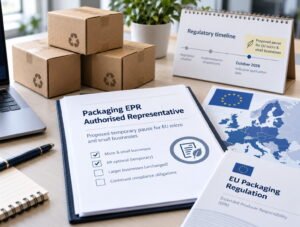
- A representative for sellers from abroad. Details are still being discussed, so follow updates. Our post on the authorised representative proposal explains the role.
- More packaging types. EPR can reach transport and commercial packaging too.
In short: PPWR is the rulebook. EPR is the payment and reporting system inside it. Each country still runs that system in its own way.
Who does what: manufacturer or producer?
Many companies mix up two roles. The manufacturer makes the packaging or has it made. The producer is the company that is responsible for EPR in a country. You can be both, but not always. Check your role in each country you sell to.
- Manufacturer side (product rules): product documents such as the declaration of conformity. Read more on the declaration of conformity for packaging.
- Producer side (EPR): register, report packaging data and pay fees. See multi-country EPR reporting.
Four common mix-ups
- “PPWR replaces EPR.” Not quite. PPWR builds on EPR. National schemes stay in place.
- “PPWR creates one EU EPR scheme.” Not quite. Each country still has its own register, fees and reporting.
- “A declaration of conformity means I have done EPR.” No. That is a product document. EPR is about registering, reporting and paying.
- “Only big brands are affected.” Not quite. Companies of all sizes can be affected.
What is still moving?
The PPWR has started to apply, and some details are still being worked out. Examples are simpler rules for smaller companies and the representative duty. Treat news as moving and check for updates. For the latest, see PPWR rules for 2026.
What to do next: your PPWR and EPR requirements
Here are five steps to meet your PPWR and EPR requirements.
- Map your packaging. List what you sell, the materials and the countries.
- Find your role. Decide in each country whether you are the manufacturer, the producer, or both.
- Register where needed. Learn the basics in EPR for packaging producers.
- Report and pay. Collect weights by material and report on time. Many countries work with a PRO (producer responsibility organisation).
- Prepare product files. Manufacturers should prepare their documents, such as the declaration of conformity.
Keep your EPR and PPWR work in one place. PackIntelX helps packaging companies manage EPR reporting and PPWR documents on one platform. Explore our EPR overview and PPWR compliance pages.
This article is general information, not advice. Rules differ by country and can change, so ask a qualified adviser if you are unsure.
Frequently asked questions
What is the difference between PPWR and EPR?
PPWR is the EU packaging regulation. It sets rules for design, recyclability, labelling and more. EPR is the idea that producers pay for collecting and recycling their packaging. PPWR builds on EPR, but each country still runs its own EPR scheme.
Is EPR part of the PPWR?
In part. PPWR contains rules that touch EPR, such as who counts as the producer, producer registers and fees that can reflect design. But EPR is older than PPWR, and each country runs its own scheme.
Does the PPWR replace EPR?
No. National EPR schemes stay in place. PPWR makes parts of them more alike across the EU.
Do I have to follow both PPWR and EPR?
Most companies that sell packaging or packaged goods in the EU have duties linked to both. Which duties apply depends on your role: manufacturer, producer or both.
Do PPWR and EPR apply to small companies?
Companies of all sizes can be affected. Your duties depend on your role and the countries you sell to, not only on your size. Simpler rules for smaller companies are still being discussed.
Where should I start?
Map your packaging and your role in each country. Then register, report and prepare your product files, using the steps above.