Quick answer: The EU Deforestation Regulation (EUDR) applies from 30 December 2026 to large and medium companies, and from 30 June 2027 to most micro and small companies. Since 18 September 2026, packaging that only supports, protects or carries another product is out of scope, whatever it is made of. Packaging sold as a product in its own right, such as empty cartons sold to a filler, still needs EUDR due diligence.
Status: 20 November 2026. The application date of 30 December 2026 is confirmed; the Commission ruled out a further delay in its May 2026 simplification package. The product-scope changes of Delegated Regulation (EU) 2026/2102 have applied since 18 September 2026.
Key takeaways
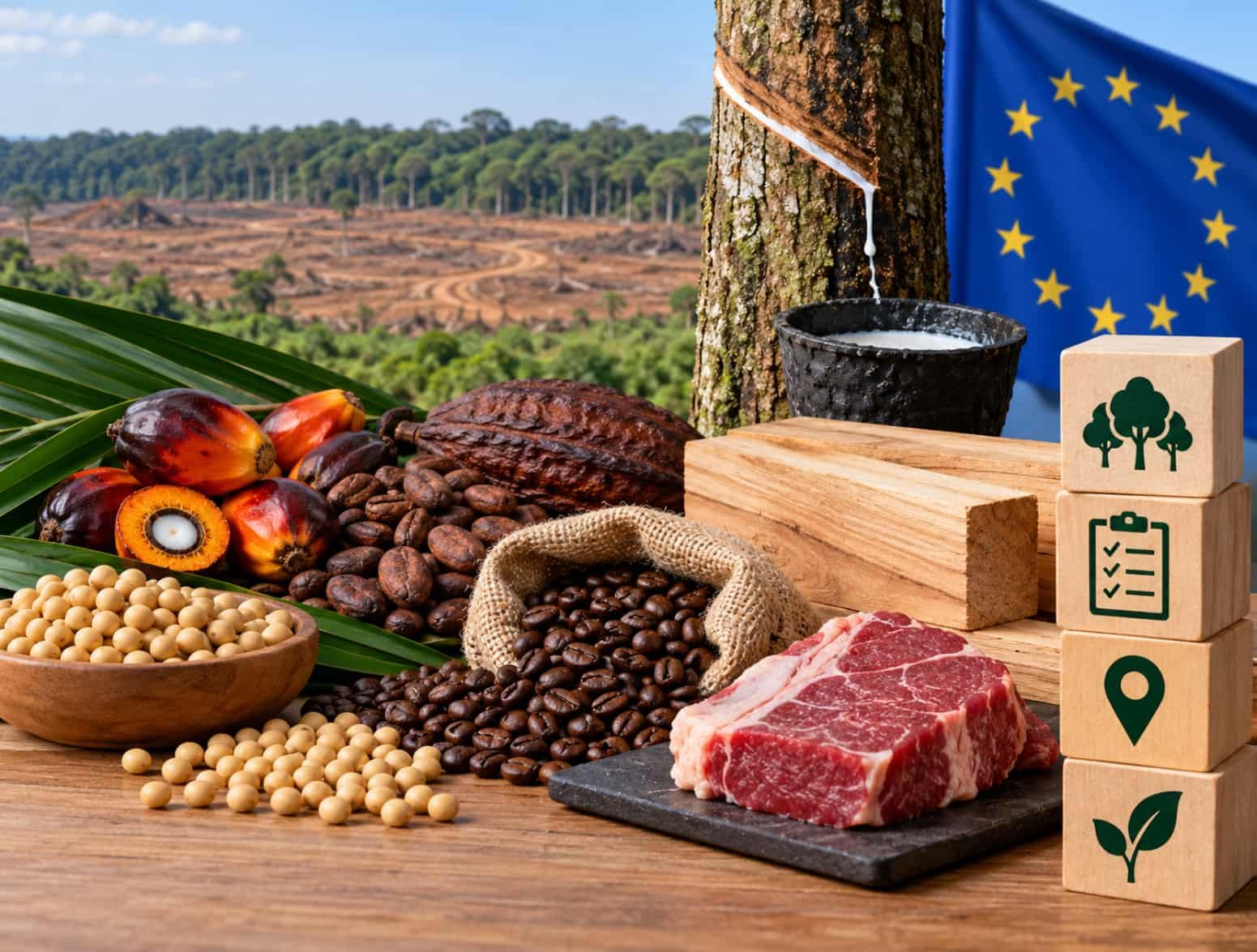
- The EUDR (Regulation (EU) 2023/1115) covers cattle, cocoa, coffee, oil palm, rubber, soya and wood, and listed products made from them.
- Products may only be placed on the EU market or exported if they are deforestation-free (no deforestation after 31 December 2020), legally produced and covered by a due diligence statement or, for micro and small primary operators, a simplified declaration.
- Packaging used to pack another product is out of scope. Paper, board and wood packaging sold as a product is still in scope.
- Operators carry the main duty. Downstream operators and traders keep information and reference numbers; those that are not SMEs must register in the EU Information System.
- Penalties are national, but the maximum fine must be at least 4% of a company’s annual EU turnover.
Application dates
| Who | Applies from |
|---|---|
| Large and medium operators and traders | 30 December 2026 |
| Micro and small operators for timber products already covered by the EU Timber Regulation | 30 December 2026 |
| All other micro and small operators | 30 June 2027 |
Products added to Annex I in 2026 follow from 30 December 2027. The EU Timber Regulation is repealed on 30 December 2026, so timber products move straight into the EUDR on that date.
What changed for packaging in 2026
Delegated Regulation (EU) 2026/2102 amended the product scope in Annex I. It was adopted on 13 July 2026, published in the Official Journal on 17 September 2026 and has applied since 18 September 2026. For packaging it draws a clear line:
| Situation | In EUDR scope? |
|---|---|
| Single-use packaging used only to support, protect or carry another product (cartons, trays, pallets, wrapping), any material | No |
| Reusable packaging, once it is used to pack another product | No |
| The first sale of new reusable packaging (e.g. new wooden pallets or crates) | Can be in scope |
| Packaging sold as a product in its own right, e.g. empty folding cartons, corrugated boxes or paper bags sold to a brand owner or filler | Yes, if the product falls under a listed wood-based code |
| Product samples, marketing material, waste, used and second-hand products, items of correspondence | Exempt under the horizontal exemptions |
The same delegated act removed several products, such as cattle hides and leather, retreaded tyres, conveyor belts and soya beans for sowing. It also adds soluble coffee, some palm-oil derivatives and frozen cattle tongues, which come into scope from 30 December 2027.
Who has to do what
| Role | Typical packaging example | Obligations |
|---|---|---|
| Operator: first places a relevant product on the EU market or exports it | A converter importing paper or board into the EU, or a mill placing pulp on the market | Full due diligence (information, risk assessment, mitigation) and a due diligence statement before placing on the market |
| Downstream operator: places on the market products made from products already covered by a statement | A carton maker that buys EU-sourced board and sells finished boxes | Collect and keep supplier information and statement reference numbers; register in the Information System if not an SME |
| Trader: makes products available without being the operator or downstream operator | A packaging distributor reselling cartons | Keep information on direct business partners and reference numbers; register if not an SME |
| Micro or small primary operator in a low-risk country | A small forest owner selling its own wood | A one-time simplified declaration |
| Brand owner that buys packed goods | A food brand using cartons as packaging | No EUDR duty for the packaging itself (exempt), but the packed product may be in scope (e.g. coffee, cocoa) |
The Commission’s May 2026 guidance confirms that downstream operators and traders can meet the “collect and keep” duty with information they already receive in normal commercial documents, such as invoices.
What to do in the 40 days before 30 December
- Map your products against Annex I as amended in September 2026: list each HS code, the commodity it contains and whether the packaging exemption applies.
- Fix your role per product and per country: operator, downstream operator or trader.
- Register in the EU Information System (EU Login, company EORI or VAT number) if you are an operator, or a downstream operator or trader that is not an SME.
- Collect supplier data: plot geolocation (points, or polygons for plots above four hectares), production dates, supplier details and evidence of legality, or the reference numbers of existing statements.
- Assess and mitigate risk where you are the operator, and document the result.
- Submit due diligence statements before the goods are placed on the market or cleared by customs, and pass the reference number to your customers.
- Keep records for five years.
Filing step by step: What is an EUDR due diligence statement and how it is filed in TRACES. Roles explained in more depth: EUDR explained: who is responsible.
EUDR and PPWR: one data set for packaging
Packaging companies already collect material and supplier data for the PPWR technical documentation and the EU Declaration of Conformity. The EUDR adds origin and geolocation data for wood-based materials. Keeping both in one structured record per material and supplier avoids asking suppliers twice and keeps declarations consistent.
Need help with scoping, supplier data or statements? See our EUDR compliance service.
Frequently asked questions
Is cardboard packaging covered by the EUDR?
Not when it is used to pack another product. Since 18 September 2026 such packaging is out of scope regardless of material. Cardboard boxes sold as products in their own right, for example by a converter to a filler, remain in scope.
Will the 30 December 2026 date be postponed again?
The Commission’s simplification package of May 2026 confirmed the date and ruled out a further delay. Plan for 30 December 2026.
Do traders and downstream operators submit a due diligence statement?
No. They keep information on their direct business partners and the reference numbers of the statements in their supply chain. Those that are not SMEs must register in the Information System.
What are the penalties?
Member States set them, but the maximum fine must be at least 4% of annual EU turnover, alongside confiscation of products and revenues and temporary exclusion from public procurement.