
EUDR Compliance 2026: Deadline, Due Diligence and TRACES
From 30 December 2026, products made from cattle, cocoa, coffee, oil palm, rubber, soya and wood may only be placed on the EU market if they are deforestation-free, legally produced and covered by a due diligence statement. PackIntelX helps you define your role, collect supplier and geolocation data, assess risk and file your statements on time.
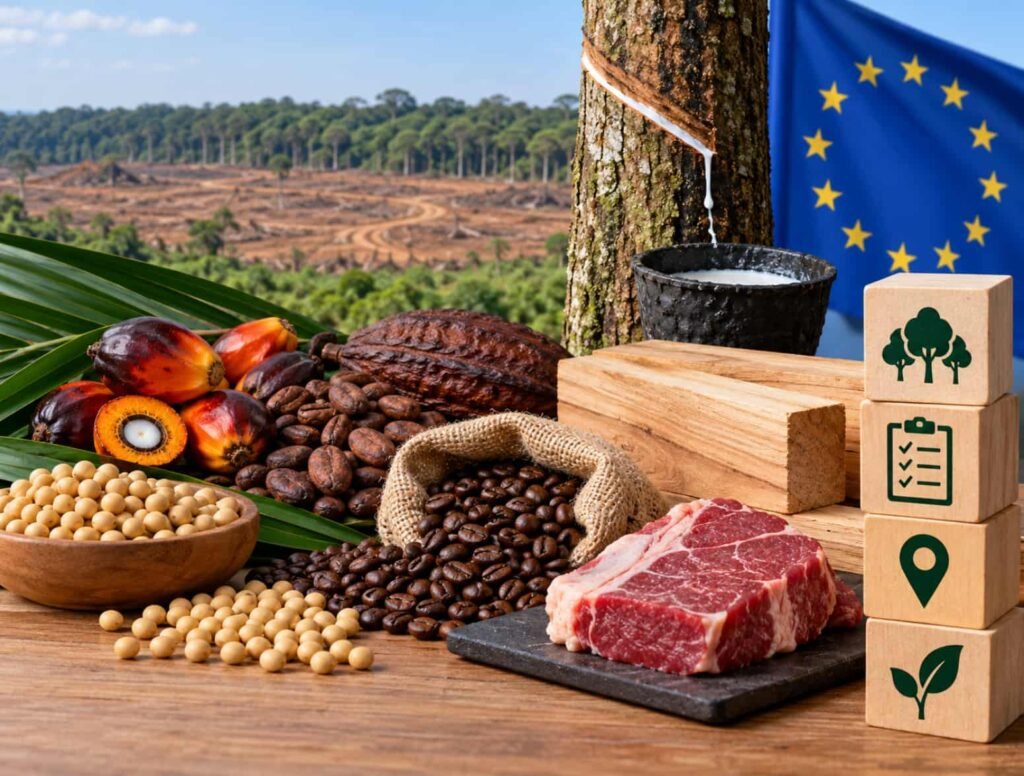
The EUDR applies from 30 December 2026
Large and medium-sized companies (and micro and small timber operators) must comply from 30 December 2026. Other micro and small operators follow on 30 June 2027.
EUDR status in November 2026: what is confirmed
39 days until the EUDR applies to large and medium-sized companies on 30 December 2026.
- No further delay. In its simplification package of 4 May 2026 the European Commission confirmed 30 December 2026 for large and medium-sized companies and for micro and small timber operators. All other micro and small operators follow on 30 June 2027.
- Downstream operators and traders no longer file their own due diligence statement since the December 2025 amendment (Regulation (EU) 2025/2650). They collect and keep the reference numbers of the statements they receive. In retail sales to consumers, nothing has to be collected.
- Low-risk countries: operators that source only from countries classified as low risk (Implementing Regulation (EU) 2025/1093) do not need a full risk assessment unless there are substantiated concerns. Micro and small primary operators use a simplified one-off declaration.
- Product scope: Delegated Regulation (EU) 2026/2102 applies since 18 September 2026. Packaging used only to support, protect or carry another product is out of scope. Leather and retreaded tyres were removed; soluble coffee and certain palm oil derivatives follow from 30 December 2027.
- Information System (TRACES) has been upgraded with the simplified declaration, grouping of reference numbers and the new roles. Non-EU companies need an EU EORI number or an authorised representative established in the EU to file.
Sources: Regulation (EU) 2023/1115 as amended by Regulation (EU) 2025/2650; Commission simplification package of 4 May 2026; Delegated Regulation (EU) 2026/2102; Implementing Regulation (EU) 2025/1093. Last reviewed: 21 November 2026.
The EUDR in 60 seconds
The EU Deforestation Regulation (EUDR), Regulation (EU) 2023/1115, replaces the EU Timber Regulation. It bans products linked to deforestation or forest degradation from the EU market. Any company that places relevant products on the EU market, or exports them from the EU, must prove through due diligence that they are deforestation-free and produced in line with the laws of the country of production.
7 commodities
Cattle, cocoa, coffee, oil palm, rubber, soya and wood, plus the derived products listed in Annex I (e.g. chocolate, furniture, paper, tyres).
Cut-off date: 31 Dec 2020
Commodities must come from land that has not been deforested or degraded after 31 December 2020.
Due diligence statement
Operators collect geolocation and supplier data, assess risk and submit a due diligence statement (DDS) in the EUDR Information System (TRACES) before placing products on the market.
Penalties up to 4% of EU turnover
Member States must set fines of at least 4% of annual EU turnover for serious breaches, plus confiscation of goods and exclusion from public contracts.
Which products are covered by the EUDR?
The EUDR covers seven commodities and the derived products listed in Annex I, identified by their HS / CN codes. The product scope was finalised by Delegated Regulation (EU) 2026/2102, in force since 18 September 2026.
Cattle
Live cattle, beef and other cattle meat. Hides, skins and leather were removed from scope in September 2026.
Cocoa
Cocoa beans, paste, butter, powder and chocolate.
Coffee
Green and roasted coffee. Soluble instant coffee is added to scope from 30 December 2027.
Oil palm
Palm oil, palm kernels, palm kernel oil and listed derivatives such as glycerol and fatty acids.
Rubber
Natural rubber and new pneumatic tyres. Retreaded tyres and several vulcanised rubber articles are out of scope.
Soya
Soybeans, soya flour, meal and oil. Soybeans for sowing are out of scope.
Wood
Timber, wooden furniture, pulp, paper, paperboard and printed products. Bamboo and rattan are excluded.
What about packaging?
Packaging used only to support, protect or carry another product is exempt. Paper and board packaging sold as a product in its own right can fall under wood, so packaging makers and distributors should check their codes. Read our EUDR packaging guide.
Am I in scope? Quick answers
| Product | In scope? | What to know |
|---|---|---|
| Cocoa, chocolate, green and roasted coffee | Yes | Soluble instant coffee follows from 30 December 2027. |
| Palm oil, soya and natural rubber and the derived products listed in Annex I | Yes | Synthetic rubber and coconut oil are not covered. |
| Live cattle and beef | Yes | Leather was removed from the scope. |
| Wood, furniture, paper and printed products | Yes | Products made only from recycled material are out; any virgin fibre share is in. Geolocation is needed for all wood components. |
| Paper and board packaging sold as a product, e.g. boxes and cartons (CN 4819) | Yes | You sell the packaging itself, so you are the operator or trader for it. |
| Packaging used to pack, protect or carry another product | No | Exempt from the moment it is used as packaging. |
| Wooden pallets and cases sold as products (CN 4415) | Yes | For repaired pallets, only the new wood components count. |
| Bamboo, rattan and other non-wood fibres | No | Only products derived from the seven commodities are covered. |
Making or trading packaging? Read our EUDR packaging guide.
Who has to comply?
Your obligations depend on your role for each product:
- Operators place relevant products on the EU market for the first time or export them. They carry out due diligence, submit the DDS and keep records for five years.
- Downstream operators and traders buy products already on the EU market. Since the December 2025 amendment they no longer file their own DDS, but must collect and keep the reference numbers of their suppliers’ statements.
- Micro and small primary operators in low-risk countries can use a simplified one-off declaration.
- Non-EU suppliers are not directly obliged, but their EU customers will ask them for geolocation data and evidence.
Key EUDR dates
18 September 2026
Final product scope in force (Delegated Regulation (EU) 2026/2102): leather, retreaded tyres and soybeans for sowing removed.
30 December 2026
EUDR applies to large and medium-sized companies, and to micro and small operators in the timber sector. The Commission has ruled out a further delay.
30 June 2027
EUDR applies to all other micro and small operators.
30 December 2027
Newly added products (e.g. soluble instant coffee and certain palm oil derivatives) come into scope.
EUDR obligations by role and company size
Your obligations depend on your role for each product, not on your company as a whole. One company can be an operator for one product and a trader for another.
| Role | Who it is | What you must do | From |
|---|---|---|---|
| Operator, large or medium-sized | Places relevant products on the EU market for the first time, or exports them | Due diligence (information, risk assessment, risk mitigation), a due diligence statement in TRACES before placing on the market or export, records kept for five years | 30 December 2026 |
| Operator, micro or small | As above | As above. Micro and small primary operators in low-risk countries use a simplified one-off declaration. | 30 June 2027 (timber: 30 December 2026) |
| Downstream operator or trader | Buys products that are already on the EU market | No own statement. Collect and keep the reference numbers of the statements you receive and pass them on. | 30 December 2026 |
| Non-EU supplier | Produces or exports to the EU | No direct obligation, but EU customers will ask for geolocation and legality evidence. To file in TRACES you need an EU EORI number or an EU-based authorised representative. | When your EU customers need it |
Your EUDR compliance journey
1. Map your products and define your role
Match your products to the Annex I HS / CN codes and decide, product by product, whether you are an operator, downstream operator or trader.
2. Collect supplier and geolocation data
Gather plot coordinates (polygons for plots over 4 hectares), production dates, quantities and supplier details along your supply chain.
3. Assess and mitigate risk
Check deforestation-free status and legality using the country risk classification. Sourcing only from low-risk countries allows simplified due diligence.
4. Submit your due diligence statements
Register in the EUDR Information System (TRACES), file each DDS before placing products on the market and pass the reference numbers down the chain.
5. Monitor, document and review
Keep records for five years, review your due diligence system at least once a year and be ready for checks by national authorities.
What happens if you are not ready on 30 December?
From 30 December 2026, customs and national authorities check EUDR compliance. The consequences are practical and fast:
- Blocked shipments: products without a valid due diligence statement reference number cannot be released for free circulation or exported.
- Fines: proportionate penalties, with a maximum of at least 4% of the company’s total annual EU turnover.
- Confiscation of the products and of the revenue made from them.
- Exclusion from public procurement and public funding for up to 12 months, and a temporary ban on placing products on the market.
Not sure where you stand? Take the readiness check or book a consultation.
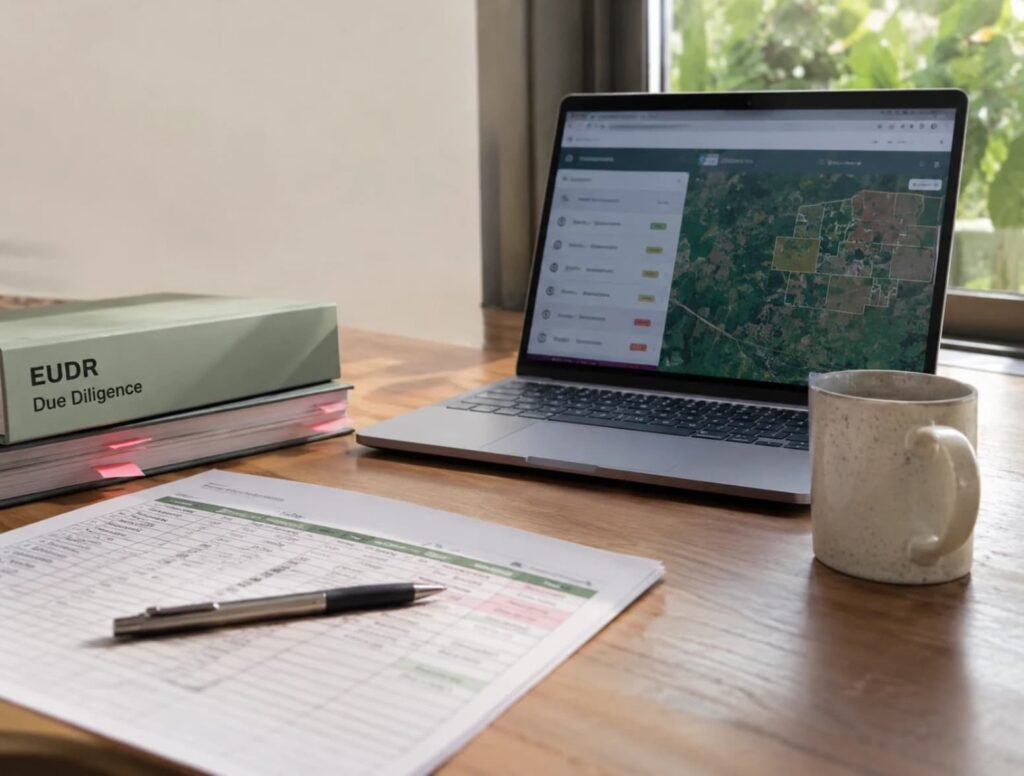
Solutions for EUDR Compliance
Expert support and digital tools to get your EUDR due diligence in place before 30 December 2026. Our services cover:
- EUDR scope and role assessment
- Supplier engagement and geolocation data collection
- Risk assessment and due diligence statement filing in TRACES
Select an option and request a quote.
EUDR Scope & Role Assessment
Supplier Data & Geolocation Collection
Risk Assessment & DDS Filing
EUDR Workshop for Your Team
Selected option
Expert Consultation
1 Hour
Is your company EUDR ready?
Answer six quick questions to see where you stand before 30 December 2026. No sign-up needed.
1. Do you place products made from cattle, cocoa, coffee, oil palm, rubber, soya or wood on the EU market, or export them from the EU?
2. Do you know whether you are an operator, downstream operator or trader for each of these products?
3. Can you get the geolocation of the plots of land where your commodities were produced?
4. Can your suppliers show that production was deforestation-free after 31 December 2020 and legal in the country of production?
5. Is your company registered in the EUDR Information System (TRACES)?
6. Do you have a process to file due diligence statements and keep records for five years?
Manage EUDR compliance & supplier documentation with PackIntelX software
Suppliers upload geolocation data, production dates and legality evidence in the Supplier Portal. Your team checks risk and prepares due diligence statements in the Compliance Hub, next to PPWR, EPR, DPP and CBAM. Customers receive DDS reference numbers, the EU DoC and compliance reports in the Customer Portal.
The complete supply chain for compliance
- Supplier Portal
Collect & validate packaging data
Suppliers submit their packaging data and evidence directly.
Supplier ASupplier BSupplier C - User Portal · Compliance Hub
Manage compliance & generate documentation
- Automated EU DoC
- Technical Documentation
- EPR Data Management
- Recyclability Assessment
- EUDR Due Diligence
- Digital Product Passport (DPP)
- CBAM Reporting
- Customer Portal
Share compliance reports & documents
Customers receive the reports and documents they need.
Customer ACustomer BCustomer C
Manage EUDR due diligence with PackIntelX
Spreadsheets break down once you have many suppliers, plots and shipments. The PackIntelX platform keeps your EUDR data, evidence and statements in one place, alongside your PPWR and EPR compliance.
Supplier portal for EUDR data
Invite suppliers to upload geolocation files, production dates and legality evidence directly, with automatic reminders for missing data.
Product and HS code mapping
Link each product to its Annex I code, commodity and your role, so you know exactly which items need a due diligence statement.
Risk assessment by country and supplier
Combine the EU country risk classification with supplier evidence to document your risk assessment and mitigation steps.
DDS records and audit trail
Prepare due diligence statements, store TRACES reference numbers and keep a five-year audit trail ready for authority checks.
Full Service for EUDR Compliance
For companies that want experts to set up EUDR due diligence from scope to first statement.
- Scope and role assessment
- Supplier engagement
- Geolocation and evidence collection
- Risk assessment and mitigation
- DDS filing in TRACES
Digital Platform for EUDR Management
For companies that want to manage EUDR data and statements themselves, at scale.
- Supplier data portal
- Product and HS code mapping
- Country and supplier risk
- DDS reference tracking
- Five-year audit trail
Download the free EUDR factsheet. Start preparing now
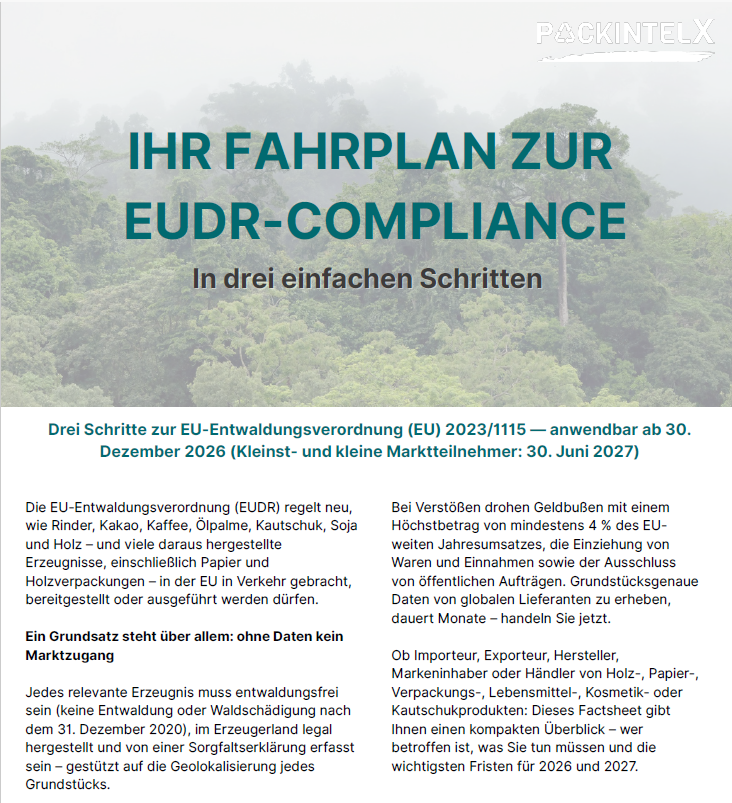
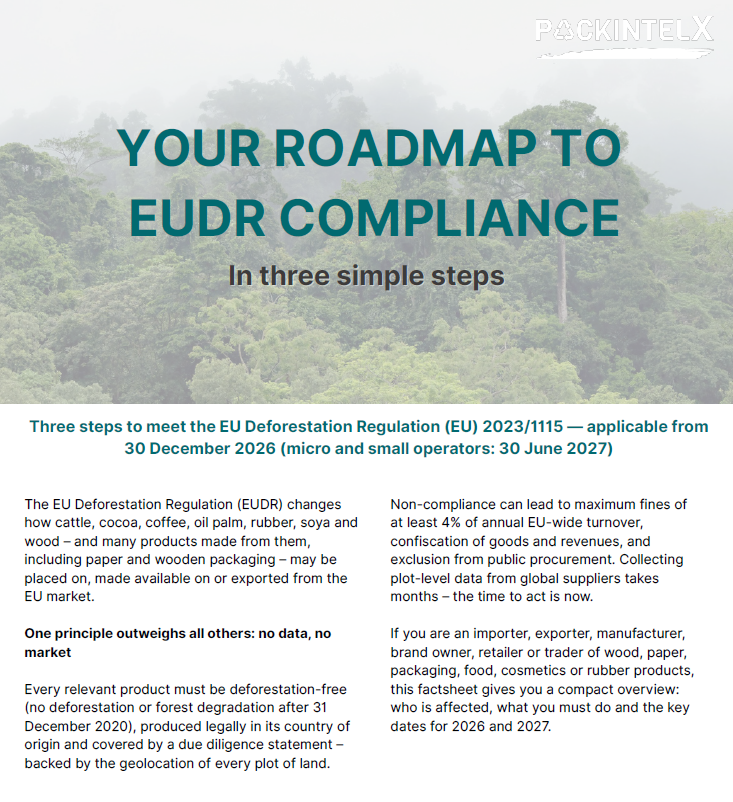
Your roadmap to EUDR compliance in three steps: who is affected, what operators, downstream operators and traders must do, and the key dates for 2026 and 2027.
Choose the factsheet you need:
- EUDR factsheet: roles, obligations, key dates and product scope after Delegated Regulation (EU) 2026/2102
- PPWR guidelines, technical factsheet and FAQs (second edition)
- Transport packaging case study
- EPR obligations across EU Member States
After submitting the form, you’ll receive your free factsheet by email as a PDF attachment.
Frequently Asked Questions
What is the EU Deforestation Regulation (EUDR)?
The EUDR (Regulation (EU) 2023/1115) bans products linked to deforestation or forest degradation from the EU market. Companies placing products made from cattle, cocoa, coffee, oil palm, rubber, soya or wood on the EU market, or exporting them, must prove through due diligence that the products are deforestation-free and legally produced.
When does the EUDR apply?
The EUDR applies from 30 December 2026 for large and medium-sized companies and for micro and small operators in the timber sector. All other micro and small operators must comply from 30 June 2027. The European Commission has confirmed there will be no further postponement.
Which products are covered by the EUDR?
The seven commodities and the derived products listed in Annex I, such as beef, chocolate, coffee, palm oil, natural rubber, tyres, soya meal, timber, furniture, pulp and paper. Since 18 September 2026, cattle hides, skins and leather, retreaded tyres and soybeans for sowing are no longer in scope. Soluble instant coffee and certain palm oil derivatives are added from 30 December 2027.
Does the EUDR apply to packaging?
Packaging used only to support, protect or carry another product is exempt. Paper and board packaging placed on the market as a product in its own right, for example by packaging manufacturers or distributors, can fall under the wood chain. Check the HS codes of your packaging products to confirm your scope.
What is the difference between an operator, a downstream operator and a trader?
An operator places a relevant product on the EU market for the first time or exports it, and must submit a due diligence statement. Downstream operators and traders buy products already on the EU market. Since the December 2025 amendment they no longer submit their own statement, but must collect and keep the reference numbers of their suppliers’ statements.
What is an EUDR due diligence statement (DDS)?
A DDS is a declaration filed in the EUDR Information System (TRACES) confirming that due diligence was carried out and that no or only negligible risk was found. Each statement receives a reference number that must accompany the product, for example in customs declarations.
What data do I need for EUDR due diligence?
You need the product description and HS code, quantity, country of production, geolocation of all plots of land (polygons for plots over 4 hectares), the date or period of production, supplier and customer details, and evidence that production was deforestation-free after 31 December 2020 and legal in the country of production.
What are the penalties for non-compliance with the EUDR?
Member States set the penalties. They must include fines of at least 4% of the company’s annual EU turnover for serious breaches, confiscation of products and revenues, temporary exclusion from public procurement and a temporary ban on placing products on the market.
Are there simplifications for small companies?
Yes. Micro and small primary operators in low-risk countries can submit a simplified one-off declaration, and operators sourcing only from low-risk countries do not need a full risk assessment unless they become aware of substantiated concerns. They must still collect the required information and keep records.
How does PackIntelX help with EUDR compliance?
PackIntelX assesses your EUDR scope and role, organises supplier and geolocation data collection, documents your risk assessment and prepares your due diligence statements for TRACES. Our platform keeps EUDR data, evidence and reference numbers in one place, alongside your PPWR and EPR compliance.