Short answer: A recyclability analysis checks, component by component, whether a pack can be collected, sorted and recycled under a given methodology. Three methodologies matter most for European and UK packaging today: the UK Recyclability Assessment Methodology (RAM), which sets red, amber or green EPR fees now; the German minimum standard, which German dual systems use to price recyclability; and the PPWR design-for-recycling grades A to C, which decide from 2030 whether packaging may be sold in the EU at all. The same pack can score differently under each, so one analysis should cover all three. Our packaging recyclability assessment page lists the methodologies by country.
Status (last checked 22 November 2026). UK: RAM 2027 applies to household packaging supplied in 2027; red fees are set to rise in 2027/28 (PackUK draft). Germany: the minimum standard is published each year by the Zentrale Stelle Verpackungsregister with the Federal Environment Agency. EU: the PPWR design-for-recycling criteria are due in delegated acts; the recyclability requirement applies from 1 January 2030.
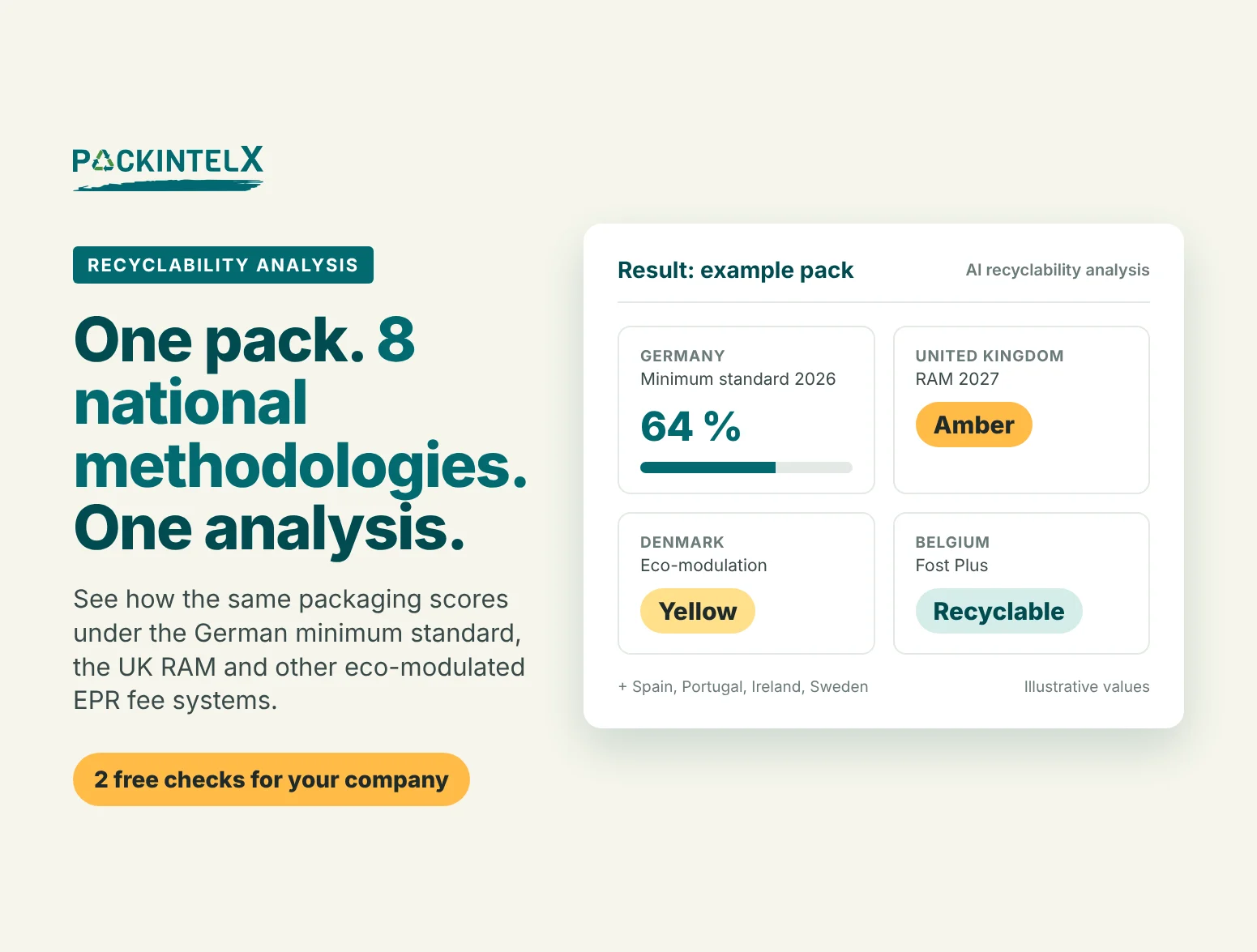
Free for your company: 2 recyclability checks. Test two packaging items against the national methodologies we cover in 8 countries: Germany, Denmark, Belgium, Spain, Portugal, the UK, Ireland and Sweden. Request your 2 free checks
Key takeaways
- Recyclability is no longer only an environmental claim: it sets EPR fees in the UK, Germany and six other countries today, and market access in the EU from 2030.
- Each methodology uses its own reference infrastructure and thresholds, so ratings differ.
- Small components such as labels, sleeves, inks, adhesives and closures often decide the result.
- One structured data set per packaging component serves all methodologies, plus the PPWR declaration of conformity.
Three methodologies at a glance
| UK RAM | German minimum standard | PPWR (EU) | |
|---|---|---|---|
| What it decides | EPR disposal fee level (red, amber, green) | Recyclability score that dual systems use to set incentives in their fees | Whether packaging may be placed on the EU market; EPR fee modulation by grade |
| Scope | Household packaging of large producers | Packaging subject to system participation in Germany | All packaging placed on the EU market |
| Result | Red / amber / green | Score of recyclability with a threshold for “recyclable” | Grade A (≥95%), B (≥80%), C (≥70%); below C not recyclable |
| Applies | Now; RAM 2027 for packaging supplied in 2027 | Now; new edition each year | From 1 January 2030; recyclable at scale from 2035 |
| Reference | UK collection, sorting and reprocessing | German sorting and recycling infrastructure | Design-for-recycling criteria in delegated acts |
Details per methodology: UK RAM and German minimum standard. How the UK fees work in practice: UK EPR 2027 and your RAM rating.
Recyclability analysis by country: 8 national methodologies
Eight countries already link packaging fees to recyclability through bonuses, surcharges or tariff categories, years before PPWR Article 6 applies. Each uses its own methodology, so a recyclability analysis for several markets has to report a result per country.
| Country | Methodology | Result | Effect on fees |
|---|---|---|---|
| Germany | Minimum standard, published yearly by ZSVR with the UBA | % recyclability by weight | Fee incentives by dual systems under § 26 VerpackDG |
| Denmark | Danish EPA eco-modulation guidance | Green, yellow or red per material | Red malus up to 35% |
| Belgium | Fost Plus tariffs and Design4Recycling | Recyclable, non-recyclable or obstructive | Much higher rates for hard-to-recycle packaging |
| Spain | Ecoembes model under RD 1055/2022 | Bonus per attribute or 10% penalty | Applied to the Ecoembes contribution |
| Portugal | Portaria 150/2024/1 | Eligible or not eligible for a reduction | Up to 10% lower base contribution since 2026 |
| United Kingdom | RAM, administered by PackUK | Red, amber or green | Modulated disposal fees |
| Ireland | Repak eco-modulated fees | Recycled or non-recycled category | Non-recycled plastics and composites pay the highest rates |
| Sweden | NPA criteria for differentiated fees | Designed for recycling or difficult to recycle | Lower fee for recyclable packaging |
What a recyclability analysis covers
- Composition by component: body, closure, label or sleeve, inks, adhesives, barrier layers and coatings, with weights.
- Collection: whether the format and size are collected for recycling in the market.
- Sorting: whether sorting machines can detect and separate the pack, for example with near-infrared detection.
- Recycling compatibility: whether the components separate in washing and whether they contaminate the recyclate.
- Evidence: specifications, supplier declarations and, where needed, test results.
- Result and fixes: the rating per methodology and the changes that would improve it.
Why the same pack scores differently
| Reason | Example |
|---|---|
| Different infrastructure | A format that UK facilities sort well may not be sorted in another market, and the other way round |
| Different thresholds | A pack can be “recyclable” under one method and fall short of grade B under the PPWR |
| Different rules for components | A label or sleeve accepted in one methodology can downgrade the pack in another |
| Different editions | The UK RAM and the German minimum standard are updated; a rating from last year may not hold |
Curious where your own pack lands? Test 2 packaging items free of charge under any of the 8 national methodologies we cover.
Design details that most often cost a grade
- Dark or black plastic that sorting machines cannot detect
- Full-body sleeves or labels that are not compatible with the main material
- Multi-material laminates that cannot be separated
- Metallised layers or barrier coatings above what the recycling process tolerates
- Adhesives and inks that do not wash off or that discolour the recyclate
- Components made of a material that contaminates the main stream, such as PVC elements on PET
A six-step process
- List your packaging by SKU, market and volume, and pick the high-volume items first.
- Collect component data from suppliers: materials, weights, colours, labels, inks, adhesives.
- Assess each pack against the methodologies of your markets, such as the UK RAM and the German minimum standard, and against the PPWR grades as far as the criteria are known.
- Rank the gaps by fee impact today and market-access risk from 2030.
- Redesign the components that drive the rating, and re-assess.
- Document the result for EPR reporting, customer requests and the PPWR technical documentation.
The material data you collect here also feeds your EU declaration of conformity under the PPWR.
PackIntelX is a RecyClass auditor and assesses packaging against the UK RAM, the German minimum standard, six further national methodologies and the PPWR. Request your 2 free recyclability checks or book a consultation.
Frequently asked questions
What is a recyclability analysis?
A component-by-component check of whether packaging can be collected, sorted and recycled under a given methodology, such as the UK RAM, the German minimum standard or the PPWR design-for-recycling grades.
Can one recyclability analysis cover several countries?
Yes. The PackIntelX AI-powered recyclability analysis assesses one packaging item against several national methodologies in one run and reports the result per country.
Is there a free recyclability analysis?
PackIntelX offers 2 free recyclability checks per company under the national methodologies it covers in 8 countries. Request them here.
When does the PPWR require packaging to be recyclable?
From 1 January 2030 packaging placed on the EU market must reach at least grade C (70%) under the design-for-recycling criteria. From 2035 it must also be recyclable at scale.
Why does my packaging get different results in different countries?
Each methodology is based on its own collection, sorting and recycling infrastructure and uses its own thresholds and component rules.
How does recyclability affect EPR fees?
In the UK, red-rated household packaging pays more and green-rated less. In Germany, dual systems must give incentives in their fees for recyclable packaging based on the minimum standard. Denmark, Belgium, Spain, Portugal, Ireland and Sweden also modulate fees by recyclability. Under the PPWR, EPR fees will be modulated by recyclability grade.
What data do I need for an analysis?
Materials, weights and colours of every component, details of labels, inks, adhesives and barrier layers, and the markets where the packaging is sold.
Sources
- Regulation (EU) 2025/40 (PPWR), Article 6 and Annex II, EUR-Lex
- PackUK: Recyclability Assessment Methodology (RAM) 2027
- Zentrale Stelle Verpackungsregister: minimum standard, 2026 edition
- Portaria n.º 150/2024/1 (Portugal), Diário da República
This article is general information, not legal advice.