Short answer: UK packaging EPR fees now depend on how recyclable your packaging is. Under the Recyclability Assessment Methodology (RAM), each item is rated red, amber or green. In 2026/27 red-rated plastic costs an illustrative £545 per tonne against £415 for green. PackUK’s draft policy would make red packaging pay twice the amber base fee in 2027/28 and 2.4 times in 2028/29, while the government plans larger discounts for green packaging from March 2027 and an exemption for glass drinks containers supplied directly to pubs and restaurants from April 2027. Your RAM rating is now a line on your P&L. Our UK RAM page explains the methodology.
Status (last checked 22 November 2026). Year 2 illustrative fees published by PackUK. Government statement on packaging EPR of 12 November 2026. PackUK draft updated modulation policy (November 2026), open for feedback. RAM 2027 published 1 July 2026. The 2027/28 multipliers and discounts are proposals, not final fees.
Key takeaways
- Large producers pay household packaging disposal fees modulated by RAM rating: amber is the base, red pays more, green pays less.
- The red surcharge is set to rise sharply: from 1.2 times amber in Year 2 to a proposed 2.0 times in 2027/28 and 2.4 times in 2028/29.
- From April 2027, most glass drinks containers supplied directly to licensed hospitality venues are no longer household packaging, so no disposal fees.
- RAM 2027 applies to household packaging supplied in 2027. RAM 1.1 still applies to 2026 data.
- Moving an item from red to green is usually a design change, not a material switch.
How RAM ratings set the fee
| Material (Year 2, 2026/27) | Green (£/t) | Amber (£/t) | Red (£/t) | Red–green gap |
|---|---|---|---|---|
| Plastic | 415 | 455 | 545 | £130 |
PackUK uses the RAM to rate each item of household packaging. Amber pays the base fee for its material. Red pays a multiple of that base, and the extra revenue funds the discount for green. In Year 2 the red fee is a fixed 20% above amber. About 45% of plastic packaging reported against the RAM was rated red.
What changes in 2027
| Change | Status | Effect |
|---|---|---|
| Red multiplier 2.0 × amber (2027/28), 2.4 × amber (2028/29) | PackUK draft policy, feedback stage | Red-rated packaging costs much more from fees based on 2026 data |
| Faster discount for green packaging from March 2027 | Government proposal, to be consulted | Green fees estimated 30–40% lower in 2027/28 and 2028/29 |
| Glass drinks containers supplied directly to licensed hospitality venues | New legislation from April 2027 | Most are no longer household packaging: no disposal fees (about 5p per beer bottle, up to 10p per wine bottle) |
| Updated cost model | PackUK, for 2027/28 | Lower estimated glass fees from March 2027 |
| RAM 2027 | Applies to packaging supplied 1 January to 31 December 2027 | Refined material rules and definitions; reassess items |
| Call for evidence on fee modulation | PackUK, early 2027 | Future fees may also reflect recycled content and excess packaging |
What it means in numbers
Take 100 tonnes of plastic household packaging. At Year 2 illustrative fees, all-red costs about £54,500 and all-green about £41,500: a gap of £13,000. If the red multiplier rises to 2.0 times amber and the amber base stayed at £455, red plastic would cost about £910 per tonne. That is an illustration, not a forecast: the 2027/28 base fees are not published yet.
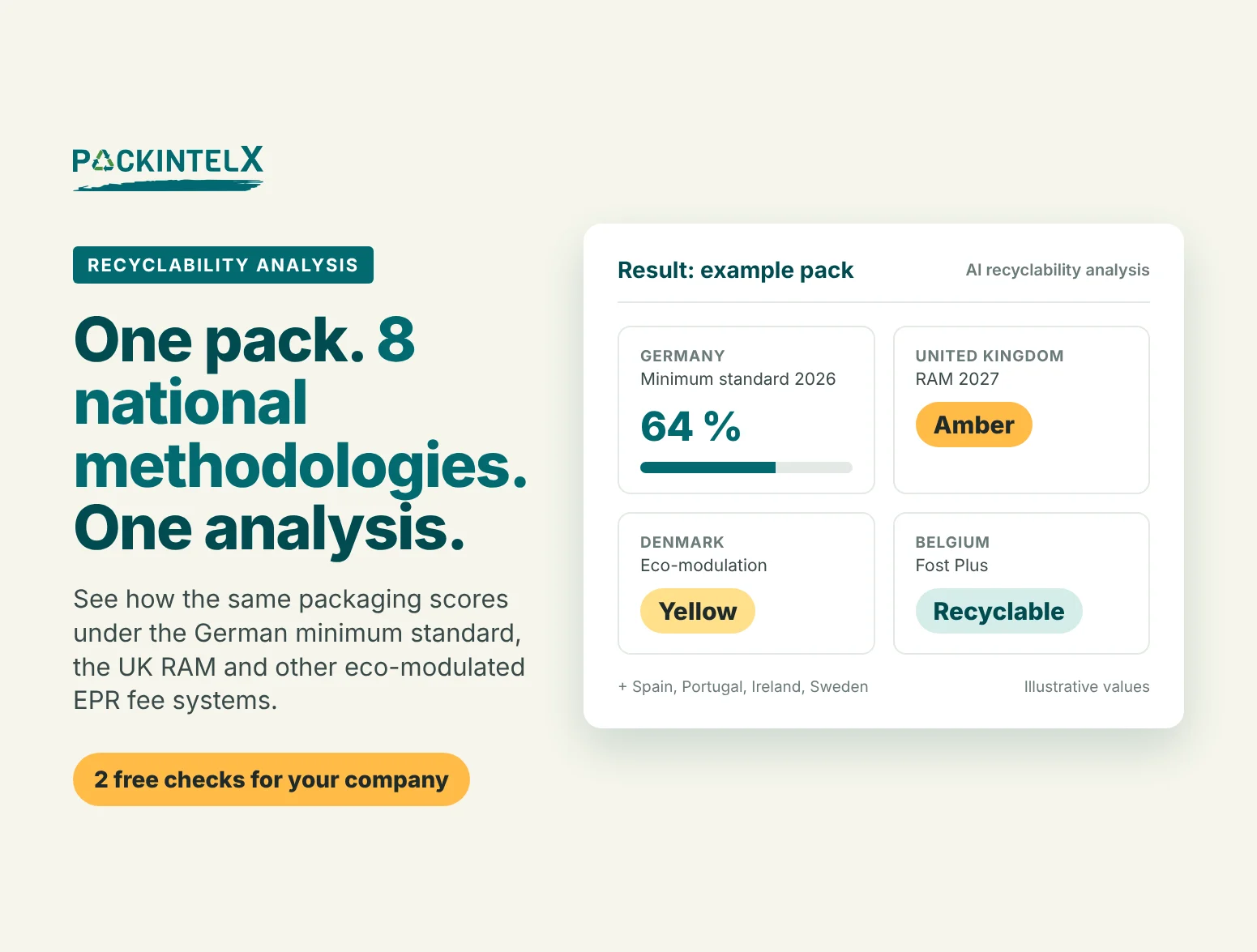
Red, amber or green? Find out before the 2027 fees. Test two packaging items free of charge under the UK RAM or any of the other national methodologies we cover in 8 countries. Request your 2 free recyclability checks
Who pays
- Large producers (turnover above £2 million and more than 50 tonnes of packaging handled) report data, assess household packaging with the RAM and pay disposal fees.
- Small producers (turnover £1–2 million and 25–50 tonnes) record and report data but do not pay disposal fees.
- Brand owners, importers, packers and fillers, distributors and online marketplaces can each be the obligated producer, depending on the packaging and the supply chain.
From red to green: where to start
- Rank your SKUs by red tonnage. A few high-volume items usually drive most of the fee gap.
- Check the reason for each red rating. Common causes are material combinations that cannot be separated, labels or sleeves that disturb sorting, dark colours that sorting machines cannot detect, and components that are hard to recycle.
- Fix the component, not the pack. A different label, closure or ink often moves an item from red to amber or green.
- Reassess against RAM 2027 for packaging you will supply in 2027; some material rules changed.
- Keep the evidence. Your RAM assessment has to stand up if PackUK or the regulator asks.
Beyond the UK: eight countries price recyclability
The UK is not alone. Germany, Denmark, Belgium, Spain, Portugal, Ireland and Sweden also link packaging fees to recyclability, each with its own methodology: Germany scores a percentage, Denmark uses green, yellow and red, Belgium sorts into recyclable, non-recyclable or obstructive. A pack that is green under the RAM can still lose a bonus elsewhere. From 2030 the PPWR adds EU-wide grades A to C on top. How the methodologies compare: recyclability analysis under PPWR, UK RAM and the German minimum standard and our packaging recyclability assessment by country.
Want a RAM assessment of your range and a red-to-green plan before the 2027 fees? PackIntelX is a RecyClass auditor. Start with 2 free recyclability checks or book a consultation.
Frequently asked questions
How much more does red-rated packaging cost under UK EPR?
In 2026/27 red-rated packaging pays 20% more than the amber base fee; for plastic that is an illustrative £545 per tonne against £455 amber and £415 green. PackUK proposes 2.0 times amber in 2027/28 and 2.4 times in 2028/29.
Can I check my packaging’s RAM rating for free?
PackIntelX offers 2 free recyclability checks per company, under the UK RAM or any of the other national methodologies it covers in 8 countries. Request them here.
Which glass is exempt from UK EPR fees from April 2027?
Most glass drinks containers supplied directly by producers to licensed hospitality venues such as pubs and restaurants will no longer count as household packaging, so they are not subject to disposal fees.
Which RAM version applies in 2027?
RAM 2027 applies to household packaging supplied between 1 January and 31 December 2027. RAM 1.1 continues to apply to 2026 data.
Are the 2027/28 fees final?
No. The higher red multipliers are a PackUK draft and the faster green discount is a government proposal subject to consultation. Final 2027/28 fees will be published by PackUK.
Do other countries modulate EPR fees by recyclability?
Yes. Germany, Denmark, Belgium, Spain, Portugal, Ireland and Sweden also link packaging fees to recyclability, each with its own methodology. Under the PPWR, EPR fees across the EU will be modulated by recyclability grade.
Do small producers pay disposal fees?
No. Small producers record and report packaging data but do not pay household packaging disposal fees.
Sources
- PackUK: Year 2 illustrative waste disposal fees (GOV.UK)
- Defra: Government steps in to reduce packaging costs for British businesses and pubs (11 Nov 2026)
- House of Commons written statement HCWS466 (12 Nov 2026)
- PackUK: Recyclability Assessment Methodology (RAM) 2027
- Clarity: PackUK propose increases to modulation multipliers (18 Nov 2026)
This article is general information, not legal advice.