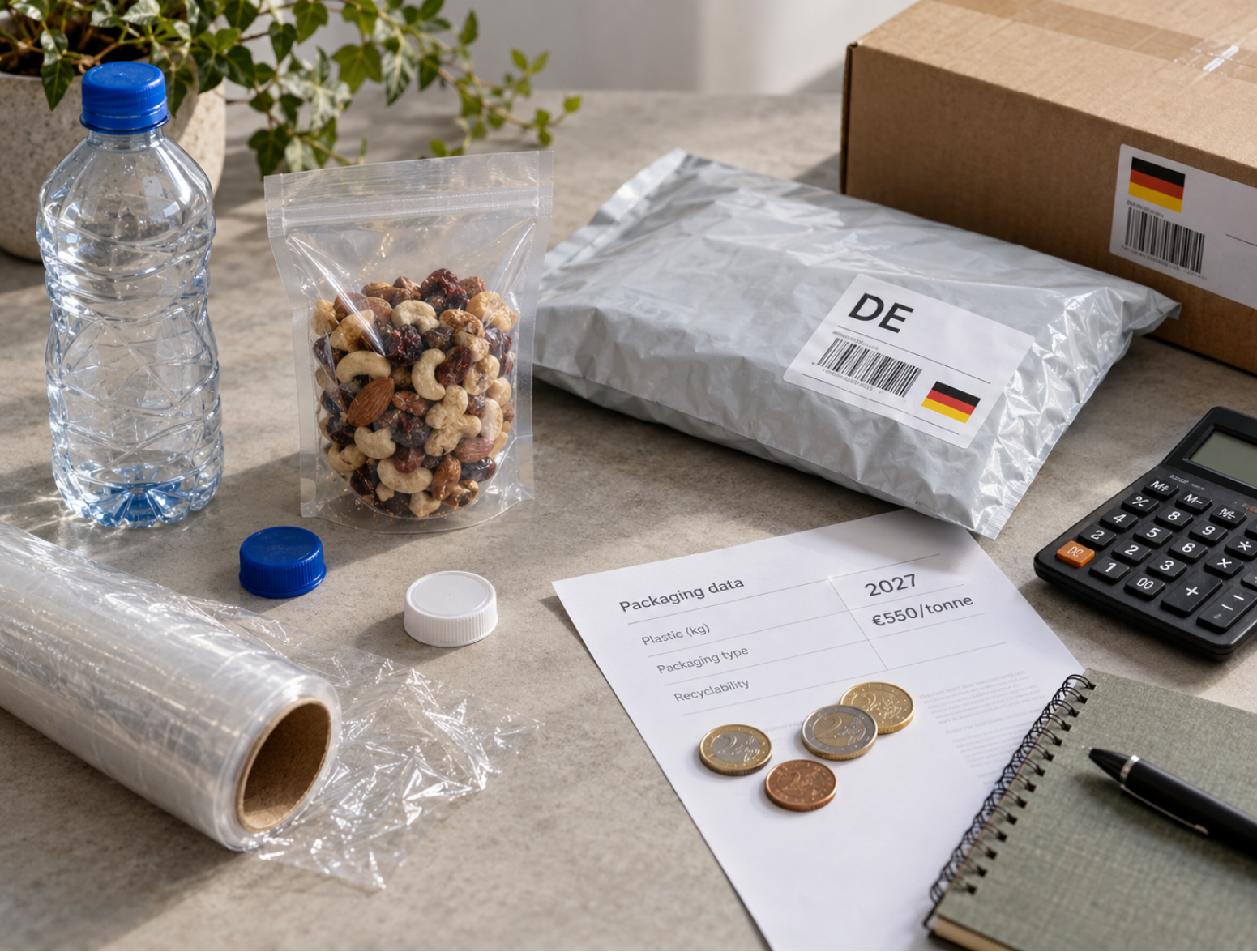
Quick answer: The Plastiksteuer is a planned German tax on plastic packaging: €550 for every tonne of plastic in packaging, proposed to start on 1 July 2027. The CDU/CSU and SPD parliamentary groups are advancing the draft Kunststoffverpackungssteuergesetz. The tax would arise when taxable packaging is
manufactured, brought into Germany from other EU countries, or imported. It is not yet law.On 5 October 2026, German media reported that the governing coalition wants a new tax on plastic packaging. The draft expects €805 million in 2027 and close to €1.5 billion a year from 2028, and business associations are already asking the Chancellery to stop what they call a rushed procedure. If your company makes, imports or sells packaged goods in Germany, this guide explains what is proposed, who is affected, what it could cost, and what to do before the Bundestag decides.
Key takeaways
- Rate and date: €550 per tonne of plastic in packaging, planned from 1 July 2027.
- Scope: plastic packaging, films and composite packaging with more than 5% plastic, including closures, lids and capsules.
- Who pays: businesses, intra-EU shipment into Germany or import from outside the EU. The draft expects them to pass the cost on to end customers.
- Relief: for packaging made from recycled plastic, the tax can be waived on application.
- Money: €805 million expected in 2027, then roughly €1.4 to 1.5 billion a year, similar in size to what Germany pays into the EU plastics levy.
- Still open: associations and the customs union want the fast-track process stopped, so the final text may differ.
What is the Plastiksteuer?
The Plastiksteuer, also called the plastic packaging tax, is a proposed German consumption tax (Verbrauchsteuer) on the plastic used in packaging.
The tax should “generate additional revenue for the federal budget” and, at the same time, “contribute to reducing the consumption of plastic packaging”.
Plastiksteuer at a glance
| Question | Answer (draft, as of 6 October 2026) |
|---|---|
| Tax rate | €550 per tonne (1,000 kg) of plastic in packaging, equal to €0.55 per kg |
| Planned start | 1 July 2027; first full year 2028 |
| When the tax arises | When taxable packaging is manufactured, brought into Germany (Verbringen) or imported |
| What is taxed | Plastic packaging, films and composite packaging with more than 5% plastic content, including films, transport and packaging materials, closures, lids and plastic capsules |
| Who pays | Businesses. The draft is designed so that they pass the cost on to end customers; private individuals are not taxed |
| Relief | For packaging made from recycled plastic, the tax can be waived on application |
| Expected revenue | €805 million in 2027; just under €1.5 billion a year from 2028 (some reports: just over €1.4 billion) |
| Federal costs | €284 million in expenditure through 2029, according to the Finance Ministry |
| Background figure | About 3 million tonnes of plastic packaging waste arose in Germany in 2023, according to the draft |
| Legal status | Draft. Associations report it is to be added as an amendment to the 2027 Budget Accompanying Act (Haushaltsbegleitgesetz 2027); Bundestag approval is pending |
Who has to pay the Plastiksteuer?
The taxpayer is the business that makes the packaging in Germany, brings it in from another EU country, or imports it. Private individuals are not taxed. The burden is unlikely to stay with those businesses, though. The draft says the tax is “designed so that the taxpayers pass the burden on to the end customer”. Retailers and online sellers should also expect higher supplier prices for films, shipping bags and filling material.
Many companies sit in more than one role. A brand owner that imports filled products, a retailer with own-brand goods, and an e-commerce seller shipping from abroad can each be the party that brings taxable packaging into Germany. Working out your role is the first compliance question, and it is the same question that PPWR and EPR ask.
What could the tax cost? A simple calculation
At €550 per tonne, the arithmetic is easy. The figures below are our own illustration based on the draft rate, not official estimates, and they ignore any relief for recycled plastic.
| Plastic packaging volume | Tax at €550/tonne | Per kilogram |
|---|---|---|
| 25 g plastic pouch (one unit) | about €0.014 | €0.55 |
| 1 tonne per year | €550 | €0.55 |
| 100 tonnes per year | €55,000 | €0.55 |
| 1,000 tonnes per year | €550,000 | €0.55 |
Per unit the amount is tiny, which fits the reported estimate of about €0.02 on a 1.5-litre PET bottle. For high-volume packers, importers and private-label retailers, though, the annual figure becomes a real budget line.
What counts as taxable plastic packaging?
The draft taxes plastic packaging and films, and composite packaging if its plastic content is more than 5%. This includes films, transport and packaging materials, closures, lids and plastic capsules. The rate applies to the weight of plastic in the packaging, not to the whole product.
For packaging made from recycled plastic, the tax can be waived on application. That sounds like a clear incentive for recyclate, but the food industry association BVE says the relief has limited use for food manufacturers. To claim relief, a company needs reliable proof of recycled content for each packaging component, and that evidence has to come from suppliers.
Why is Germany introducing a plastic tax now?
Three drivers sit behind the draft.
Revenue. The draft expects €805 million in 2027 and close to €1.5 billion a year from 2028. The Finance Ministry expects federal spending of €284 million through 2029 to set the tax up, mainly at the IT service centre (ITZ) and customs.
Behaviour. About 3 million tonnes of plastic packaging waste arose in Germany in 2023, according to the draft. The tax is meant to nudge companies towards less plastic, reuse and recyclate.
The EU bill. Since 2021, EU member states pay €0.80 per kilogram of non-recycled plastic packaging waste into the EU budget, the so-called EU plastics levy (European Commission). For Germany this comes to about €1.4 billion a year, reports say. According to Deutsche Umwelthilfe, Germany has so far paid it from the federal budget instead of charging the companies responsible for the non-recycled plastic waste. That is now set to change. The expected yield of the Plastiksteuer is of a similar size. Some other countries, such as Spain, already pass a national plastic packaging tax on to producers.
Why are industry groups pushing back?
Business criticism focuses on the process as much as on the tax itself.
- A fast-track procedure. In a letter to Chancellery Minister Nina Warken (CDU), associations including the food industry, the retail association HDE and the plastic packaging industry warned against introducing the tax “im Schnellverfahren”, without involvement of the ministries and without a cabinet decision. They say the Finance Ministry plans to send a drafting proposal to the Bundestag budget committee shortly, so that the tax enters the ongoing procedure for the 2027 Budget Accompanying Act as an amendment. They want economic, administrative and ecological effects assessed first, with the National Regulatory Control Council (Nationaler Normenkontrollrat).
- Eight associations. The alliance behind the criticism includes HDE (retail), BVE (food industry), BDE (waste and recycling), BDZ (customs union), IK (plastic packaging), Markenverband, Plastics Europe Deutschland and VDMA (plastics and rubber machinery).
- Retail calls it a broken promise. The Handelsverband describes the tax as a breach of the coalition agreement.
- Plastics Europe calls it an experiment. Managing director Christine Bunte called it “not a mature law, but a national tax experiment”, citing open questions on tax liability, import controls, administrative burden and real environmental impact.
- Cost figures differ widely. The Finance Ministry expects €284 million in federal expenditure through 2029, and media reports cite bureaucracy costs of about €150 million. The industry alliance estimates compliance costs for business of more than €600 million a year and warns of a large increase in customs staff. Treat all cost figures as provisional.
- Environmental groups welcome it, with conditions. Deutsche Umwelthilfe supports the initiative but says the tax must stay limited to single-use packaging and must not hit reusables. To stop a shift to other materials, it wants the tax extended to paper, cardboard and metals such as aluminium and tinplate. The industry alliance also warns of ecological side effects such as heavier packaging and lower recycling rates.
Plastiksteuer, PPWR and EPR: three regimes, one data problem
For most packaging companies, the Plastiksteuer is not a stand-alone issue. It lands on top of EU and national rules that are already moving. The table shows how they differ.
| Rule | Timing | What it asks of companies |
|---|---|---|
| PPWR, Regulation (EU) 2025/40 | Applies from 12 August 2026 | Applies directly in all EU member states. Producers need a Declaration of Conformity to place packaging on the EU market. Recycled-content targets for plastic packaging follow from 2030, with recyclability and labelling rules phasing in. |
| EPR (Germany: VerpackDG, LUCID) | In force and tightening | Registration, reporting and licence fees. Foreign producers without a German establishment need an authorised representative. Fees are increasingly modulated by recyclability and recycled content. |
| Plastiksteuer | Proposed 1 July 2027 | €550 per tonne of plastic in packaging; waiver on application for recycled plastic packaging. |
Read side by side, the three have one thing in common: each needs reliable packaging data. To answer the tax question, a PPWR conformity question or an EPR fee question, you need to know for every packaging item its material, weight, plastic share, recycled content, supplier and target market.
That is why design choices now move several cost lines at once. More recycled content can lower the Plastiksteuer (through the waiver), improve EPR fee modulation and prepare you for the PPWR 2030 targets. Companies with clean SKU-level data can answer all three from one source. Companies without it will build the same spreadsheet three times, under deadline.
What should companies do now?
The law is not final, but preparation does not have to wait. A practical sequence:
- Inventory your plastic packaging. List every packaging item by SKU with material, weight, plastic share, and whether it is composite packaging with more than 5% plastic.
- Define your role. Decide whether you manufacture packaging in Germany, bring it in from other EU countries, or import it, and whether you act as brand owner, retailer or online seller.
- Map suppliers and imports. Request weight, material and recycled-content declarations from suppliers, including those outside Germany.
- Model your exposure. Multiply plastic weight by €0.55 per kg, then test scenarios with less plastic or more recyclate.
- Review contracts and pricing. Check whether supplier price changes can be passed through and how you will handle customer pricing.
- Align with PPWR and EPR. Check your Declaration of Conformity position, LUCID registration and, where needed, an authorised representative.
- Watch the legislative process. The Bundestag may amend scope, relief rules or timing, so keep your assumptions flexible.
Frequently asked questions about the Plastiksteuer
What is the Plastiksteuer?
The Plastiksteuer (plastic packaging tax) is a planned German tax on plastic packaging, films and composite packaging with more than 5% plastic content. The proposed rate is €550 per tonne of plastic. The draft says it should create incentives to use less plastic packaging and bring additional revenue to the federal budget.
How much is the plastic tax in Germany?
The draft sets €550 per tonne (1,000 kg) of plastic in packaging, which equals €0.55 per kilogram. A company that places 100 tonnes of taxable plastic packaging on the market in a year would owe about €55,000 before any relief for recycled plastic.
When does the Plastiksteuer start?
The draft provides for a start on 1 July 2027. The first full tax year would be 2028. The date is not final until the Bundestag passes the law.
Who has to pay the Plastiksteuer?
Businesses pay it. According to the draft, the tax arises when taxable packaging is manufactured, brought into Germany from other EU countries, or imported. Private individuals are not taxed, but the draft is designed so that businesses pass the cost on to end customers.
Is recycled plastic exempt from the Plastiksteuer?
Not automatically. For packaging made from recycled plastic, the tax can be waived on application. Industry groups say this relief is of limited use for some sectors, such as food manufacturers.
Does the Plastiksteuer apply to paper, cardboard or metal packaging?
No, the draft covers plastic only. Deutsche Umwelthilfe wants the tax extended to paper, cardboard and metals such as aluminium and tinplate, and limited to single-use packaging, so that companies do not simply switch materials.
Is the Plastiksteuer already law?
No. As of 6 October 2026 it is a draft that the CDU/CSU and SPD parliamentary groups plan to bring into the Bundestag. Business associations and the customs union have asked the Chancellery to stop the fast-track procedure, so details may still change.
How is the Plastiksteuer different from PPWR and EPR?
The Plastiksteuer is a tax on the weight of plastic in packaging. The EU Packaging and Packaging Waste Regulation (PPWR, Regulation (EU) 2025/40) sets product and compliance rules, including a Declaration of Conformity, and Extended Producer Responsibility (EPR) requires producers to register, report and pay licence fees. A company can fall under all three at once.
Will consumers pay more because of the plastic tax?
Probably, in small amounts. The draft is designed so that taxpayers can pass the burden on to end customers. One estimate puts the effect at about €0.02 on a 1.5-litre PET bottle.
Get ahead of PPWR and EPR: join a free expert webinar
The Plastiksteuer is one more reason to get your packaging obligations in order. PackIntelX is running a series of live webinars on the new Packaging and Packaging Waste Regulation and Extended Producer Responsibility, led by packaging compliance practitioners. Each session runs about 45 to 60 minutes and ends with live Q&A. Upcoming sessions, all 11:00 to 12:00 CEST:
- 13 October 2026, English: EPR obligations in the EU. What new costs could producers face? Covers VerpackDG updates and authorised representatives, fines and control measures, EU developments, and eco-modulated fees tied to recyclability and recycled content.
- 20 October 2026, German: PPWR und EPR nach dem 12. August. Was Unternehmen jetzt wissen müssen.
- 27 October 2026, English: PPWR and EPR after 12 August. The Commission’s latest FAQs and interpretations, changes for transport packaging and own-brand products, producer responsibilities and Article 5, plus labelling, implementation and potential fines.
The webinars are free for companies that place packaging on the market, such as brand owners, manufacturers, importers and retailers. If packaging, filled products or imports touch your business, you are likely affected.
Register for the free webinars: packintelx.com/webinar