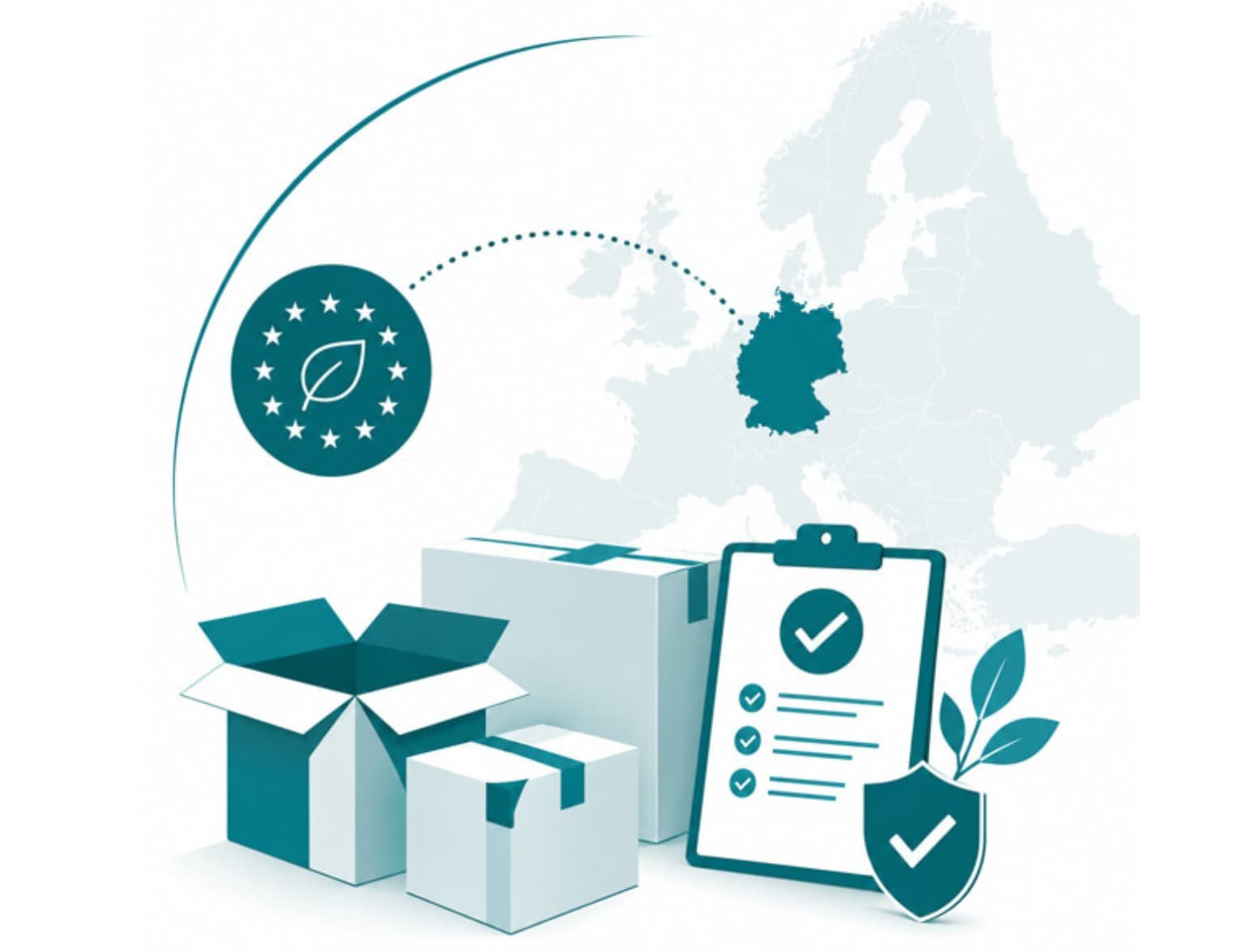
The transition to the EU Packaging and Packaging Waste Regulation is entering a critical phase. From 12 August 2026, the PPWR will apply directly across all EU Member States, regardless of whether national packaging laws have already been fully updated or aligned.
Germany is now becoming one of the first examples showing how complex this transition can become. The European Commission has formally raised objections to Germany’s planned Packaging Law Implementation Act, known as VerpackDG, under the EU TRIS notification procedure. As a result, the standstill period has been extended until 17 August 2026, meaning the law cannot enter into force before that date.
For businesses working with packaging, this situation sends a clear message. PPWR compliance cannot wait for national implementation laws to be finalized. Companies must begin preparing now for a regulatory environment that is evolving quickly and becoming more complex.
What Is Happening With VerpackDG?
Germany introduced VerpackDG to adapt its national packaging framework to the EU Packaging and Packaging Waste Regulation. The law is intended to align existing national requirements with the new EU-wide packaging rules that become applicable from August 2026.
However, under the EU TRIS notification procedure, the European Commission reviews national technical legislation to ensure compatibility with EU law and to prevent fragmentation within the Single Market.
The Commission has now issued a reasoned opinion regarding the German VerpackDG draft. This automatically extends the standstill period until 17 August 2026.
Although the detailed concerns have not yet been publicly released, reports suggest that questions may relate to definitions around plastic packaging, material recycling, and the alignment between national and EU-level requirements.
This situation highlights an important reality for companies across Europe. Even as PPWR becomes directly applicable, some national frameworks may still contain rules, definitions, or obligations that require adjustment.
Why This Matters for Businesses?
For manufacturers, brand owners, distributors, and packaging suppliers, regulatory uncertainty creates operational pressure.
Many companies are already trying to understand how PPWR compliance will affect packaging design, recyclability targets, extended producer responsibility obligations, reporting requirements, and technical documentation.
At the same time, national implementation laws like VerpackDG are still evolving.
The table below highlights the main compliance and operational challenges businesses may face as PPWR implementation continues to evolve across the EU.
| Challenge Area | What Businesses Are Facing? | Why It Matters for PPWR Compliance? |
| Regulatory Uncertainty | National packaging laws may not fully align with the PPWR framework yet | Companies must still prepare for direct PPWR compliance from August 2026 |
| Changing Packaging Definitions | Definitions related to recyclability and material classifications may continue evolving | Incorrect interpretation can increase packaging compliance risks |
| EPR Obligations | Different reporting and administrative expectations across EU countries | Businesses need structured systems to manage extended producer responsibility requirements |
| Supplier Coordination | Packaging data often comes from multiple suppliers across different regions | Missing or inconsistent information can affect EU conformity declaration processes |
| Technical Documentation | Companies must maintain accurate and updated compliance records | Strong documentation is essential for audit readiness and regulatory inspections |
| Compliance Data Management | Manual spreadsheets and disconnected systems create operational inefficiencies | Centralized compliance digitalization improves accuracy and scalability |
| Packaging Recyclability | Businesses must assess packaging against future PPWR recyclability standards | Early preparation reduces redesign costs and compliance risks later |
| Cross-Functional Coordination | Sustainability, sourcing, legal, and packaging teams must work together | PPWR compliance is now a company-wide operational responsibility |
| Market Access Risks | Delayed preparation may create challenges when placing packaging on the EU market | Non-compliant packaging may face restrictions or additional regulatory scrutiny |
| Future Regulatory Updates | Additional PPWR guidance and delegated acts are still expected | Flexible digital compliance systems help businesses adapt more efficiently |
The key point is that the PPWR itself will still apply from 12 August 2026 across the EU, regardless of delays in national laws.
Companies that delay preparation until every national detail becomes finalized may face serious compliance challenges later.
PPWR Applies Directly Across the EU
One of the most important aspects of the PPWR is that it is a regulation, not a directive.
Unlike previous packaging legislation, the Packaging and Packaging Waste Regulation applies directly in all Member States without requiring national transposition into law.
This means companies placing packaging on the EU market must prepare for direct compliance obligations related to:
- Packaging recyclability
- Material composition
- Packaging minimization
- Recycled content
- Labelling requirements
- EU conformity declaration processes
- Technical documentation
- Extended producer responsibility obligations
National laws such as VerpackDG are intended to support implementation and define local administrative structures. However, they do not delay the direct applicability of the PPWR itself.
For businesses, this increases the importance of having a structured and proactive compliance strategy.
The Growing Challenge of Legal and Operational Uncertainty
The VerpackDG delay shows that businesses are entering a transition period where some practical aspects of implementation may remain uncertain for some time.
This affects several operational areas:
1. Definitions and Scope
Questions around packaging categories, recyclable packaging definitions, and material classifications may continue evolving as guidance develops.
2. EPR Obligations
Extended producer responsibility systems remain one of the most complex parts of packaging compliance. Companies operating across multiple countries may face differences in administration and reporting expectations.
3. Documentation Requirements
PPWR introduces stronger documentation expectations, including technical files and EU conformity declaration processes. Businesses must ensure that packaging data is complete, traceable, and consistently updated.
4. Supplier Coordination
Many compliance obligations depend on supplier-provided information. This includes material composition, recyclability performance, and technical specifications.
5. Internal Coordination
PPWR compliance is no longer handled only by regulatory teams. Procurement, packaging development, sustainability, legal, and operations teams must work together more closely.
Without structured systems, these challenges can quickly become operational bottlenecks.
Why Early Preparation Is Critical?
The VerpackDG situation reinforces a broader lesson across the packaging industry. Waiting for complete regulatory certainty is no longer a practical strategy.
Businesses that begin preparation early will be in a stronger position to manage future changes efficiently.
Early preparation allows companies to:
- Identify packaging compliance gaps
- Review the recyclability performance
- Strengthen compliance documentation
- Improve supplier coordination
- Centralize packaging data
- Reduce future operational disruption
- Build scalable compliance processes
Most importantly, early preparation helps companies move from reactive compliance management to proactive packaging governance.
The Role of Compliance Digitalization
As PPWR requirements expand, manual processes become increasingly difficult to manage.
Many companies still rely on spreadsheets, disconnected supplier records, and fragmented documentation systems. This creates risks related to data consistency, reporting accuracy, and audit readiness.
Compliance digitalization is becoming essential for managing PPWR obligations effectively.
Digital systems can help companies:
- Centralize packaging information
- Track supplier documentation
- Manage EU conformity declaration workflows
- Monitor recyclability data
- Organize compliance records
- Support reporting obligations
- Improve traceability across packaging portfolios
As regulatory complexity increases, structured digital systems will become one of the most important tools for maintaining packaging compliance efficiently.
Packaging Compliance Is Becoming Strategic
The PPWR is changing how businesses think about packaging.
Packaging decisions are no longer based only on cost, functionality, or branding. They now directly affect:
- Regulatory exposure
- Market access
- Sustainability performance
- EPR fee structures
- Reporting obligations
- Operational efficiency
The VerpackDG delay demonstrates how quickly regulatory environments can evolve.
Companies that invest early in compliance readiness, documentation systems, and packaging governance will be better prepared to adapt as additional guidance and national measures continue to develop.
How PackIntelX Supports PPWR Preparation?
PackIntelX helps businesses prepare for the operational reality of PPWR compliance through structured digital solutions.
The platform supports companies with:
- Compliance digitalization
- Packaging data management
- Supplier coordination
- EU conformity declaration workflows
- Packaging compliance tracking
- Recyclability assessments
- Documentation management
- Regulatory reporting support
As national implementation frameworks continue evolving, businesses need systems that remain flexible, scalable, and aligned with the broader PPWR framework.
PackIntelX helps companies reduce compliance complexity while improving visibility, efficiency, and regulatory readiness across the packaging value chain.
Conclusion
Germany’s VerpackDG delay highlights an important reality for the packaging industry. Regulatory transition under the PPWR will not always move in a perfectly synchronized way across Europe.
Even while national implementation laws continue evolving, the PPWR will still apply directly across all EU Member States from 12 August 2026.
For businesses, this means preparation cannot be postponed. Strong packaging compliance strategies, structured documentation systems, supplier coordination, and compliance digitalization are becoming essential for managing regulatory uncertainty effectively.
Companies that begin preparing now will be better positioned to reduce risks, improve operational efficiency, and adapt to future packaging requirements more confidently.
PackIntelX helps businesses turn PPWR preparation into a structured and scalable process through expert consultation, practical workshops, and digital compliance solutions designed for the future of packaging regulation.
Start preparing for PPWR today with PackIntelX and simplify packaging compliance through expert guidance and digital solutions.