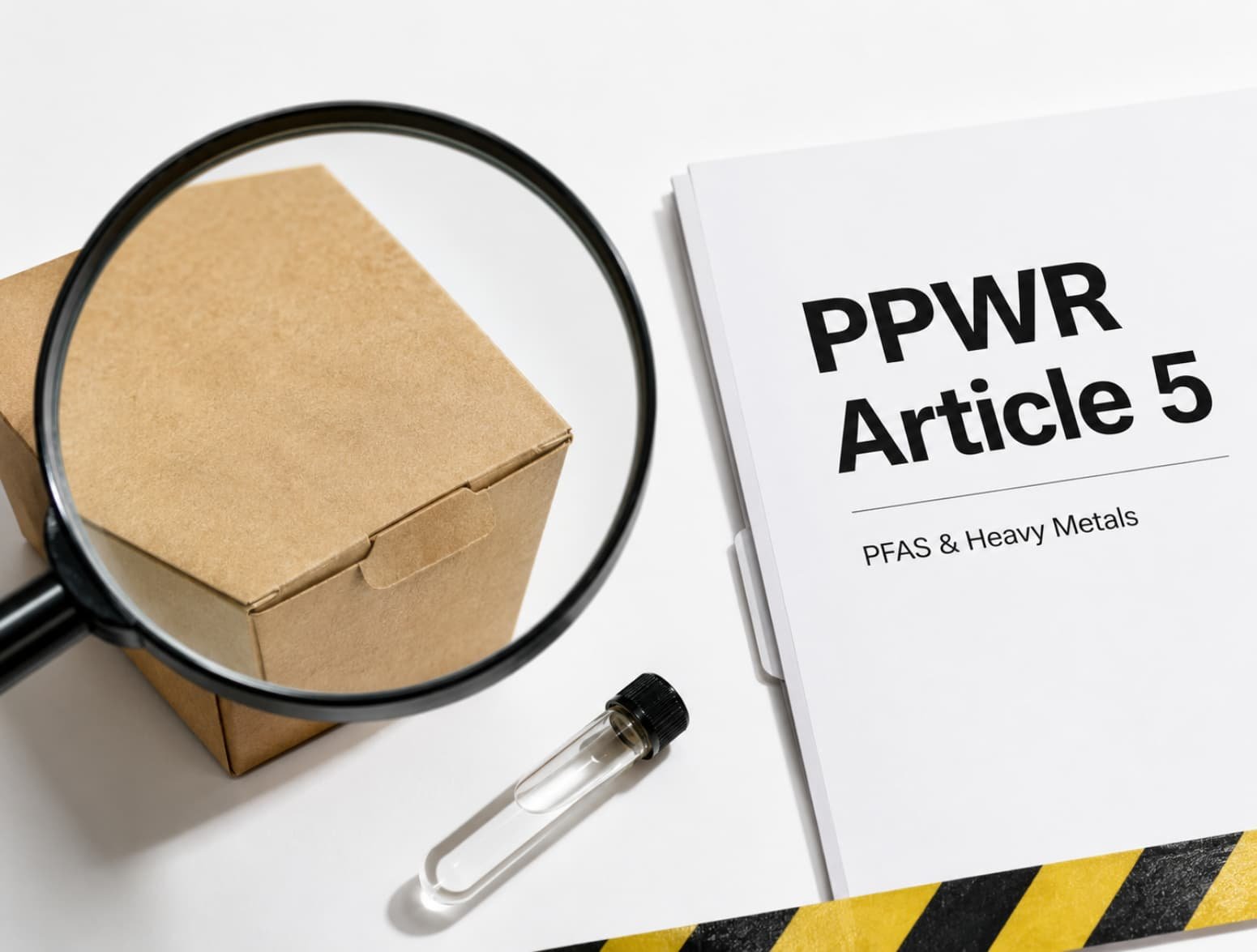
As the Packaging and Packaging Waste Regulation (PPWR) comes into effect across the European Union, businesses are facing increased scrutiny over the substances used in packaging materials. Among the most significant requirements is Article 5, which focuses on substances of concern in packaging and sets clear expectations for demonstrating compliance through reliable evidence and technical documentation.
For manufacturers, importers, and brand owners, compliance goes beyond understanding regulatory requirements. Businesses must be able to prove that their packaging does not contain restricted levels of substances such as PFAS and heavy metals, while maintaining audit-ready documentation that can be presented to market surveillance authorities when requested.
This blog explains the importance of PFAS and heavy metals testing under PPWR Article 5, the documentation businesses should maintain, and how a structured compliance approach can simplify regulatory readiness.
Understanding PPWR Article 5
Article 5 focuses on reducing the presence of substances of concern in packaging to protect human health, improve recyclability, and support the transition towards a circular economy. The regulation places greater responsibility on businesses to understand the chemical composition of their packaging materials and maintain evidence demonstrating compliance.
Rather than relying solely on supplier declarations, organisations should establish processes that verify material compliance through appropriate testing, documentation, and ongoing supplier engagement. This creates greater transparency across the supply chain while supporting long-term compliance with the PPWR.
Why PFAS and Heavy Metals Matter?
PFAS and heavy metals have become a major focus of packaging regulations because of their potential impact on both human health and the environment. As packaging materials become increasingly regulated, businesses need greater visibility into the substances present within their products.
PFAS in Packaging
Per- and polyfluoroalkyl substances (PFAS) are widely used for their resistance to water, grease, and heat. They are commonly found in certain food packaging, coatings, and industrial applications. However, many PFAS compounds are highly persistent and can remain in the environment for extended periods, leading to growing regulatory attention.
Under the PPWR, businesses should understand whether PFAS are present in their packaging materials and maintain supporting evidence demonstrating compliance with applicable requirements.
Heavy Metals in Packaging
Heavy metals such as lead, cadmium, mercury, and hexavalent chromium have long been regulated within packaging because they can affect recycling processes and pose environmental risks.
Businesses placing packaging on the EU market should verify that heavy metal concentrations remain within permitted limits while maintaining documentation that supports conformity assessments and future inspections.
Why PFAS Testing Has Become Essential?
Supplier declarations remain an important part of packaging compliance, but they may not always provide sufficient evidence on their own. As regulatory expectations continue to evolve, businesses increasingly require independent laboratory testing to validate compliance claims and strengthen technical documentation.
Testing provides measurable evidence that supports packaging compliance while helping businesses identify potential risks before products enter the market.
Reliable testing also improves confidence across the supply chain by providing scientifically verified information that can support customer requests, regulatory inspections, and internal compliance processes.
Building Audit-Ready Documentation
Laboratory testing is only one part of PPWR compliance. Businesses also need well-organised documentation that demonstrates how compliance has been assessed and maintained throughout the packaging lifecycle.
An audit-ready documentation process should include the following components.
Supplier Declarations
Supplier declarations provide important information regarding packaging materials, substances used during production, and supporting certifications. Collecting updated declarations from suppliers helps strengthen compliance records and improves supply chain transparency.
Laboratory Test Reports
Accredited laboratory testing provides scientific evidence supporting compliance with PFAS and heavy metal requirements. Test reports should be maintained alongside supplier documentation as part of the overall compliance file.
Technical Documentation
Technical documentation brings together packaging specifications, material information, supplier declarations, laboratory reports, and other supporting evidence required to demonstrate conformity under the PPWR.
Maintaining structured documentation helps businesses respond more efficiently during regulatory inspections and conformity assessments.
EU Declaration of Conformity
The EU Declaration of Conformity confirms that packaging complies with applicable PPWR requirements and should be supported by complete technical documentation. Maintaining accurate supporting evidence simplifies preparation of the declaration while strengthening regulatory confidence.
Key Components of an Audit-Ready Compliance Process
Preparing for PPWR Article 5 requires businesses to establish consistent processes across multiple departments and suppliers. The following activities help create a stronger compliance framework.
- Identify packaging materials that may require PFAS or heavy metals testing.
- Collect supplier declarations and supporting compliance certificates.
- Conduct testing through accredited laboratories where appropriate.
- Maintain structured technical documentation for every packaging type.
- Organise laboratory reports and supplier evidence in a central repository.
- Prepare documentation to support the EU Declaration of Conformity.
- Review documentation regularly to ensure information remains current.
A structured approach reduces administrative effort while improving readiness for audits and regulatory inspections.
PPWR Article 5 Compliance Checklist
| Compliance Activity | Purpose |
| Review packaging materials | Identify substances requiring assessment |
| Collect supplier declarations | Improve material transparency |
| Conduct PFAS testing | Verify compliance with applicable requirements |
| Perform heavy metals testing | Demonstrate restricted substance compliance |
| Maintain laboratory reports | Provide scientific evidence during inspections |
| Prepare technical documentation | Support conformity assessments |
| Organise compliance records | Improve audit readiness |
| Prepare the EU Declaration of Conformity | Demonstrate regulatory compliance |
Why Is Documentation Just as Important as Testing?
Testing confirms whether packaging meets the required limits for regulated substances, but compliance does not end there. Businesses must also be able to demonstrate how testing was performed, where supporting evidence is stored, and how documentation is maintained over time.
Without organised technical documentation, even valid laboratory results may become difficult to retrieve during inspections or customer audits. A structured documentation process therefore plays an equally important role in achieving PPWR compliance.
The Value of Combining Testing with Digital Compliance
As packaging regulations become more detailed, businesses need more than laboratory reports to demonstrate compliance. They require a connected compliance process that brings together testing, supplier information, technical documentation, and regulatory evidence in one structured system.
Managing these activities through spreadsheets and disconnected documents can increase the risk of missing information, inconsistent records, and delays during audits. Digital compliance solutions help centralise documentation, improve traceability, and simplify collaboration across procurement, quality, regulatory, and sustainability teams.
By combining laboratory testing with digital documentation management, businesses can build a more efficient compliance process that supports both current PPWR obligations and future regulatory requirements.
Benefits of an Integrated Compliance Approach
Organisations that integrate testing with documentation management are better positioned to respond to evolving regulatory expectations.
Some of the key benefits include:
Improved Audit Readiness
Maintaining laboratory reports, supplier declarations, technical documentation, and conformity records in one place enables businesses to respond more efficiently to inspections and customer requests.
Better Supply Chain Transparency
Collecting information directly from suppliers improves visibility into packaging materials while strengthening the quality of compliance evidence.
Reduced Administrative Effort
Digital workflows minimise repetitive manual tasks, making it easier to update documentation, manage packaging records, and monitor compliance across multiple products.
Stronger Regulatory Confidence
Combining accredited laboratory testing with structured documentation helps businesses demonstrate a robust compliance process that aligns with PPWR Article 5 requirements.
Common Documentation Gaps Businesses Should Avoid
Many organisations begin their compliance journey by focusing solely on testing. However, Article 5 compliance depends on maintaining complete and traceable documentation throughout the packaging lifecycle.
Common gaps include:
- Missing supplier declarations.
- Outdated laboratory reports.
- Incomplete technical documentation.
- Limited traceability of packaging materials.
- Disconnected packaging data stored across multiple systems.
- Missing supporting evidence for the EU Declaration of Conformity.
- Inconsistent document version control.
Addressing these gaps early helps businesses reduce compliance risks and improve long-term regulatory readiness.
The PackIntelX and SGS Institut Fresenius Partnership
Meeting the requirements of PPWR Article 5 requires both technical expertise and reliable scientific evidence. To support businesses in this process, PackIntelX has partnered with SGS Institut Fresenius, combining digital compliance capabilities with accredited laboratory testing.
This collaboration enables organisations to move beyond manual compliance management by integrating laboratory testing with structured documentation and digital workflows. Businesses benefit from a more streamlined approach that supports regulatory readiness while improving confidence in their packaging compliance programme.
Through this partnership, businesses can access:
- Accredited PFAS testing for packaging materials.
- Heavy metals testing to support Article 5 compliance.
- Expert interpretation of laboratory results.
- Technical documentation aligned with PPWR requirements.
- Digital management of supplier declarations and compliance records.
- Support for preparing the EU Declaration of Conformity.
- A structured approach to maintaining audit-ready documentation.
Rather than treating testing and documentation as separate activities, the partnership helps businesses manage them through a connected compliance process.
Conclusion
PPWR Article 5 places greater emphasis on understanding the substances present in packaging and maintaining evidence that demonstrates compliance. While PFAS and heavy metals testing provides valuable scientific verification, businesses must also establish structured documentation processes that support audits, inspections, and conformity assessments.
Preparing for these requirements involves more than collecting laboratory reports. It requires supplier collaboration, technical documentation, organised compliance records, and ongoing visibility across the packaging supply chain.
PackIntelX helps businesses simplify PPWR Article 5 compliance through digital packaging compliance solutions, supplier collaboration, technical documentation management, EU Declaration of Conformity support, and its partnership with SGS Institut Fresenius for accredited PFAS and heavy metals testing. Together, these capabilities help organisations build audit-ready documentation and prepare confidently for evolving packaging regulations.
FAQs
1. What is PPWR Article 5?
PPWR Article 5 focuses on substances of concern in packaging. It requires businesses placing packaging on the EU market to ensure compliance with applicable substance restrictions while maintaining technical documentation and supporting evidence that demonstrate conformity.
2. Why is PFAS testing important under the PPWR?
PFAS testing helps businesses determine whether packaging materials contain regulated per- and polyfluoroalkyl substances. Laboratory testing supports supplier declarations and provides scientific evidence that strengthens technical documentation and audit readiness.
3. Which heavy metals are commonly assessed in packaging?
Packaging is commonly assessed for lead, cadmium, mercury, and hexavalent chromium. Testing helps verify that concentrations remain within applicable regulatory limits and supports compliance with packaging legislation.
4. What documents should businesses maintain for Article 5 compliance?
Businesses should maintain supplier declarations, laboratory test reports, packaging specifications, technical documentation, compliance records, and the supporting evidence required for the EU Declaration of Conformity. Keeping these documents organised improves audit readiness and simplifies regulatory inspections.
5. How does the partnership between PackIntelX and SGS Institut Fresenius support businesses?
The partnership combines accredited laboratory testing with digital compliance solutions. Businesses can access PFAS and heavy metals testing, technical documentation support, supplier data management, and structured compliance workflows that help prepare audit-ready documentation for PPWR Article 5.