How the new interpretations may affect ongoing PPWR implementation
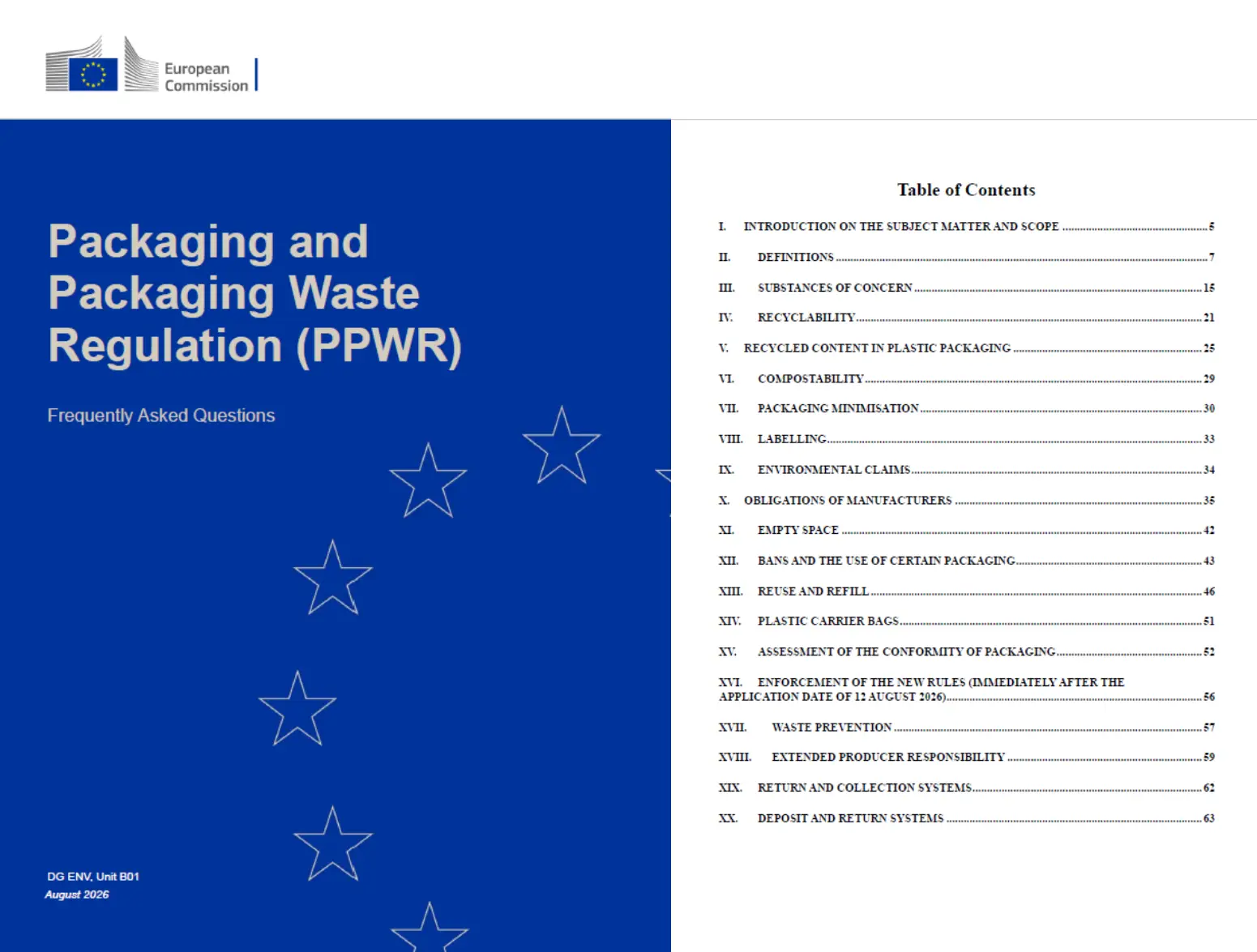
On 1 August 2026, the European Commission published the second edition of its Frequently Asked Questions on the Packaging and Packaging Waste Regulation. Only 11 days before the PPWR becomes applicable on 12 August 2026, companies are being presented with a substantial update containing new interpretations of central definitions and obligations.
What is new? Facts and figures
The document in numbers:
- 2nd edition of the FAQ
- only 11 days before the PPWR application date
- 69 pages across 20 chapters,
- more than 30 new or substantively revised entries, and
- 1 wholly new Chapter XVI dedicated to enforcement.
The Commission provides new or expanded guidance on:
- packaging identification and traceability,
- enforcement after 12 August 2026,
- obligations for transport packaging,
- the identification of the manufacturer,
- substances of concern under Article 5,
- identification of the packaging, and
- the treatment of packaging and products already held in stock.
Several of these clarifications may directly affect implementation decisions that companies have already made.
Highlight 1: Who is the manufacturer of transport packaging?
The most significant update concerns the manufacturer role for transport packaging.
According to the Commission’s new interpretation, the manufacturer of transport packaging is generally the entity that produces the packaging in its final form.
This could mean that suppliers of certain transport packaging or packaging materials may assume greater responsibility under the PPWR than previously expected.
The issue is particularly controversial for packaging materials that only obtain their final form during use, such as stretch film, wrapping materials or similar flexible packaging.
The Commission’s position does not appear to be fully aligned with the previous understanding of the European National Registers for Packaging (EUNR) and Germany’s Zentrale Stelle Verpackungsregister. Their earlier guidance indicated that certain materials only become packaging when they are applied, filled or assembled into their final packaging form.
The updated interpretation could therefore cause a major shift in responsibility from brand owners, fillers or users of packaging towards packaging suppliers and material producers.
Highlight 2: Article 5 and substances of concern
The updated FAQ also provides further guidance on compliance with Article 5, which addresses substances of concern in packaging.
The Commission refers to existing standards and technical reports that manufacturers may use to demonstrate compliance with the obligation to minimise substances of concern and with the heavy metal concentration limits.
This provides companies with a more practical route for structuring their compliance assessment.
However, it also reinforces the importance of obtaining reliable supplier information and supporting evidence.
Manufacturers should be able to demonstrate:
- which materials and substances are present in the packaging,
- which supplier declarations or test reports are available,
- how the minimisation requirement has been assessed, and
- how compliance with applicable concentration limits has been documented.
For many companies, the main implementation challenge will not be the legal threshold itself but the availability and quality of information throughout the supply chain.
The updated FAQ therefore increases the pressure on suppliers to provide complete and usable evidence.
Highlight 3: Packaging labelling and identification
The second edition also contains further guidance on the identification and traceability of packaging.
Packaging must be identifiable in a way that allows it to be linked to the relevant Declaration of Conformity and technical documentation.
In practice, this will generally require a type, batch, serial or other identification number.
The Commission indicates that batch-level identification may be sufficient in many cases. Individual marking of every packaging item may not always be necessary, provided that the packaging can be clearly linked to the relevant compliance documentation.
This is important for companies that have been uncertain about whether every individual packaging component requires a unique number.
The updated guidance also confirms that compliance with other sector-specific labelling legislation, such as food law, does not automatically satisfy the PPWR identification requirements.
Companies must therefore review whether their existing packaging labels and accompanying documentation include all PPWR-relevant information.
What does this mean for existing stocks?
The new FAQ provides some practical relief regarding packaging produced before 12 August 2026.
Existing packaging stocks do not generally need to be destroyed or relabelled solely because the PPWR becomes applicable.
In certain cases, missing identification or manufacturer information may be provided through accompanying documentation.
However, companies are still expected to make best efforts to obtain or reconstruct the necessary compliance documentation, including where the original supplier is no longer available.
This means that existing stocks should not be ignored. Businesses should identify which packaging was produced before the application date and document how it will be handled.
Implications for 12 August 2026
The updated FAQ may significantly affect how companies allocate responsibilities within their supply chains.
In particular, more suppliers may be considered manufacturers and therefore become responsible for obligations that many companies previously expected to remain with the brand owner, filler or user of the packaging.
This may include responsibility for:
- conformity assessment,
- technical documentation,
- the EU Declaration of Conformity,
- packaging identification,
- supplier evidence, and
- communication with importers and distributors.
For some packaging materials, this could represent a major shift from the brand owner towards the packaging or material supplier.
At the same time, the Commission signals that enforcement after 12 August 2026 should generally follow a proportionate and cooperative approach.
Non-compliant packaging is not expected to be automatically banned immediately after the application date in every case. Authorities may initially request corrective measures and allow companies time to address identified deficiencies.
This should not be misunderstood as a delay of the PPWR obligations. Companies must still be able to demonstrate that they have actively prepared for compliance and that they are addressing remaining gaps.
What companies should review now
The updated FAQ makes a renewed role and packaging assessment essential.
Companies should review:
- the classification of each packaging type,
- the manufacturer role for every packaging and component,
- the responsibilities of packaging suppliers,
- the treatment of transport packaging and packaging materials,
- the available Article 5 evidence,
- packaging identification and traceability,
- documentation for existing stocks, and
- the allocation of responsibilities in supplier contracts.
A general company-level assessment is unlikely to be sufficient.
The same company may be the manufacturer for one packaging type, a distributor for another and an importer or producer for a third.
Clarity can therefore only be achieved through a detailed analysis of the packaging portfolio and the company’s role in the supply chain at packaging and component level.
PackIntelX offers a free Webinar on the FAQ document –
Register here: PPWR Last-Minute Update: Webinar
Conclusion
The second edition of the Commission’s PPWR FAQ arrives at a highly sensitive point in the implementation process.
It provides useful guidance in several areas, but it also introduces new interpretations that may require companies to revisit decisions that appeared settled.
The most important impact concerns the manufacturer role, particularly for transport packaging and packaging materials.
With the application date approaching, companies should not restart their entire implementation. They should, however, identify which parts of their current approach are affected by the new guidance and where supplier responsibilities, documentation or packaging identification may need to be adjusted.
One week before the PPWR becomes applicable, clarity regarding packaging roles and responsibilities is more important than ever.