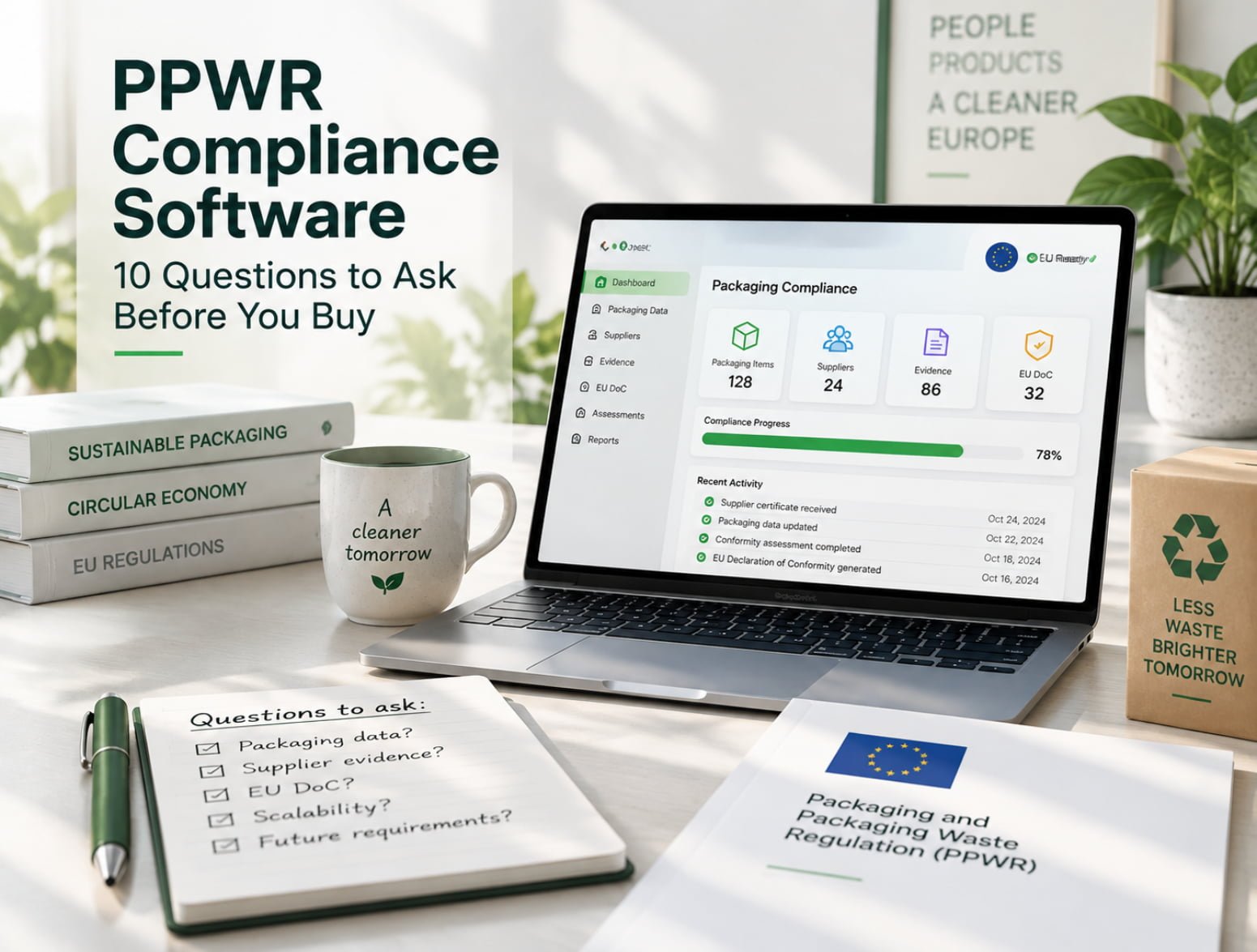
The Packaging and Packaging Waste Regulation (PPWR) is changing how businesses need to manage packaging compliance in the European Union.
For companies with multiple packaging formats, components, and suppliers, compliance is not simply about understanding what the regulation says. Companies also need to collect the right packaging data, obtain supporting evidence, carry out applicable conformity assessments, prepare technical documentation, and maintain EU Declarations of Conformity.
The PPWR requires manufacturers to carry out the applicable conformity assessment, prepare technical documentation and, where conformity has been demonstrated, draw up an EU Declaration of Conformity. The regulation also sets retention requirements for this documentation.
As a result, more businesses are looking at PPWR compliance software to help them organise and manage the process. But choosing the right software is not as simple as comparing feature lists. A platform may generate an EU Declaration of Conformity but offer little support for supplier evidence. Another may centralise packaging data, but it offers only limited regulatory functionality.
So before you buy, it is worth asking a more important question: Does this software actually support the compliance process we need to manage?
But before going into questionnaires, let’s talk about-
Why PPWR Compliance Software Matters
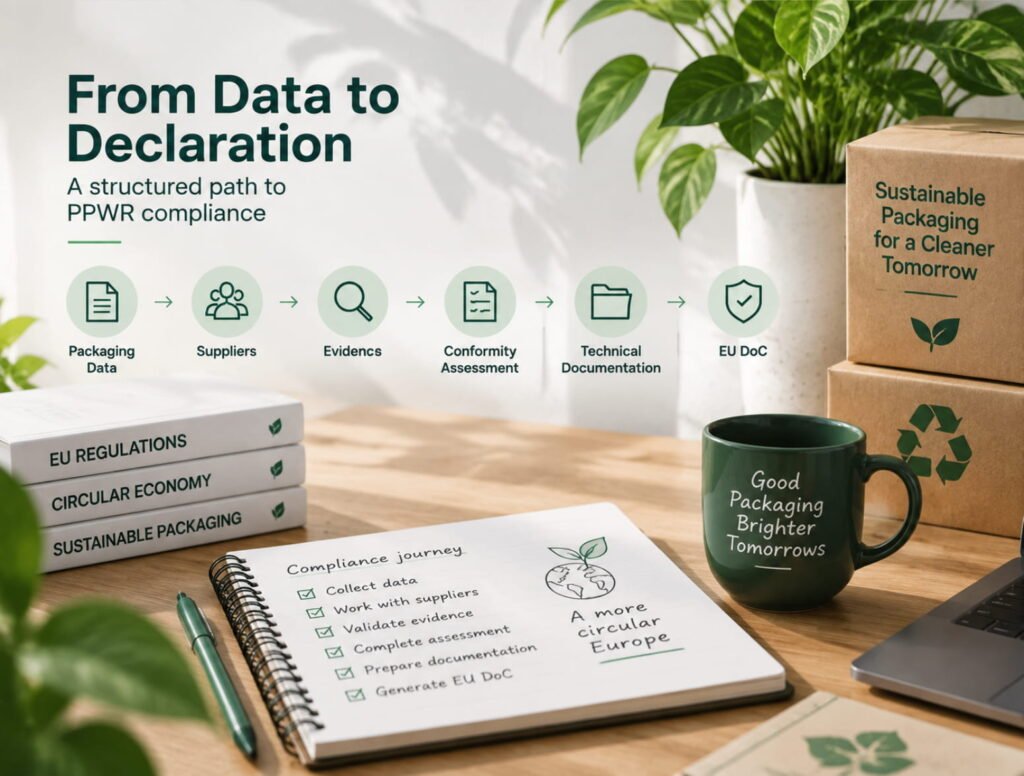
PPWR compliance is fundamentally connected to packaging data and evidence. A typical compliance workflow may involve:
- Packaging data
- Supplier information
- Evidence
- Conformity assessment
- Technical documentation
- EU Declaration of Conformity
- Ongoing compliance
The challenge is that these activities are often handled separately. Packaging information may sit in Excel files. Supplier certificates may arrive by email. Technical documents may be stored in shared folders. EU Declarations may be created from separate templates.
Such practices can make it difficult to answer basic questions such as:
- What packaging information do we have?
- What information is still missing?
- Which supplier provided this evidence?
- Which packaging does this document support?
- Has the relevant assessment been completed?
- Which EU DoC is the current version?
- What happens when the packaging changes?
The right PPWR compliance platform should help bring these activities into a more structured and traceable process.
But before choosing one, there are several mistakes buyers should avoid.
Common Mistakes Buyers Make When Choosing PPWR Software
1. Choosing software because it can generate an EU DoC
One of the most obvious PPWR software features is EU Declaration of Conformity generation. But a declaration is an output of the compliance process – not the entire process.
Under the PPWR, the declaration is supported by conformity assessment and technical documentation. The declaration must also follow the required structure and be kept up to date.
The mistake: choosing a tool because it produces a PDF declaration.
What to ask instead: Can the software connect the declaration to the packaging information, assessment and supporting evidence behind it?
2. Treating packaging data collection as a simple upload exercise
Uploading spreadsheets or documents does not necessarily mean your packaging data is structured. A packaging portfolio can contain multiple components, materials, weights, combinations, coatings and other characteristics.
The mistake: assuming that collecting files is the same as creating usable compliance data.
What to ask instead: Can the platform create a structured packaging data set that can be reused across compliance activities?
3. Underestimating supplier coordination
A significant part of packaging compliance information may need to come from suppliers.
The PPWR requires suppliers of packaging or packaging materials to provide manufacturers with information and documentation necessary to demonstrate conformity.
The mistake: choosing software that manages internal data but leaves supplier communication in email.
What to ask instead: Can suppliers provide information and evidence directly? Can the company track what has been requested, received, reviewed and is still missing?
4. Buying software for today’s requirements only
PPWR requirements are not all implemented at once. Future requirements will affect how companies assess and manage packaging, including recyclability-related obligations.
The mistake: evaluating software only against the requirements you need to manage today.
What to ask instead: Can the platform evolve as new PPWR requirements become applicable, without requiring another disconnected system?
5. Choosing technology without regulatory expertise behind it
PPWR compliance is not simply a software problem.
The system needs to reflect the applicable regulatory requirements and translate them into useful operational workflows.
The mistake: assuming that a PPWR-labelled platform automatically has the necessary regulatory depth.
What to ask instead: Who maintains the regulatory logic? How are regulatory changes incorporated? And is expert support available when a situation cannot simply be automated?
10 Questions to Ask Before Buying PPWR Compliance Software
Now that the most common buying mistakes are clear, these are the questions worth putting directly to every software provider.
1. Does the software create one structured source of packaging data?
Ask:
- Can it centralise packaging information?
- Can it manage individual packaging components?
- Can it capture materials, combinations and weights?
- Can packaging information be updated and reused?
Packaging data is the foundation of the compliance process.
A useful packaging compliance software solution should do more than store documents. It should create a structured record of the packaging itself.
For example, a packaging format may contain a box, label, adhesive, closure, coating or other components. The software should allow relevant information to be captured in a way that can support subsequent compliance activities.
The key question is:
Can this platform turn our packaging portfolio into a structured compliance data set?
That becomes particularly important when the same data needs to support multiple regulatory processes.
2. Can it generate EU Declarations of Conformity from structured data?
Ask:
- Does it generate EU Declarations of Conformity?
- Is the declaration connected to the underlying packaging information?
- Can declarations be generated consistently across a portfolio?
- Can they be updated when relevant information changes?
Article 39 of the PPWR specifies the EU Declaration of Conformity requirements, including its model structure, and states that the declaration must be continuously updated.
This is why businesses should look beyond a simple document template. For organisations with a limited number of declarations, a lightweight EU DoC software solution may be sufficient.
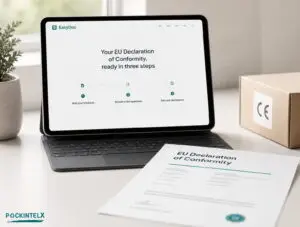
For example, PackIntelX EasyDoc is designed specifically for businesses that need a straightforward way to prepare EU Declarations of Conformity. It guides users through packaging information and compliance questions and produces the declaration through a three-step workflow.
The important distinction is that a focused EU DoC tool can address declaration preparation, while companies with larger and more complex portfolios may need a broader PPWR compliance platform.
3. Does it manage the technical documentation behind the declaration?
Ask:
- Can technical documentation be structured?
- Can supporting evidence be connected to the relevant packaging?
- Can documentation be maintained over time?
- Can you retrieve evidence supporting a compliance decision?
The EU Declaration of Conformity does not exist in isolation. The PPWR requires manufacturers to prepare technical documentation supporting the applicable conformity assessment. Therefore, ask the software provider:
“What happens to the evidence behind the EU DoC?”
A stronger workflow should connect:
- Packaging data
- Requirements
- Evidence
- Assessment
- Technical documentation
- EU DoC
That creates traceability instead of simply generating another PDF. For companies looking for more information specifically about PPWR EU DoC and technical documentation, PackIntelX also provides dedicated guidance on the documentation process.
Learn about EU DoC and Technical Documentation
4. Can it manage supplier data and supporting evidence?
Ask:
- Can suppliers provide information directly?
- Can you track missing supplier information?
- Can documents be reviewed and validated?
- Can supplier evidence be linked to the relevant packaging?
Supplier coordination is often one of the most time-consuming parts of packaging compliance. The PPWR specifically requires suppliers to provide information and documentation necessary for manufacturers to demonstrate conformity.
That may include:
- Material specifications
- Component information
- Certificates
- Test reports
- Substance-related information
- Recycled-content evidence
- Other technical documentation
A strong PPWR supplier portal should therefore support a process such as:
- Request
- Collect
- Review
- Validate
- Link
- Maintain
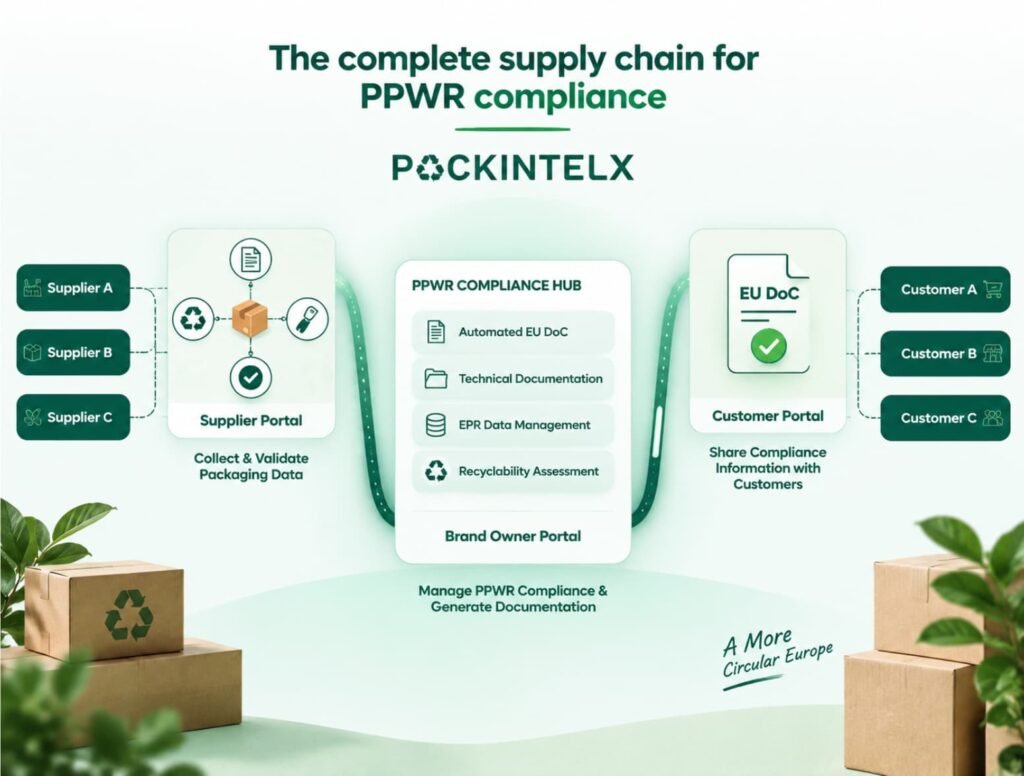
PackIntelX’s PPWR platform includes supplier information collection and validation through a dedicated supplier portal.
Explore PackIntelX PPWR Digital Solutions
5. Can the software show what is missing?
Ask:
- Can it identify incomplete packaging records?
- Can it highlight missing supplier evidence?
- Can teams see which requirements still need attention?
- Can compliance gaps be tracked?
This is one of the most important questions – and one that is easy to overlook. A compliance platform should not only tell you what information you have. It should help you understand what you still need.
For example:
- Packaging A: complete data and evidence
- Packaging B: supplier certificate missing
- Packaging C: component weight missing
- Packaging D: assessment still required
This turns software into a compliance management system, rather than simply a digital document repository.
6. Can the same data support future PPWR requirements?
Ask:
- Can the platform adapt as new PPWR requirements become applicable?
- Can existing packaging data be reused?
- Can recyclability information be incorporated?
- Does the provider maintain the regulatory logic?
This is particularly important when choosing software today. You are not only buying a solution for the requirements that apply immediately. Your packaging data may need to support additional assessments and obligations as the PPWR framework develops.
Recyclability is a good example. A future-ready platform should allow the structured packaging data you collect today to support additional compliance processes rather than forcing your organisation to build a completely separate data system later.
PackIntelX’s broader digital platform currently combines packaging data management, EU conformity declaration workflows, EPR data management and recyclability assessment.
Explore PackIntelX Recyclability Solutions
7. Can it connect PPWR with EPR and other packaging obligations?
Ask:
- Can the same packaging data support EPR activities?
- Can the platform support multiple markets?
- Can information be reused instead of entered repeatedly?
PPWR is not the only packaging compliance obligation businesses may need to manage. The same packaging portfolio can also be relevant to Extended Producer Responsibility (EPR), recyclability assessments and national packaging requirements.
If each process requires a separate spreadsheet, businesses may end up collecting the same information several times.
A more efficient model is:
- One packaging data foundation
- Multiple compliance outputs
This is particularly valuable for companies managing packaging across several European markets.
Explore PackIntelX EPR Solutions
8. Can you maintain traceability and document control?
Ask:
- Can you identify which evidence supports a declaration?
- Can you track documentation?
- Can you retrieve previous declarations?
- Can documentation be associated with the correct packaging?
The PPWR requires manufacturers to retain technical documentation and the EU Declaration of Conformity for five years for single-use packaging and ten years for reusable packaging. So document management should be more than a folder structure.
You should be able to answer:
- Which packaging does this document relate to?
- Which supplier provided it?
- When was it received?
- Is it still relevant?
- Which declaration does it support?
- Where is the current version?
When evaluating software, ask for a demonstration of the complete documentation trail, not just the dashboard.
9. Is the software usable for non-regulatory teams?
Ask:
- Can packaging teams understand what information is required?
- Are compliance questions clear?
- Can procurement teams contribute?
- Can suppliers participate without specialist regulatory knowledge?
PPWR compliance can involve packaging, procurement, quality, sustainability and regulatory teams. If every user needs to understand regulatory terminology before they can use the platform, adoption can become difficult.
Good packaging compliance software should translate regulatory requirements into clear operational questions and workflows. This is another area where EasyDoc demonstrates a useful principle: its workflow uses plain-language questions and built-in explanations to guide users through the information needed for the declaration.
The objective should be simple: Make compliance easier to execute – not make the software another compliance project.
10. Can the solution scale with your packaging portfolio?
Ask:
- Can it handle your current packaging volume?
- Can it support multiple suppliers?
- Can data be imported in bulk?
- Can the system scale as the portfolio grows?
A platform that works well for 20 packaging items may not be suitable for 5,000.
Before choosing software, consider:
- Number of packaging types
- Number of components
- Number of suppliers
- Number of markets
- Number of users
- Expected portfolio growth
Also ask how existing data can be transferred into the platform. For larger organisations, bulk data import and integration capabilities can be critical. PackIntelX’s broader platform supports packaging data collection and supplier workflows and is structured around different packaging and supplier portfolio sizes.
The Bottom Line
Choosing PPWR compliance software is not about finding the platform with the longest feature list.
It is about finding a solution that can connect the different parts of your compliance process:
- Packaging data
- Supplier evidence
- Assessment
- Technical documentation
- EU DoC
- Ongoing compliance
Before making a decision, test the software against your own packaging and supplier information. The right platform should not simply digitalise the spreadsheets and documents you already have. It should help create a more structured, traceable and scalable way to manage packaging compliance.
PackIntelX combines packaging compliance expertise with digital solutions for packaging data management, supplier collaboration, EU Declarations of Conformity, technical documentation, EPR and recyclability.