PPWR Declaration of Conformity: What Manufacturers Should Be Aware
The EU Packaging and Packaging Waste Regulation (PPWR) is moving packaging compliance from a broad environmental obligation to a more structured, evidence-based compliance framework.
For manufacturers placing packaging on the EU market, one document is increasingly important: the EU Declaration of Conformity (DoC).
Manufacturers must demonstrate that their packaging complies with the relevant PPWR requirements before it can be placed on the market. This involves conducting the relevant conformity assessment, preparing the necessary technical documentation, and, where conformity has been demonstrated, preparing an EU Declaration of Conformity.
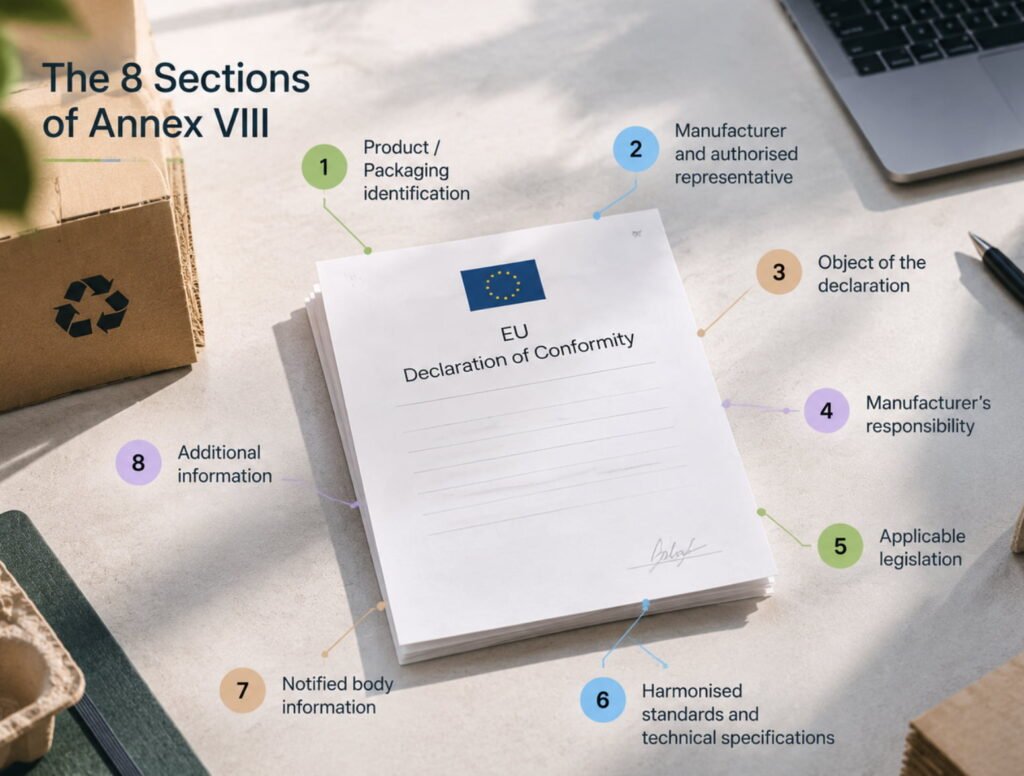
Annex VIII provides the model structure for the PPWR Declaration of Conformity.
At first glance, Annex VIII appears relatively simple: eight numbered sections plus the place, date, name, function and signature.
But in practice, preparing a useful and defensible declaration involves much more than copying those headings into a Word document.
The information in the declaration needs to connect back to the packaging identification, technical documentation, conformity assessment, applicable requirements and supporting evidence.
Looking for practical support with your EU Declaration of Conformity? – Explore PackIntelX EU Declaration of Conformity support
Download the PPWR Declaration of Conformity Template
Annex VIII PPWR: What Are the 8 Sections of the EU Declaration of Conformity?
Annex VIII provides the model structure for the PPWR Declaration of Conformity.
The 8 sections cover:
- Unique identification of the packaging
- Manufacturer and authorised representative information
- Manufacturer’s responsibility statement
- Object of the declaration and packaging traceability
- Relevant Union harmonisation legislation
- Harmonised standards, common specifications and technical specifications
- Notified body information, where applicable
- Additional information
The declaration then concludes with:
- Place and date of issue
- Name
- Function
- Signature
Let’s examine each section in detail.
1. Unique Identification of the Packaging
What Does Annex VIII Require?
The first section requires a unique identification of the packaging.
This is one of the areas where companies often underestimate the importance of traceability.
The DoC should avoid generic descriptions such as:
“Plastic packaging.”
For companies managing multiple packaging formats, this is unlikely to provide sufficient practical traceability.
Instead, the identification should connect the declaration with a specific packaging type, model, product family or controlled identifier used within the manufacturer’s compliance system.
What Information Can Be Included?
Depending on the manufacturer’s internal system, identification could include:
- Packaging reference number
- Packaging SKU
- Packaging model number
- Packaging family ID
- Technical specification number
- Drawing number
- Material code
- Internal packaging ID
- Revision number
- Batch or series identifier, where applicable
Example
Packaging ID: PKG-PET-500-BTL-001 / Rev. 02
The key principle is consistency.
The identifier used in the Declaration of Conformity should be traceable to the technical documentation and, where appropriate, the packaging placed on the market.
Practical Compliance Tip
Do not generate the DoC identification manually every time.
A better approach is to maintain a controlled packaging master-data record from which the DoC can be generated.
This is particularly useful for companies managing hundreds or thousands of packaging components.
2. Manufacturer and Authorised Representative Information
The second section identifies the legal entity responsible for the declaration.
Annex VIII requires the:
Name and address of the manufacturer
and, where applicable:
Name and address of the manufacturer’s authorised representative.
This information should identify the legal entity responsible for the packaging and should remain consistent across regulatory documentation.
Before Issuing the DoC, Verify:
- Legal business name
- Registered office address
- Country
- Authorised representative details, where applicable
- Consistency with other regulatory documentation
A common operational problem occurs when companies use different versions of their corporate name across technical files, packaging records, declarations and market documentation.
These records should be aligned to support regulatory traceability.
3. Manufacturer’s Sole Responsibility Statement
Section 3 is short but legally important.
Annex VIII includes the manufacturer’s responsibility statement:
“This declaration of conformity is issued under the sole responsibility of the manufacturer.”
This is not merely introductory wording.
The manufacturer should therefore not view the DoC as a document that transfers responsibility to a supplier, laboratory or consultant.
Suppliers can provide:
- Technical information
- Material data
- Supporting documentation
- Test results
Testing laboratories can provide test reports.
Consultants can support the conformity assessment process.
However, the manufacturer’s Declaration of Conformity remains the formal declaration of responsibility for the packaging’s conformity.
4. Object of the Declaration and Packaging Traceability
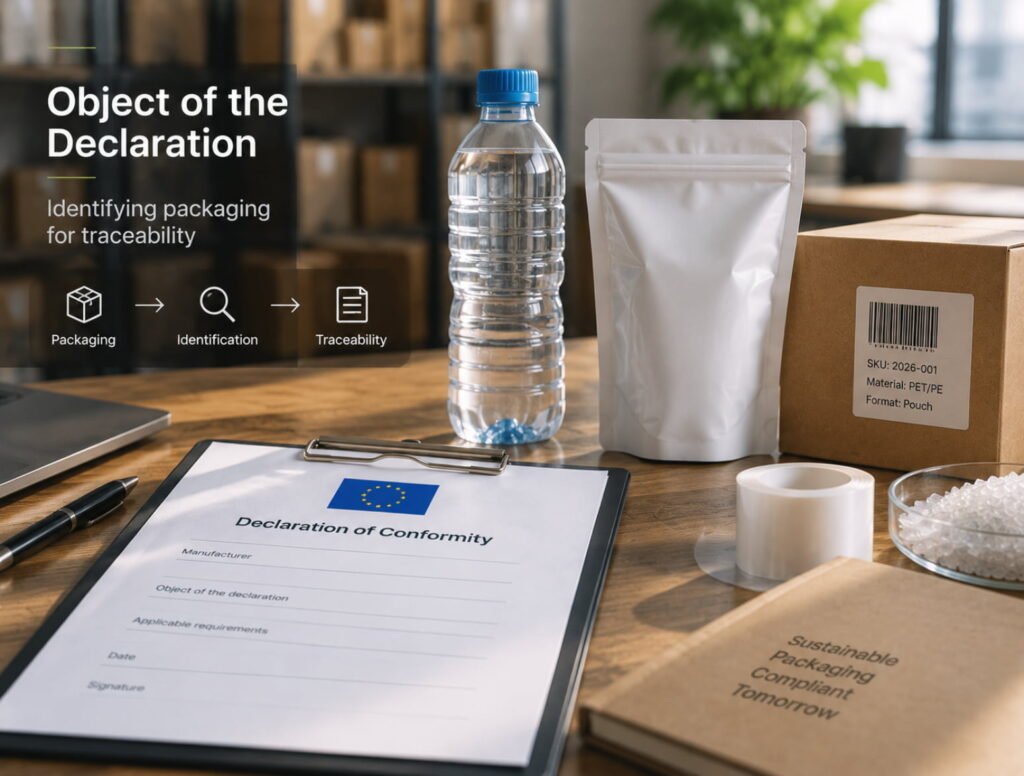
This section describes what the declaration actually covers.
Annex VIII requires:
Object of the declaration — identification of the packaging enabling traceability and a description of the packaging.
This makes the declaration significantly more useful than a generic compliance statement.
The description should allow a third party to understand which packaging is covered by the declaration.
What Should the Packaging Description Include?
Depending on the packaging type, relevant information may include:
- Packaging type
- Primary, secondary or transport packaging classification
- Material
- Structure
- Dimensions
- Capacity
- Components
- Closure
- Layers or coatings
- Intended use
- Product application
- Packaging format
Example: Rigid Packaging
500 ml PET bottle comprising a PET body, PP closure and label, intended for beverage packaging.
Example: Flexible Packaging
Multilayer flexible pouch comprising PET/PE layers for food packaging, including a printed outer layer and PE sealing layer.
The level of detail should be sufficient to establish traceability without turning the Declaration of Conformity into the entire technical file.
5. Relevant Union Harmonisation Legislation
This section is often misunderstood.
Annex VIII requires the manufacturer to identify the relevant Union harmonisation legislation and other Union acts applied to the object of the declaration.
This becomes particularly important where packaging or the packaged product is subject to more than one EU legal act requiring an EU Declaration of Conformity.
Where appropriate, Article 39 allows a single EU Declaration of Conformity to cover multiple applicable Union acts.
Why Is This Important?
Packaging can interact with other regulatory frameworks depending on its intended use.
These may include legislation relating to:
- Food contact materials
- Medical products
- Chemicals
- Product-specific requirements
- Other relevant Union harmonisation legislation
The DoC should therefore reflect the actual regulatory scope applicable to the packaging.
Important
Do not simply list every EU regulation mentioned somewhere in the company’s compliance documentation.
Only legislation relevant to the declaration should be identified.
6. Harmonised Standards, Common Specifications and Technical Specifications
This section is important because it connects the Declaration of Conformity to the technical route used to demonstrate conformity.
Annex VIII requires references to applicable:
- Harmonised standards
- Common specifications
- Other relevant technical specifications
What Should Be Recorded?
Where applicable, the manufacturer should record:
Standard / specification:
Designation or reference
Version / edition:
Applicable version
Application:
Which packaging requirement or characteristic it supports
For example:
| Technical Reference | Application |
| Harmonised standard | Relevant packaging requirement |
| Common specification | Applicable technical requirement |
| Technical specification | Testing or calculation methodology |
Why Does This Matter?
A statement such as:
“Packaging complies with PPWR.”
does not by itself explain how conformity was demonstrated.
The Declaration of Conformity should therefore be viewed as a summary of a documented conformity assessment, not a replacement for the evidence itself.
For companies that need to manage technical documentation and declarations across large packaging portfolios, PackIntelX’s PPWR Digital Solutions provides a centralised approach to packaging data, supplier information, technical documentation and EU DoC workflows.
7. Notified Body Information — Where Applicable
The wording “where applicable” in Annex VIII is important.
Section 7 is conditional. It does not mean that every manufacturer must involve or list a notified body.
If a notified body has participated in the applicable conformity assessment procedure, relevant information should be provided, such as:
- Name of the notified body
- Address
- Identification number
- Intervention performed
- Certificate information
- Certificate date
- Validity period or applicable conditions
Do Not Add a Notified Body Unless Applicable
A common mistake in regulatory templates is assuming that every Declaration of Conformity requires certification by a third-party body.
That is not necessarily the case.
The applicable conformity assessment route determines whether a notified body is involved.
Therefore, a practical template should contain:
Notified body: [Complete only if applicable]
rather than requiring every manufacturer to enter a certification body.
8. Additional Information
The final numbered section is:
Additional information
This section provides space for information needed to make the declaration complete and useful but which does not fit naturally into Sections 1–7.
It should not become a place to insert random compliance statements.
Potential information may include:
- Additional conformity references
- Relevant restrictions or conditions
- Specific technical qualifications
- Cross-references to supporting documents
- Information required by another applicable Union act
- Clarification of the conformity assessment route
The information should remain controlled, relevant and traceable.
The Signature Section
After the eight numbered sections, Annex VIII provides for:
Signed for and on behalf of:
This is followed by:
- Place and date of issue
- Name
- Function
- Signature
The final section identifies who is signing the declaration on behalf of the manufacturer.
Best Practice
Use an authorised person whose role and authority are clearly defined within the company’s compliance or quality-management process.
For electronically generated declarations, the signing process should also be subject to appropriate document control.
PPWR Declaration of Conformity vs. Technical Documentation

This distinction is critical.
A common misconception is that once a company completes the eight Annex VIII fields, it has completed its PPWR compliance documentation.
It has not.
The Declaration of Conformity is the formal declaration.
The technical documentation is the evidence supporting that declaration.
Technical documentation should enable the assessment of the packaging’s conformity with the applicable requirements and contain the relevant supporting information and evidence.
A simplified structure looks like this:
Technical Documentation — Evidence Layer
→ Packaging description
→ Design documentation
→ Material and component information
→ Applicable PPWR requirements
→ Assessments
→ Calculations
→ Test reports
→ Standards/specifications
→ Risk assessment
→ Supporting evidence
Declaration of Conformity — Formal Declaration Layer
→ Packaging identification
→ Manufacturer
→ Responsibility
→ Object of declaration
→ Relevant legislation
→ Technical references
→ Notified body, if applicable
→ Additional information
→ Signature
The two layers should be connected within the company’s compliance system.
For companies looking to automate this relationship, PackIntelX EU Declaration of Conformity solution supports centralised packaging data, technical evidence and EU DoC workflows.
Final Thoughts: The PPWR Declaration of Conformity Is More Than an 8-Field Form

The PPWR Declaration of Conformity is not simply an eight-field form.
It is the formal output of a wider conformity-assessment process.
Annex VIII gives manufacturers the structure, but the quality of the declaration ultimately depends on whether the information is:
Accurate → Traceable → Consistent → Supported by technical evidence → Kept up to date
The most reliable approach is therefore:
Identify the packaging → Identify the applicable PPWR requirements → Perform the conformity assessment → Build the technical documentation → Complete the Annex VIII Declaration of Conformity → Sign and control the document → Keep it updated
For businesses managing multiple packaging formats, the real challenge is not creating one Declaration of Conformity.
The challenge is maintaining a complete, traceable and up-to-date compliance record across the entire packaging portfolio.
Download the PPWR Declaration of Conformity Template
Need a practical starting point for your Annex VIII documentation?
Download the PPWR Declaration of Conformity template and use it to structure the information required for your packaging compliance process.
[DOWNLOAD THE PPWR DECLARATION OF CONFORMITY TEMPLATE]
Need More Than a Template?
A template is useful for understanding what needs to be documented. But companies with complex packaging portfolios often face a bigger challenge: collecting supplier data, validating packaging information, linking evidence, managing technical documentation, and keeping multiple DoCs updated.
PackIntelX helps businesses manage these processes through a centralised digital PPWR compliance workflow, including:
- EU Declaration of Conformity
- Technical documentation
- Packaging data management
- Supplier data collection
- PPWR compliance assessment
- Recyclability assessment
- EPR data management
Explore PackIntelX PPWR Compliance Solutions
Want to see how this works for your packaging portfolio?