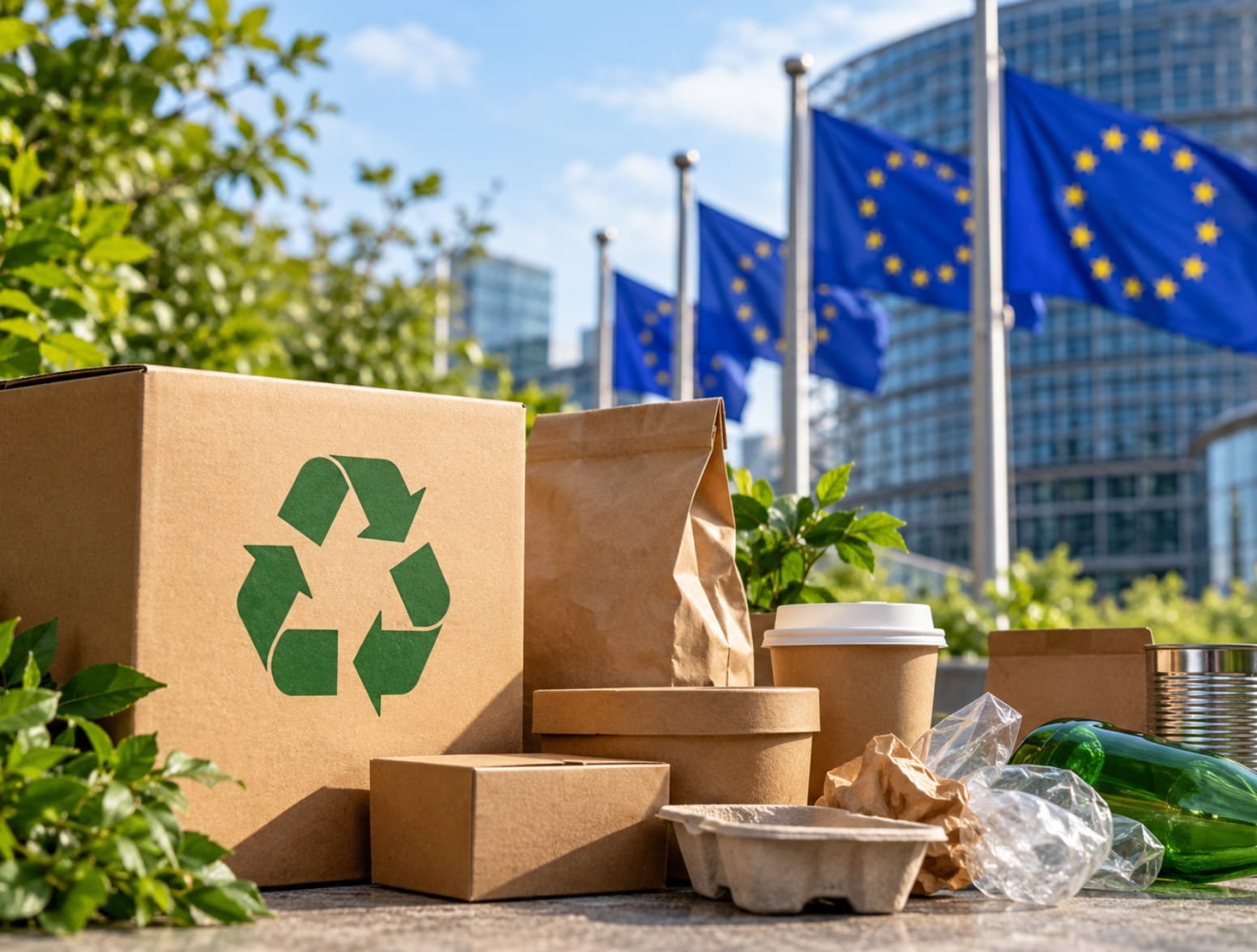
The Packaging and Packaging Waste Regulation (PPWR) has been generally applicable across the EU since 12 August 2026. While much of the regulation focuses on packaging design, recyclability, waste prevention and circularity, one topic is currently attracting particular attention among small and medium-sized businesses: Extended Producer Responsibility (EPR) and the cost of managing it across multiple EU markets.
Recent discussions in the European Parliament have highlighted concerns that national registrations, reporting obligations and Authorised Representatives can create disproportionately high fixed costs for smaller companies selling relatively small quantities across borders. At the same time, the EU is already working on measures designed to make EPR more harmonised, digital and easier to manage.
EPR is not new – and it serves an important purpose
Extended Producer Responsibility has existed across Europe for many years. Its basic principle is straightforward: companies responsible for placing packaging on the market contribute financially to the collection, sorting and recycling of the resulting packaging waste.
This is an important part of financing effective waste management and creates a connection between packaging decisions and their end-of-life costs.
What the PPWR changes is therefore not the fundamental idea of EPR. Instead, it brings EPR into a more harmonised European framework.
Historically, companies operating across several EU countries have had to navigate different definitions, registration processes, reporting formats, material categories, deadlines and fee structures. This fragmentation creates considerable complexity, particularly for businesses selling across multiple markets.
The PPWR aims to reduce those differences over time.
Harmonisation can make EPR easier to manage
One of the important developments under the PPWR is the move towards more standardised producer registration and reporting.
Member States will continue to operate national producer registers, but the European Commission is establishing common formats for registration and reporting. The Commission’s draft implementing regulation explicitly states that producers should be able to submit data in a single and consistent way across Member States, reducing administrative burden caused by divergent national formats.
The proposed system also supports greater digitalisation. Registration data would be submitted electronically through systems that allow automated processing and bulk verification of producer registration numbers and compliance certificates.
Another important improvement is the possibility of reusing packaging data already collected for PPWR Technical Documentation. Information on packaging composition and material weights can also support EPR reporting, reducing duplication and improving data quality.
For companies operating internationally, this direction is valuable: common data structures, clearer rules and digital processes can make multi-country EPR compliance considerably more manageable.
But cross-border compliance can be expensive for SMEs
The challenge is that this harmonisation is still developing, while companies must already comply with national EPR systems.
For small companies selling limited volumes into several EU countries, fixed compliance costs can quickly become significant. Members of the European Parliament recently raised concerns about the combined burden of national registrations, reporting, fees and Authorised Representatives for cross-border sellers.
The Authorised Representative requirement has become a particular focus of the debate. For certain cross-border distance-selling situations, producers must appoint an EPR Authorised Representative in the destination Member State. While this supports enforcement and ensures that a responsible entity can be reached locally, the cost can be difficult to justify where only a very small volume of products is sold into a market.
Several MEPs have therefore called for solutions such as simplified procedures, de-minimis thresholds or digital one-stop-shop approaches for smaller businesses. The concerns are not primarily about whether producers should contribute to packaging waste management, but about whether the administrative cost of doing so is proportionate to the volume of packaging placed on a market.
The Commission has recognised the issue
The European Commission has already proposed changes to the Authorised Representative requirement for intra-EU cross-border trade. However, the legislative change has not yet been adopted, meaning that the existing PPWR rules continue to apply for now.
The political discussion is therefore still ongoing.
At the same time, the Commission’s work on harmonised producer registers shows that simplification is already part of the PPWR implementation process. The draft reporting framework even distinguishes between producers placing less than 10 tonnes and those placing 10 tonnes or more of packaging on a national market, allowing for different levels of reporting detail.
This points towards the right principle: environmental responsibility should remain, while the administrative process should become more proportionate and efficient.
Strong EPR and simpler implementation should go together
The debate around SME costs should not obscure why EPR and the PPWR matter.
Europe needs effective systems for financing packaging collection and recycling. Businesses also benefit from more consistent rules across the Single Market. A genuinely harmonised framework can reduce uncertainty, improve packaging data and eventually make cross-border compliance easier rather than harder.
The current challenge is therefore not to weaken EPR.
It is to ensure that the transition from fragmented national systems towards a harmonised European framework works for companies of different sizes.
For large companies placing substantial packaging volumes across Europe, the cost of local compliance structures may be manageable. For a micro-enterprise shipping only a small number of products into several countries, the same fixed administrative costs can have a very different impact.
A proportionate system should recognise that difference.The most constructive way forward is therefore further harmonisation, digitalisation and simplification: common reporting formats, interoperable producer registers, more efficient data exchange and practical solutions for low-volume cross-border sellers.
The PPWR has already created the framework for much of this harmonisation. The next step is to make sure its implementation delivers on one of the fundamental advantages of EU-wide regulation: common environmental standards without creating unnecessary barriers to doing business across the Single Market.