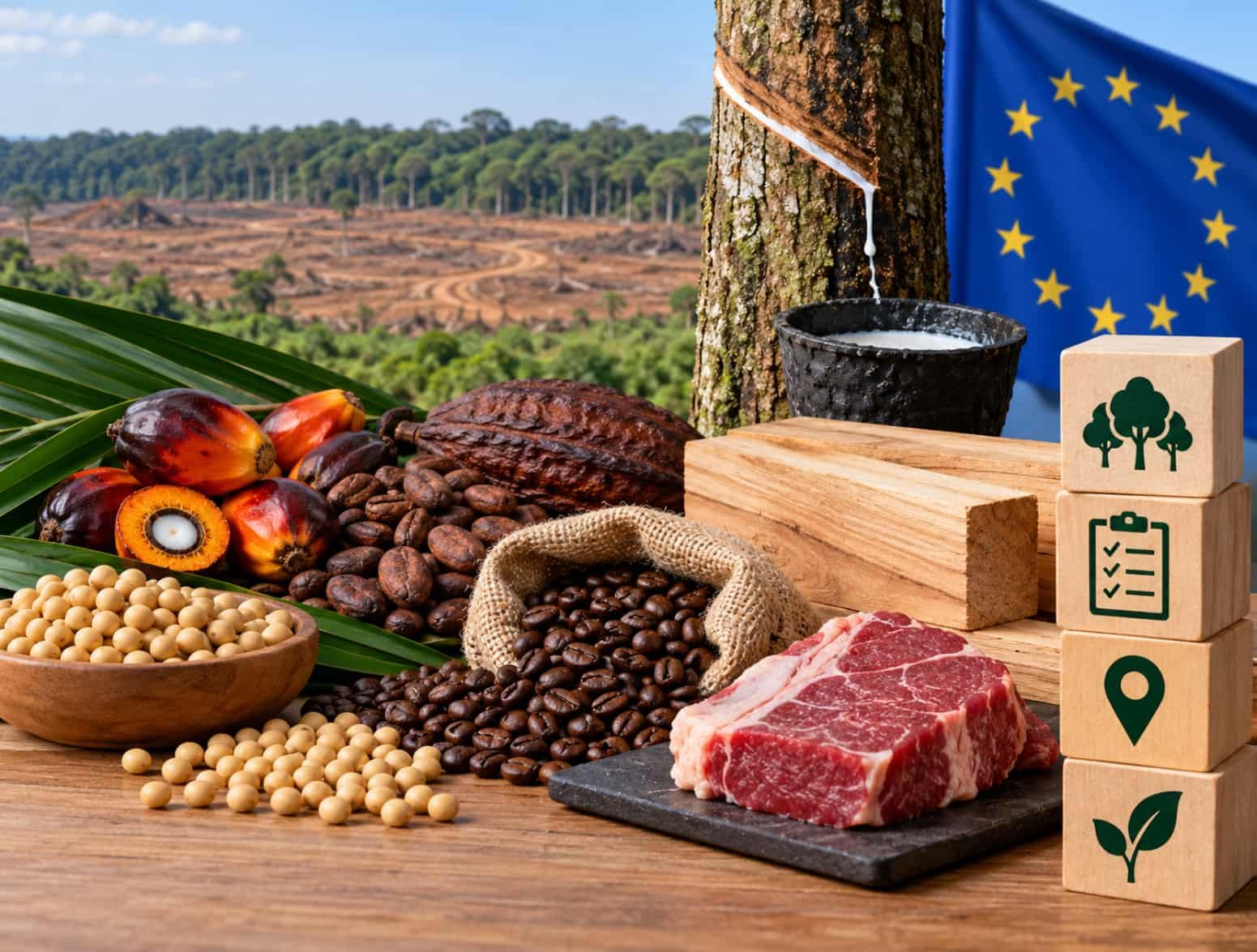
Short answer: A product is in EUDR scope only if its customs code (CN/HS code) is listed in Annex I of Regulation (EU) 2023/1115 and it contains, or was made using, cattle, cocoa, coffee, oil palm, rubber, soya or wood. Many entries carry the prefix “ex”, which means only part of that heading is covered. Annex I was rewritten by Delegated Regulation (EU) 2026/2102: some products left the scope on 18 September 2026, others join on 30 December 2027. Check every product at the eight-digit code level. The full obligations are in our EUDR requirements guide.
Status: 22 November 2026. Annex I as amended by Delegated Regulation (EU) 2026/2102 has applied since 18 September 2026. Removed products are out of scope now. Added products, such as soluble coffee and soap made with palm oil, apply from 30 December 2027. The EUDR itself applies from 30 December 2026 (dates explained).
Key takeaways
- The CN code decides, not the product description on the invoice.
- An “ex” entry covers only products made from the commodity, or only certain subheadings.
- Leather, conveyor belts, other vulcanised rubber articles and vehicle seats have been out of scope since 18 September 2026.
- Packaging used only to pack, protect or carry another product is out of scope. Packaging sold as a product is in scope.
- Bamboo, rattan, synthetic rubber, buffalo and bison are not covered.
How to check whether your product is in scope
- Find the exact CN code (eight digits) for each product you place on the EU market or export. Use the code from your customs declaration, not an internal article number.
- Look it up in Annex I. Use the consolidated version of the regulation. If the entry starts with “ex”, read the description: it limits the entry to products made from the relevant commodity or to named subheadings.
- Check the application date. Entries added in 2026 carry the note “This provision shall apply from 30 December 2027”.
- Apply the exemptions below: packing material, samples, used and second-hand goods for certain entries, and products made entirely from recycled material.
- Record the result per product and per supplier. Customs and competent authorities can ask how you decided.
EUDR HS codes by commodity
The table shows the typical headings for each commodity. It is a starting point, not a substitute for Annex I: always confirm the exact code and any “ex” wording in the legal text.
| Commodity | Typical HS headings | Examples | Notes |
|---|---|---|---|
| Cattle | 0102 21, 0102 29; 0201; 0202; ex 0206; ex 1602 50 | Live cattle, fresh and frozen beef, offal, prepared beef | Hides and leather (ex 4101, ex 4104, ex 4107) removed in 2026. Frozen cattle tongues (ex 0206 21 00) join on 30 December 2027. Only the genus Bos counts |
| Cocoa | 1801 to 1806 | Beans, shells, paste, butter, powder, chocolate | No change in 2026 |
| Coffee | 0901 | Green and roasted coffee, husks | Soluble coffee (2101 11 00) joins on 30 December 2027 |
| Oil palm | 1207 10; 1511; 1513 21, 1513 29; ex 2306 60; selected entries of chapters 29 and 38 | Palm nuts and kernels, palm oil, palm kernel oil, oilcake, oleochemicals | Further derivatives (for example ex 1516 20) and soap containing or made with oil palm (ex 3401) join on 30 December 2027 |
| Rubber | 4001; selected headings of chapter 40 such as 4011, 4013, 4015 | Natural rubber, new pneumatic tyres, inner tubes, gloves | Conveyor belts (ex 4010) and other vulcanised rubber articles (ex 4016) removed. Of 4012 only tyre treads (4012 90 30) remain. Synthetic rubber is not covered |
| Soya | 1201; 1208 10; 1507; 2304 | Soya beans, flour, oil, oilcake | Soya beans for sowing removed in 2026 |
| Wood | Chapter 44 (for example 4401, 4402, 4403, 4407, 4412, 4415); chapter 47; chapter 48; chapter 49; ex 9401, ex 9403; 9406 10 | Logs, charcoal, sawn wood, plywood, pallets, pulp, paper and board, printed products, wooden furniture, prefabricated buildings | Seats are now a positive list; aircraft and vehicle seats are out. Bamboo, rattan and other woody materials such as reed and straw are not wood |
What Delegated Regulation (EU) 2026/2102 changed
| Change | Products | Applies from |
|---|---|---|
| Removed | Cattle hides, skins and leather (ex 4101, ex 4104, ex 4107) | 18 September 2026 |
| Removed | Conveyor and transmission belts (ex 4010) and other articles of vulcanised rubber (ex 4016) | 18 September 2026 |
| Narrowed | Heading 4012: only tyre treads (4012 90 30) remain; retreaded tyres are out | 18 September 2026 |
| Narrowed | Wooden seats (ex 9401): now a list of subheadings; aircraft and motor vehicle seats are out | 18 September 2026 |
| Added | Soluble coffee (2101 11 00), frozen cattle tongues (ex 0206 21 00) | 30 December 2027 |
| Added | Palm oil derivatives (for example ex 1516 20 and entries in chapters 29) and soap containing or made with oil palm (ex 3401) | 30 December 2027 |
| Clarified | Cattle = genus Bos only; oil palm = Elaeis only; rubber = Hevea brasiliensis only; wood excludes bamboo, rattan and similar materials | 18 September 2026 |
Exemptions that take products out of scope
- Packing material. Packaging and containers used only to support, protect or carry another product are out of scope. Packaging sold as a product in its own right, such as empty cartons sold to a filler, and the first sale of reusable packaging such as new pallets, can be in scope. Details: EUDR and packaging.
- Samples and tests. Samples and specimens of negligible value, and products consumed or destroyed in tests, analyses or trials, are out of scope.
- Used and second-hand products are excluded for the entries that say so, for example wooden seats and certain rubber products.
- Recycled products. Goods made entirely from material that has completed its life cycle and would otherwise be discarded as waste are not covered. Products made partly from recycled material remain in scope for their virgin content.
Common mistakes
| Mistake | Why it is wrong | What to do |
|---|---|---|
| Deciding by HS chapter | Two products in the same chapter can fall on different sides of an “ex” entry | Check the eight-digit CN code |
| Using the invoice description | Authorities go by the customs classification | Take the code from the customs declaration |
| Treating all paper packaging as exempt | Only packaging used to pack another product is exempt | Separate packaging you use from packaging you sell |
| Ignoring the 2027 additions | Soluble coffee, palm derivatives and soap need supplier data from 2027 | Start collecting data for them in 2027 planning |
| Assuming recycled content exempts the whole product | Only products made entirely from recycled material are exempt | Document the recycled share and cover the virgin part |
Once you know which products are in scope, the next question is your role for each one: operator, downstream operator or trader. Not sure where you stand overall? The EUDR readiness check takes two minutes.
Need a product-by-product scope check before 30 December? See our EUDR compliance service or book a consultation.
Frequently asked questions
Where can I find the list of EUDR HS codes?
In Annex I of Regulation (EU) 2023/1115. Use the consolidated version on EUR-Lex, which includes the changes made by Delegated Regulation (EU) 2026/2102.
What does “ex” mean in Annex I?
It means only part of the heading is covered, for example only products made from the relevant commodity or only named subheadings. Check the description next to each “ex” entry.
Is leather still covered by the EUDR?
No. Cattle hides, skins and leather (ex 4101, ex 4104 and ex 4107) were removed from Annex I on 18 September 2026.
Are paper and cardboard covered?
Paper and board of chapter 48 are covered when they are placed on the market as products. Packaging used only to pack, protect or carry another product is out of scope.
When do soluble coffee and palm oil derivatives come into scope?
From 30 December 2027. The date is noted next to each added entry in Annex I.
Sources
- Regulation (EU) 2023/1115, consolidated text, EUR-Lex
- Delegated Regulation (EU) 2026/2102, EUR-Lex
- European Commission: EU Deforestation Regulation (EUDR)
This article is general information, not legal advice.