Packaging compliance is becoming increasingly complex as businesses prepare for the Packaging and Packaging Waste Regulation (PPWR) while continuing to meet existing Extended Producer Responsibility (EPR) obligations across Europe. Companies can no longer rely on spreadsheets, emails, and disconnected systems to manage packaging data, supplier information, technical documentation, and regulatory reporting.
With PPWR introducing new requirements for recyclability, recycled content, technical documentation, EU Declarations of Conformity, and supplier collaboration, businesses need a more structured approach to compliance. Choosing the right packaging compliance software can help organisations centralise information, improve efficiency, reduce compliance risks, and prepare for evolving regulatory requirements.
However, not every software platform offers the same capabilities. Before investing in a solution, businesses should understand which features truly support long-term compliance rather than simply storing documentation.
Why Packaging Compliance Software Is Becoming Essential
Packaging compliance has evolved far beyond submitting annual reports or maintaining product specifications. Businesses placing packaging on the EU market must now demonstrate compliance throughout the packaging lifecycle while responding quickly to changing regulations.
Managing these obligations manually often results in duplicate information, inconsistent documentation, and increased administrative effort. As organisations expand into multiple European markets, the complexity only continues to grow.
A dedicated packaging compliance platform helps businesses organise packaging information, automate repetitive tasks, and maintain the documentation required for audits, inspections, and regulatory reporting. Instead of reacting to compliance challenges, organisations can build a proactive and scalable compliance process.
What Challenges Are Businesses Facing Today?
Before selecting a software solution, it is important to understand the operational challenges businesses are trying to solve. Many organisations experience similar issues regardless of their size or industry.
Managing Packaging Data Across Multiple Systems
Packaging specifications are often stored in different spreadsheets, ERP systems, emails, and shared folders. This fragmented approach makes it difficult to maintain accurate records and creates unnecessary duplication of work.
Collecting Supplier Documentation
Compliance depends heavily on supplier declarations, material specifications, certificates, and test reports. Collecting and updating this information manually can consume significant time while increasing the risk of missing documentation.
Keeping Up With PPWR and EPR Requirements
Regulatory obligations continue to evolve. Businesses must monitor new guidance, implementing acts, country-specific EPR requirements, and PPWR obligations while ensuring their internal processes remain aligned.
Preparing for Audits and Regulatory Inspections
When authorities request supporting documentation, businesses need immediate access to technical files, packaging data, supplier information, and compliance evidence. Manual systems often make this process slower and more difficult than necessary.
What Should Packaging Compliance Software Actually Do?
Choosing the right software is about more than digitising documents. An effective solution should support the entire compliance journey, from packaging design and supplier collaboration to technical documentation and regulatory reporting.
The best platforms help businesses centralise compliance activities, reduce manual administration, and provide greater visibility across their packaging portfolio.
Packaging Data Management
Packaging data forms the foundation of every compliance activity. A software platform should maintain a central repository for packaging specifications, material composition, weights, packaging formats, and other important information.
Having one reliable source of packaging data improves consistency while reducing duplicate records across different departments.
Technical Documentation Management
The PPWR requires businesses to maintain comprehensive technical documentation demonstrating packaging compliance.
A suitable platform should allow businesses to organise supporting documents, maintain version control, track updates, and ensure documentation remains accessible throughout the product lifecycle.
EU Declaration of Conformity
Preparing and maintaining the EU Declaration of Conformity requires accurate supporting evidence.
Packaging compliance software should help businesses organise the documentation needed to support conformity assessments while making it easier to retrieve information during inspections.
Supplier Collaboration
Supplier information is one of the biggest challenges in packaging compliance.
The right software should provide structured workflows that allow suppliers to submit declarations, certificates, material information, and supporting documentation through one central platform.
This improves data quality while reducing manual follow-ups.
Multi-Country EPR Reporting
Businesses selling products across multiple European countries often face different EPR registration processes, reporting requirements, and Producer Responsibility Organisations.
An effective platform should simplify multi-country EPR reporting by centralising packaging data and supporting country-specific reporting requirements.
Recyclability Assessments
PPWR places significant emphasis on packaging recyclability.
Software should help businesses assess packaging performance, identify potential compliance gaps, and support packaging design decisions that improve recyclability before products are placed on the market.
Essential Questions to Ask Before Choosing a Compliance Platform
Selecting the right software requires careful evaluation. Instead of focusing only on current requirements, businesses should choose a platform that can adapt as packaging regulations continue to evolve.
Consider asking the following questions:
- Can the platform manage both PPWR and EPR compliance?
- Does it support technical documentation management?
- Can suppliers upload compliance information directly?
- Does it centralise packaging data across multiple products?
- Can it support EU Declaration of Conformity preparation?
- Does it simplify multi-country EPR reporting?
- Can it scale as new regulatory requirements are introduced?
A platform that answers these questions positively is more likely to provide long-term value than one designed only for individual reporting tasks.
Combine Software Solutions With Compliance Expertise
While digital compliance software plays a critical role, successful PPWR implementation also depends on knowledge, planning, and organisational readiness. Businesses first need to understand how the regulation applies to their operations before they can build effective compliance processes.
This is where structured assessments and practical training become valuable.
PPWR Workshops
The PPWR Workshops offered by PackIntelX help businesses understand the practical implications of the regulation and prepare for implementation with confidence. These workshops cover topics such as PPWR obligations, packaging roles and responsibilities, technical documentation, supplier engagement, EU Declaration of Conformity, and implementation planning.
Rather than focusing only on legislation, the workshops provide practical guidance that helps teams develop a clear roadmap for achieving compliance across their packaging portfolio.
PPWR Check
Before investing time and resources into implementation, businesses also need to understand their current level of readiness.
The PPWR Check is designed to help organisations assess their preparedness for the regulation by identifying applicable obligations, documentation gaps, and potential compliance risks. The assessment provides practical recommendations that help businesses prioritise the next steps in their PPWR journey.
When combined with digital compliance software, the PPWR Workshop and PPWR Check help organisations move from understanding the regulation to implementing structured, scalable compliance processes.
Common Mistakes Businesses Make When Choosing Packaging Compliance Software
Investing in packaging compliance software is a long-term decision. However, many businesses focus only on immediate reporting needs instead of selecting a solution that can support future regulatory requirements. Choosing the wrong platform can lead to additional costs, fragmented processes, and unnecessary manual work.
Prioritising Reporting Over Compliance Management
Some software solutions are designed primarily for submitting reports rather than managing the entire compliance process. While reporting is important, businesses also need support for packaging data management, supplier collaboration, technical documentation, and regulatory documentation.
Choosing a platform that only addresses reporting may result in multiple disconnected systems as compliance obligations continue to grow.
Overlooking Supplier Collaboration
Suppliers play a critical role in providing declarations, certificates, material specifications, and other compliance evidence. If supplier information cannot be collected and managed efficiently, businesses may struggle to maintain complete technical documentation and demonstrate compliance during inspections.
An effective software platform should simplify supplier communication while creating a structured process for collecting and maintaining documentation.
Ignoring Scalability
Packaging regulations continue to evolve. Businesses should select software that can grow alongside future requirements instead of meeting only today’s compliance needs.
Whether expanding into additional European markets or preparing for new PPWR obligations, organisations need software that remains flexible and adaptable over time.
Choosing Software Without Regulatory Expertise
Technology alone cannot solve compliance challenges. Packaging regulations require interpretation, practical implementation, and continuous monitoring.
Working with a provider that understands packaging legislation, recycling requirements, and Extended Producer Responsibility helps businesses build stronger compliance processes while reducing uncertainty.
Packaging Compliance Software Checklist
Before selecting a platform, businesses should evaluate whether it supports the activities that matter most for PPWR and EPR compliance.
| Feature | Why It Matters |
| Packaging Data Management | Creates one reliable source of packaging information |
| Technical Documentation | Supports conformity assessments and inspections |
| EU Declaration of Conformity | Helps organise evidence required for compliance |
| Supplier Collaboration | Simplifies collection of declarations and supporting documents |
| Multi-Country EPR Reporting | Reduces complexity across European markets |
| Recyclability Assessments | Supports packaging design improvements |
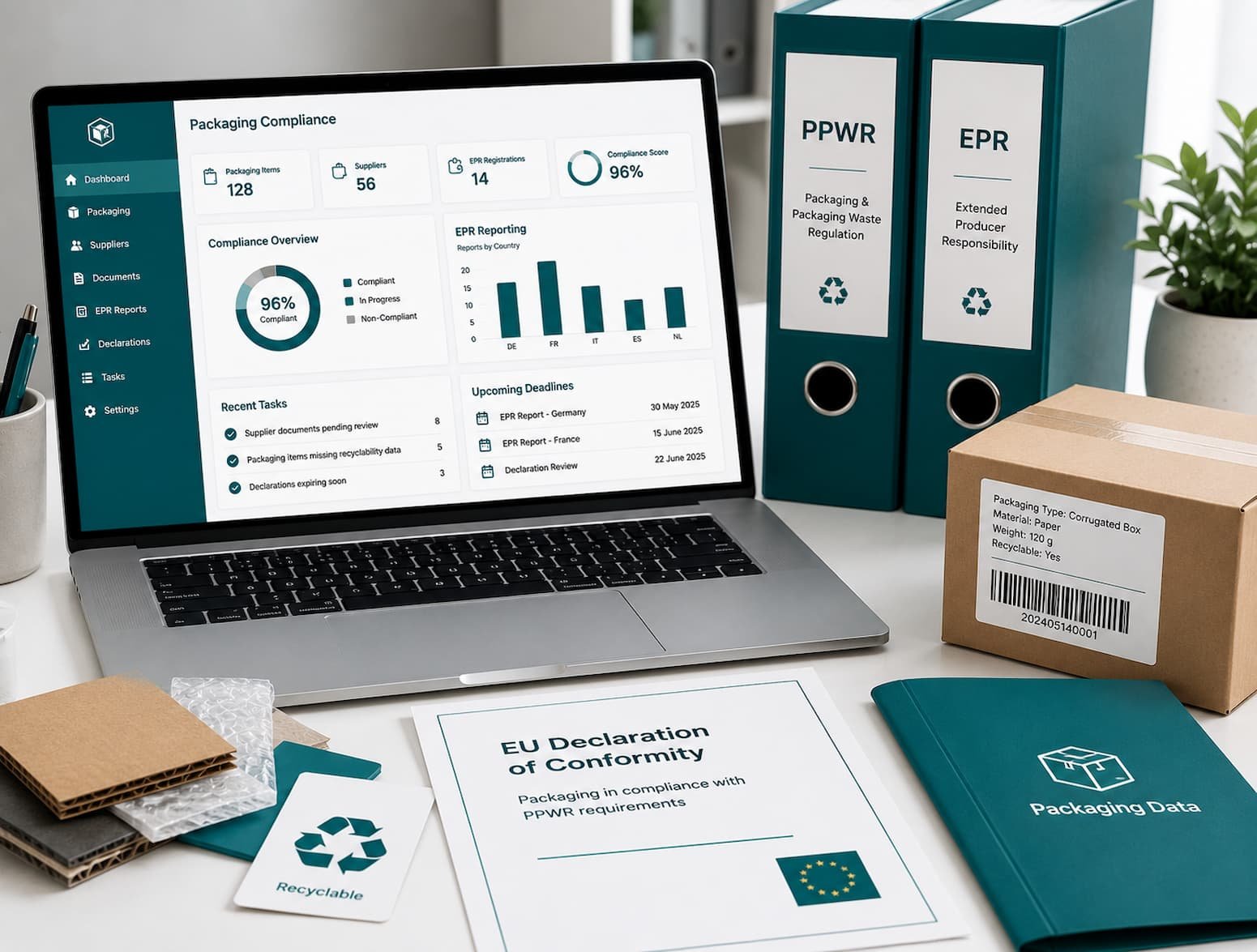
| Compliance Dashboard | Provides visibility into packaging status and documentation |
| Regulatory Updates | Helps businesses stay aligned with changing legislation |
| Secure Document Management | Improves audit readiness and record accessibility |
| Scalable Platform | Supports future PPWR and EPR requirements |
Why Digital Compliance Will Define the Future of Packaging Regulations?
Packaging compliance is becoming increasingly data-driven. As businesses prepare for PPWR implementation and continue managing EPR obligations, the volume of packaging information, supplier documentation, and regulatory evidence will continue to grow.
Digital compliance platforms allow organisations to centralise these activities into one structured system. Instead of searching through spreadsheets or requesting documents repeatedly from suppliers, businesses gain immediate access to the information needed for regulatory reporting, audits, and decision-making.
Digital systems also improve collaboration between procurement, sustainability, packaging, quality, and regulatory teams by providing consistent information across departments. This reduces duplicate work while improving transparency throughout the organisation.
As future delegated and implementing acts introduce additional PPWR requirements, businesses with digital compliance processes will be better positioned to respond quickly and confidently.
Summing Up
Choosing the right packaging compliance software is no longer simply an IT decision. It is a strategic investment that can strengthen regulatory readiness, improve operational efficiency, and reduce compliance risks across the organisation.
The ideal platform should support more than documentation. It should help businesses centralise packaging data, collaborate with suppliers, manage technical documentation, prepare EU Declarations of Conformity, perform recyclability assessments, and simplify multi-country EPR reporting. Combined with practical guidance such as the PPWR Workshop and PPWR Check, businesses can build a structured compliance strategy that prepares them for both current and future regulatory requirements.
PackIntelX combines industry expertise with digital compliance solutions to help businesses simplify PPWR and EPR compliance through packaging data management, supplier collaboration, technical documentation, EU Declaration of Conformity support, recyclability assessments, and multi-country EPR reporting. By adopting a connected compliance approach today, organisations can confidently prepare for the evolving packaging regulations across the European Union.
FAQs
1. What is packaging compliance software?
Packaging compliance software is a digital platform that helps businesses manage packaging regulations by centralising packaging data, technical documentation, supplier information, compliance records, and regulatory reporting. It simplifies compliance activities while improving visibility across packaging portfolios and reducing manual administration.
2. Why is packaging compliance software important for PPWR?
The PPWR introduces new obligations related to recyclability, recycled content, technical documentation, supplier collaboration, and EU Declarations of Conformity. Packaging compliance software helps businesses organise the information needed to demonstrate compliance, prepare for inspections, and manage regulatory requirements more efficiently.
3. Can packaging compliance software help with Extended Producer Responsibility (EPR)?
Yes. Many advanced platforms support multi-country EPR reporting by centralising packaging data, helping businesses manage country-specific reporting requirements, monitor compliance obligations, and maintain accurate documentation across multiple European markets.
4. How do PPWR Workshops and PPWR Check support compliance?
PPWR Workshops provide practical guidance on understanding regulatory obligations, technical documentation, supplier responsibilities, and implementation planning. The PPWR Check helps businesses evaluate their readiness by identifying compliance gaps, applicable obligations, and recommended next steps before implementation.
5. What should businesses look for when choosing packaging compliance software?
Businesses should look for features such as packaging data management, supplier collaboration, technical documentation management, EU Declaration of Conformity support, recyclability assessments, multi-country EPR reporting, secure document management, and scalability to accommodate future PPWR and EPR requirements.