Key Takeaways
- What is EPR compliance? The legal requirement for anyone placing packaging on the EU market to register, report packaging data, and pay fees toward its collection and recycling.
- Who must comply? Brand owners, manufacturers, importers, distributors, fillers, retailers, and online sellers — including non-EU companies selling into the EU.
- Deadline: PPWR became fully enforceable across the EU on 12 August 2026. If you haven’t registered yet, you’re already out of step with the rules — registering now is the priority.
- Is there one EU registration? No — registration is country-by-country, with no single EU-wide number yet.
- What does it cost? Fees are calculated as weight × material rate × recyclability modulation – better-recycling packaging pays less.
- What if I don’t comply? Sales bans, marketplace delisting, customs holds, and fines — exact penalties vary by country.
- Fastest first step: Download PackintelX’s free EPR factsheet and registration template → packintelx.com/epr
What Is EPR Compliance for Packaging Businesses?
EPR (Extended Producer Responsibility) compliance means registering with the national producer register in every EU country where you place packaging on the market, reporting the type and weight of that packaging every year, and paying fees that fund its collection and recycling. Under the EU’s Packaging and Packaging Waste Regulation (PPWR), these obligations have applied since 12 August 2026 to brand owners, manufacturers, importers, and online sellers alike — regardless of where the company itself is based.
EPR isn’t new — France, Germany, and a handful of other member states have run national schemes for years. What’s changed is that PPWR makes the underlying rules (data reporting, eco-modulated fees tied to recyclability, and penalties) consistent across all 27 member states, while registration itself stays country-by-country until at least 2029.
If you need the full regulatory background — legal basis, definitions, and how EPR fits into the wider PPWR — see our complete EPR guide. This article focuses on the action plan: what to actually do, in what order — whether you’re getting ahead of PPWR obligations or catching up now that the deadline has passed.
Who Needs to Comply With EPR in the EU?
| Role | In scope? | Notes |
| Brand owners | Yes | Whoever’s brand is on the packaging is usually the “producer” of record. |
| Manufacturers filling/packing goods | Yes | Applies even if packaging materials are bought pre-made from a supplier. |
| Importers bringing packaged goods into the EU | Yes | Obligation shifts to the importer when the brand owner is outside the EU. |
| Distributors and retailers | Yes, in some markets | Some countries extend obligations further down the supply chain. |
| Online sellers / marketplace sellers | Yes | Marketplaces increasingly verify registration before allowing a listing to stay live. |
| Non-EU companies selling into the EU | Yes, via an Authorised Representative | Same obligations as an EU-based company — location doesn’t exempt anyone. |
| Micro and small businesses | Usually yes | Some paperwork may be reduced for smaller businesses, but registration requirements generally still apply — check current thresholds for your markets. |
If you sell in eight EU countries, expect to register separately in all eight — there’s no “one form covers the EU” option yet.
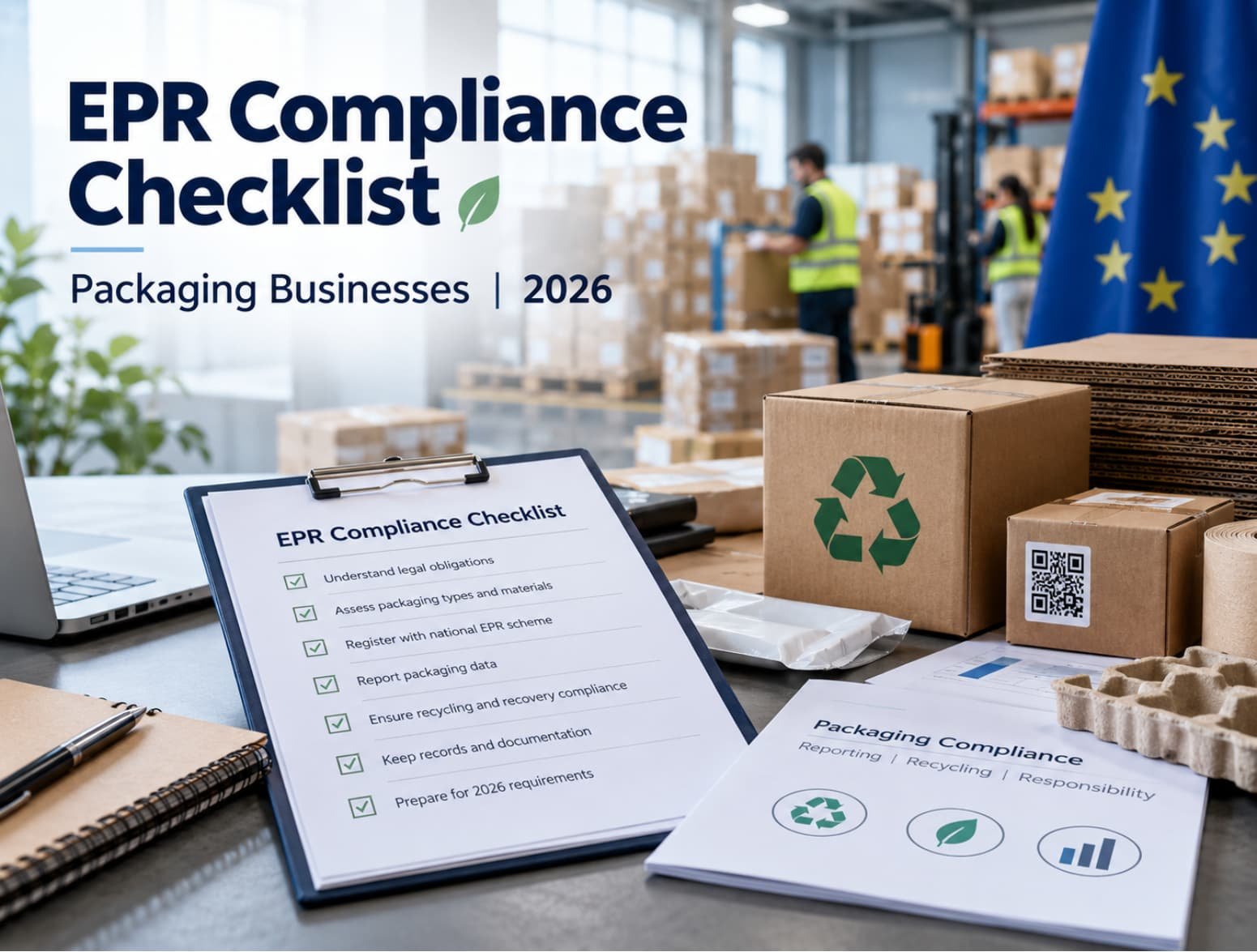
The EPR Compliance Checklist: 11 Steps to Get (and Stay) Compliant
| Steps | Why it matters |
| Confirm whether you’re a “producer” under PPWR | Brand owners, fillers, importers, and online sellers all qualify — don’t assume it only applies to manufacturers. |
| List every EU country where your packaging reaches an end customer | Registration is per-country, so this list defines your entire to-do list. |
| Register with the national producer register / PRO in each country | No EU-wide number exists yet — expect to register separately with each country for now. |
| Classify packaging by material and weigh what you place on the market | Fees are calculated on weight × material rate, so this data feeds every downstream step. |
| Assign a recyclability grade (A–E) to each packaging format | Lower grades face phased market restrictions over time, so better-recycling formats keep you future-proof. |
| Budget for eco-modulated fees based on those grades | Mono-material, easily-recycled packaging pays less; multilayer laminates pay more. |
| Prepare a Declaration of Conformity for every distinct product | Keep clear records on file — retention periods vary by product type. Use our free EU DoC template to start. |
| Check PFAS and heavy-metal limits if you sell food-contact packaging | Strict PFAS and heavy-metal limits apply to food-contact packaging — lab testing is generally required, and a supplier declaration alone usually isn’t enough. |
| Plan for QR-code digital labelling | Expected to include material composition, recyclability grade, sorting instructions, and your producer registration number per country — start preparing your product data now. |
| Confirm your marketplace registration is visible to platforms | Online marketplaces now verify EPR registration and can suspend listings immediately if it’s missing. |
| Set up an annual reporting calendar | Fee schedules and reporting cycles differ per country — missing one deadline can trigger fines even if you’re otherwise compliant. |
For the QR-code and labelling requirements specifically, see PPWR Article 15: Digital Labelling & QR Codes. For the Declaration of Conformity itself, see our EU Declaration of Conformity guide.
EPR Registration & Fees: How Countries Differ
Registration requirements and fee structures differ by country. Most EU markets run their own national producer register, calculate fees based on packaging weight and material type, and apply some form of discount for packaging that’s easier to recycle. Exact rates, reporting cycles, and registration steps vary by country and are updated regularly — confirm the current requirements for each market you sell into.
For Germany-specific detail, see Germany VerpackDG: Eco-Modulated Fees & PPWR Compliance. For France, see France Professional Packaging EPR 2026.
Compliance Timeline: 2026–2038
- 12 August 2026 — PPWR became fully enforceable across the EU (now in effect).
- In the years that follow — Recyclability grading, digital labelling, and reuse requirements phase in gradually; expect the rules to tighten over time.
Already Past 12 August 2026? What to Do Now
If you’re reading this after the fact and haven’t registered yet, you’re not the only one — the priority now is speed, not panic. Regulators typically focus first on getting non-compliant producers registered and their data backfilled, before moving to harsher penalties.
- Register immediately in every country where you place packaging — a late registration is still far better than staying unregistered.
- Check for catch-up provisions — some national producer registers allow backdated reporting or short windows for late filers; confirm directly with each register rather than assuming.
- Get your packaging data ready (weight, material type, recyclability grade) so you can report as soon as you’re registered, instead of registering now and stalling on the data.
- Resolve marketplace or customs issues first if a listing has been suspended or a shipment held, registering is usually the fastest way to get it released.
- Get help if you’re behind in several countries at once — catching up across multiple national systems in parallel is where most delays and mistakes happen.
The checklist below applies either way — whether you’re getting ahead of EPR obligations or catching up on them now.
What Happens If You Don’t Comply?
- Fines – Penalties vary by member state and can be significant; some countries count each non-compliant product as a separate violation.
- Sales prohibition – Non-compliant packaging cannot legally be placed on the market.
- Marketplace delisting – Online platforms now verify EPR registration and can suspend a listing immediately, with no warning.
- Customs holds – Shipments can be blocked at the border.
- Mandatory recall – Non-compliant products may need to be pulled from distribution.
Get Your Free EPR Factsheet & Registration Template
Don’t build your EPR tracker from scratch. PackintelX’s free factsheet walks through registration, fee modulation, and documentation requirements — with a ready-to-use template for your own packaging data.
Download the free EPR factsheet & template →
Need hands-on help across multiple countries? See how PackintelX’s EPR consulting services can manage registration and reporting for you.
FAQs
What is EPR compliance for packaging companies?
EPR compliance means registering with the national producer register in every EU country you sell into, reporting packaging weight and material data annually, and paying fees that fund collection and recycling.
Who needs an EPR registration in the EU?
Brand owners, manufacturers, importers, distributors, fillers, retailers, and online sellers — including non-EU companies selling into the EU through an Authorised Representative.
Is there one EU-wide EPR registration number?
No. Registration is handled separately by each member state, and there’s no single EU-wide number yet.
What happens if I don’t register for EPR?
You risk fines, sales bans, marketplace delisting, customs holds, and mandatory recalls — exact penalties vary by member state, so it’s worth checking with a compliance advisor for your specific markets.
How much are EPR fees?
Fees are calculated as packaging weight × material rate × recyclability modulation. Better-recycling packaging (Grade A) pays less than harder-to-recycle formats (Grade C and below); exact rates are set nationally and change annually.
Do micro-enterprises need to register for EPR?
Generally, yes. Smaller businesses may get some paperwork relief, but registration requirements typically still apply — check the specific rules for your markets.
When is the EPR compliance deadline in 2026?
12 August 2026 — and that date has passed. PPWR is now fully enforceable across the EU, so if you haven’t registered yet, the priority is catching up as quickly as possible rather than waiting.
What if I missed the 12 August 2026 EPR deadline?
You should still register as soon as possible — late registration and reporting is generally treated better than staying unregistered. Some national registers allow backdated filing for late producers; check directly with each register you need to catch up with, since provisions vary by country.