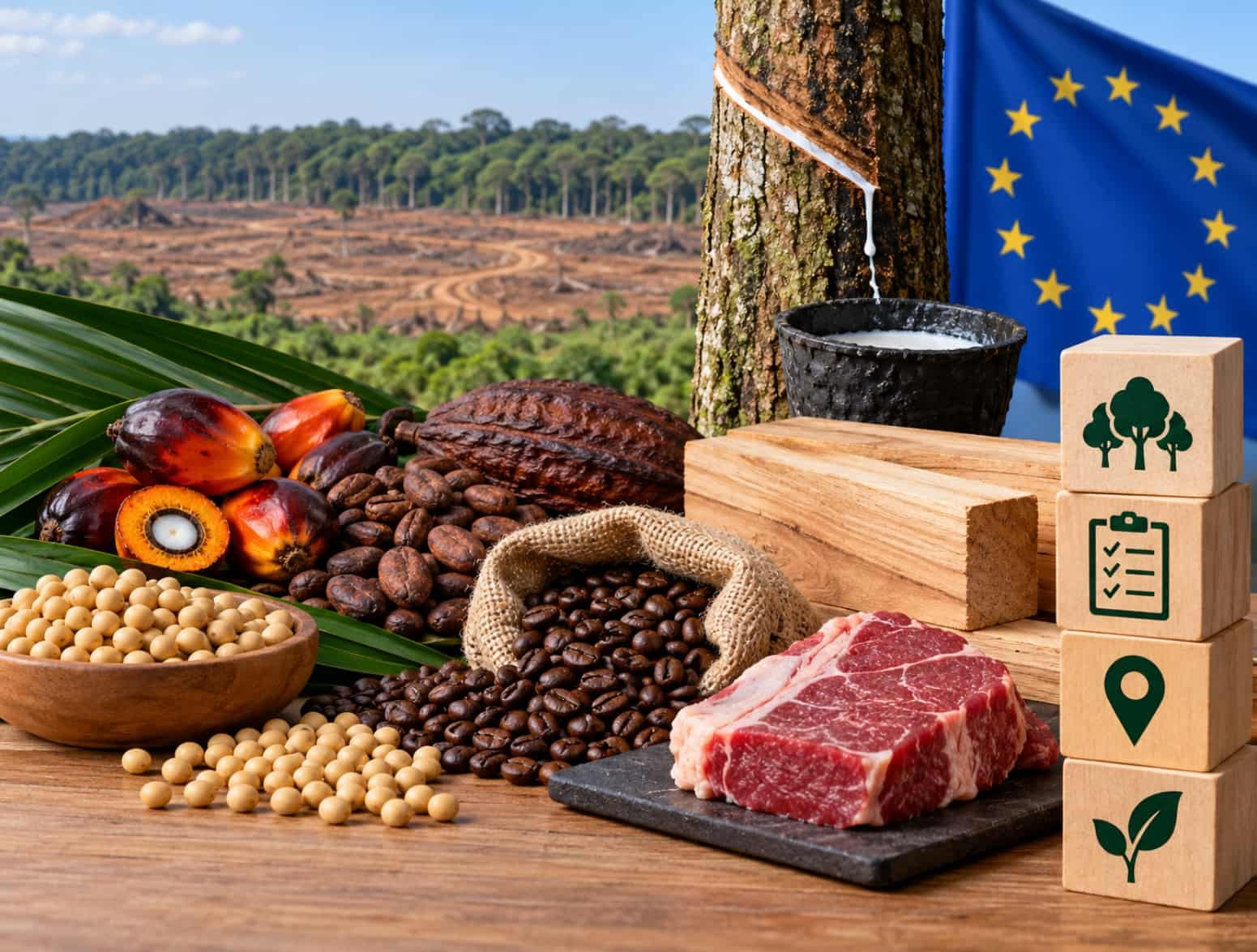
The EU Deforestation Regulation (EUDR) is Regulation (EU) 2023/1115. It covers seven key commodities. You may only sell them in the EU, or export them, if they are deforestation-free and legally produced. They must also be covered by a due diligence statement. The rules start on 30 December 2026 for large and medium companies. Who is responsible depends on your role: operator, downstream operator or trader.
Key takeaways
- The EUDR covers cattle, cocoa, coffee, oil palm, rubber, soya and wood, plus products made from them.
- Land must not have been deforested after 31 December 2020.
- Operators carry the main duty. They do the due diligence and submit the due diligence statement.
- Downstream operators and traders do not submit a statement. They must hold the information and the reference numbers.
- Large and medium companies start on 30 December 2026. Most micro and small companies start on 30 June 2027.
- Member States set the penalties. The maximum fine must be at least 4% of a company’s yearly EU-wide turnover.
What is the EUDR?
The EUDR aims to stop EU demand from driving deforestation and forest damage. The European Commission says it should cut at least 32 million tonnes of CO2 emissions each year. It replaces the old EU Timber Regulation from 30 December 2026.
A product may enter the EU market, or leave it, only if it meets three conditions:
- It is deforestation-free. The land was not deforested after 31 December 2020.
- It was produced legally under the laws of the country of origin.
- It is covered by a due diligence statement, or by a simplified declaration for some small producers.
Which products are covered?
| Commodity | Examples | Note |
|---|---|---|
| Cattle | Beef and other cattle products | Leather and hides were removed in 2026. Frozen cattle tongues join from 30 December 2027 |
| Cocoa | Cocoa and chocolate | No change in 2026 |
| Coffee | Coffee beans | Soluble coffee joins from 30 December 2027 |
| Oil palm | Palm oil | Some palm oil derivatives join from 30 December 2027 |
| Rubber | Natural rubber products | Re-treaded tyres and conveyor belts were removed in 2026 |
| Soya | Soya beans and soya products | Soya beans for sowing were removed in 2026 |
| Wood | Timber and wood products | Check your product code in the regulation |
An EU update in 2026 changed the product list. It took out some items, such as leather and re-treaded tyres. It adds three items from 30 December 2027. Always check your product code in the regulation before you decide.
Who is responsible under the EUDR?
The EUDR names four main roles. Your role decides your duties. One company can hold different roles for different products.
| Role | Who it is | Main duty |
|---|---|---|
| Operator | Places relevant products on the EU market for the first time, or exports them | Does the due diligence, submits the due diligence statement, keeps records for 5 years and passes on reference numbers |
| Downstream operator | Places on the market, or exports, products made from relevant products that are already covered by a statement | Holds the information and the reference numbers. Keeps records for at least 5 years |
| Trader | Any other person in the supply chain who makes relevant products available on the market | Holds the information and the reference numbers. Keeps records for at least 5 years |
| Micro or small primary operator | A small producer in a low-risk country that places its own products on the market | Files a one-time simplified declaration. May give a postal address instead of geolocation |
If you bring these goods onto the EU market for the first time, you are the operator. The operator stays responsible even when it asks someone else to file for it. An operator may name an authorised representative based in the EU to submit the statement.
Downstream operators and traders that are not SMEs have extra steps. They must register in the EU Information System. They must also check that due diligence was done. If they have doubts, they may not go ahead until the risk is negligible.
What must an operator do?
The operator does due diligence in three steps:
- Collect information. This covers the product, the amount and the country of production. It also covers the geolocation of every plot of land. A plot over 4 hectares needs a polygon. A plot under 4 hectares needs one point. Coordinates need six decimal places.
- Assess the risk. Look at the country risk level (low, standard or high). Look at the chance of deforestation, corruption and how complex the supply chain is.
- Reduce the risk. If the risk is more than negligible, act before you sell. You may ask for more data or run checks. If the risk stays too high, you may not place the product on the market.
Then the operator submits the due diligence statement in the EU Information System. The system issues a reference number. The operator passes that number to the next company in the chain. Records must be kept for 5 years.
When does the EUDR start?
| Date | Who and what |
|---|---|
| 30 December 2026 | Large and medium companies. Also micro and small companies that were already covered by the EU Timber Regulation |
| 30 June 2027 | Other micro and small companies that were set up by 31 December 2024 |
| 30 December 2027 | The products added in 2026 |
The EU moved the start date twice before. The first date was 30 December 2024. It then moved to 30 December 2025, and then to 30 December 2026.
What are the penalties?
Each Member State sets its own penalties. For companies, the maximum fine must be at least 4% of yearly EU-wide turnover.
What should you do now?
- Match your products to the product list. Check each product code.
- Decide your role. Are you an operator, a downstream operator or a trader?
- Ask suppliers for data. Start with origin and plot locations.
- Plan the reference number flow. Know who gives you numbers and who needs yours.
- Set up records. Keep them for at least 5 years.
Not sure which role you hold?
PackIntelX consulting can help you find your EUDR role, check your data gaps and plan the next steps. See how we support EUDR compliance, or book a consultation.
FAQ
Who is responsible for EUDR compliance?
The operator carries the main duty. It does the due diligence and submits the statement. Downstream operators and traders must hold the information and reference numbers.
What is the difference between an operator and a trader?
An operator places products on the EU market for the first time, or exports them. A trader is any other person in the supply chain.
Do small companies have to comply?
Yes, but later. Most micro and small companies start on 30 June 2027. Some small primary producers file a one-time simplified declaration.
Do I need a due diligence statement if I buy from an EU supplier?
Not if your supplier is an operator and you are a downstream operator or trader. You must hold the reference numbers. Firms that are not SMEs must also register in the EU Information System.
Is the EUDR delayed again?
The current start date is 30 December 2026 for large and medium companies. The EU moved the date twice before.
How long must records be kept?
Operators must keep their statement records for 5 years. Downstream operators and traders must keep theirs for at least 5 years.
Note:- This article is general information, not legal advice.