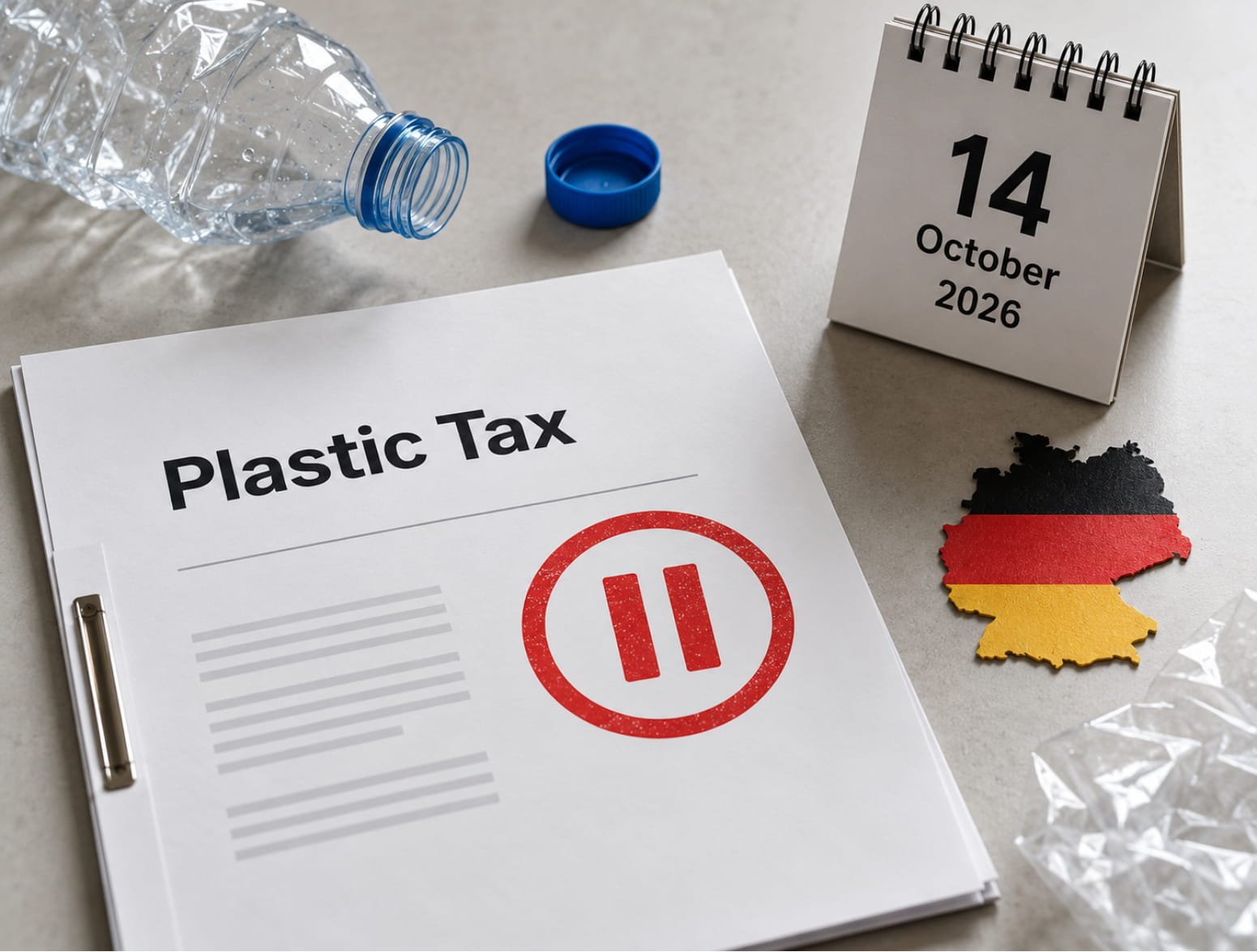
Quick answer: Germany’s planned plastic packaging tax, the Plastiksteuer, is on hold. The federal cabinet was expected to approve the draft on Wednesday 14 October 2026, but the decision was postponed after resistance from CDU/CSU lawmakers. Union parliamentary group leader Thorsten Frei said the draft is not approvable in its current form. The tax has not been cancelled, but its planned start on 1 July 2027 is no longer secure.
For packaging companies, the Plastiksteuer looked like the next big cost topic. Now the coalition government has paused it. This post explains what happened, why it happened, what is still open and what companies can sensibly do in the meantime.
It is an update to our full guide to the Plastiksteuer 2027 and the €550 per tonne rate
Status: based on media reports up to 17 October 2026. The situation can change quickly.
Key takeaways
- The cabinet decision on the Plastiksteuer planned for 14 October 2026 was postponed.
- The reason is resistance in the CDU/CSU parliamentary group. Its leader, Thorsten Frei, called the current draft not approvable.
- Media reports say at least 24 Union MPs declared in writing that they will not vote for the tax in its current form.
- The plan is not cancelled. Whether the rate changes, exceptions are added or the start is delayed is open.
- The planned start on 1 July 2027 is no longer secure.
- For companies this is breathing space, not an all-clear. PPWR and EPR are separate topics and stay in place.
What happened on 14 October 2026?
The draft law on a plastic packaging tax (Kunststoffverpackungsteuergesetz), dated 30 September 2026, was meant to go to the federal cabinet on Wednesday 14 October. It did not. According to neue verpackung and MS-Aktuell, the decision was postponed after resistance in the CDU/CSU parliamentary group.
On the same day, the cabinet did move forward with a tax on sugary drinks, in changed form. For the Plastiksteuer there was no agreement on 14 October. According to MS-Aktuell, the Union’s stance makes an understanding between CDU, CSU and SPD harder.
On the evening of 14 October, Thorsten Frei told WELT TV that the reservations in his group are fully justified and that the draft, as it stands, is not approvable. His main point was the balance between cost and benefit. It has to be weighed not only for public administration but also for private business, and at the moment, he said, it does not fit.
Timeline: how the Plastiksteuer got here
| Date | What happened |
| July 2026 | The federal government agrees in principle on a plastic tax in the context of budget planning. No law with a binding rate and start date follows. |
| 30 September 2026 | Date of the draft law: €550 per tonne of plastic, planned start on 1 July 2027. |
| 2 October 2026 | Business associations write to the Federal Chancellery. Signatories include HDE, BVE, IK and VDMA. They criticise the plan to bring in the tax quickly through the 2027 budget accompanying act. |
| 12 October 2026 | The Bundestag budget committee deals with the 2027 budget accompanying act. A plastic tax rule is not yet part of the government draft. |
| 14 October 2026 | The planned cabinet decision is postponed. Frei says on WELT TV that the draft is not approvable. The sugary drinks tax moves ahead in changed form. |
| 16 October 2026 | In reply to a BILD enquiry of 16 October, the Environment Ministry says the draft is still being coordinated within the government. No new cabinet date is known. |
Why did the Union object?
Frei’s main criticism is the ratio between the expected revenue and the burden on companies and administration. According to BILD, as relayed by EUWID, the concerns among Union MPs include competitive disadvantages for German companies, extra bureaucracy for businesses and high administrative effort for the federal government.
Business groups had warned before. According to neue verpackung, eight business associations warned of the consequences in early October. A letter of 2 October to the Federal Chancellery was signed, among others, by HDE, BVE, IK and VDMA, according to MS-Aktuell. The associations criticised the fast-track plan and disagree with the government on costs. The draft puts the extra yearly bureaucracy cost for business at about €44 million, while the associations estimate at least €600 million a year. The higher figure is an association estimate, not independently confirmed.
What was in the draft, in short?
Only the main points are listed here. The guide linked above explains the draft in detail.
- Rate and start: €550 per tonne of plastic, planned from 1 July 2027.
- Scope: Packaging, plastic films, closures and certain composite packaging.
- Pass-on: The draft assumes companies pass the cost on to customers.
- Relief: Relief for recycled plastic is foreseen. According to neue verpackung, its concrete design is left to a later ordinance.
What does the delay mean for the federal budget?
The government wanted the tax to strengthen the federal budget. The draft counts on €670 million reaching the budget in cash in 2027 and about €1.5 billion a year from 2028. For 2027 it also shows €805 million as the tax effect in the assessment year. These are forecasts and assume the tax is introduced.
The tax was also meant to cover Germany’s contribution to the EU plastics levy. According to the ministry paper cited by WELT, this is about €1.4 billion a year, and it is paid so far from the general federal budget. Without the tax, the financing of the planned extra revenue is unclear, according to MS-Aktuell.
What happens next?
There is no new date. According to the reports, the government must now find a way to settle the reservations inside the coalition. Whether the rate is changed, more exceptions are added or the start is moved is open.
EUWID reports that the tax could go through its own legislative procedure instead of an amendment to the 2027 budget accompanying act. The Environment Ministry neither confirmed nor denied this and said only that the matter is under discussion. In any case, the tax needs a text that can win a majority and the full parliamentary procedure before it can apply.
What should companies do now?
The trade magazine neue verpackung calls the decision a breathing space, but planning certainty is still missing. A practical approach:
- Do not read the delay as a cancellation. Keep the Plastiksteuer on your risk list.
- Keep your packaging data in good shape. List material, weight, plastic share, recycled content and supplier for each packaging item. You need this for PPWR and EPR anyway.
- Run two cases. Model your plastic weight at the draft rate of €0.55 per kg, and a case with no tax.
- Watch for three signals. A new cabinet date, changes to the rate, exceptions or start date, and a separate procedure instead of the budget act.
- Keep PPWR and EPR work moving. These are separate topics. See our pages on PPWR and EPR, and our short post on the difference between PPWR and EPR.
Frequently asked questions about the plastic tax delay
Is the Plastiksteuer cancelled?
No. The cabinet decision planned for 14 October 2026 was postponed, but there is no final rejection of the plan. How and when it may continue is still open.
Why was the German plastic tax postponed?
The CDU/CSU parliamentary group opposed the draft. Its leader, Thorsten Frei, said the draft is not approvable in its current form and that the balance between cost and benefit does not fit, for public administration and for private business.
Will the Plastiksteuer still start on 1 July 2027 after the delay?
That is no longer secure. The draft planned a start on 1 July 2027, but the government still has to settle the dispute. It could change the rate, add exceptions or move the start date. None of this has been decided.
How many CDU/CSU MPs oppose the plastic tax?
Media reports say at least 24 Union MPs declared in writing that they will not vote for the tax in its current form. The figure goes back to a BILD report.
What did the German cabinet decide on 14 October 2026?
It moved forward with a tax on sugary drinks, in changed form. The plastic tax was not decided.
What does the delay mean for the federal budget?
The government counted on about €670 million in cash in 2027 and about €1.5 billion a year from 2028. Without the tax, the financing of this planned extra revenue is unclear, according to MS-Aktuell.
Does the delay change PPWR or EPR duties?
No. The Plastiksteuer is a separate national tax proposal. PPWR and EPR are separate sets of rules, so companies should keep working on their packaging data and compliance.
Stay ahead of PPWR and EPR
PackIntelX runs free live webinars on PPWR and EPR for companies that place packaging on the market. Sessions end with live Q&A. Register for the free webinars.
Sources
This post summarises media reports from 15 to 17 October 2026. It is general information, not legal or tax advice.
- neue verpackung: Plastiksteuer vorerst gestoppt, Union blockiert Gesetzentwurf (15 October 2026)
- WELT: Nächster Krach in der Bundesregierung, Union lehnt Plastiksteuer-Plan ab (15 October 2026)
- MS-Aktuell: Plastiksteuer vorerst vertagt, Union stellt sich gegen Entwurf (17 October 2026)
- EUWID: Plastiksteuer, Widerstand in der Union wächst (15 October 2026)