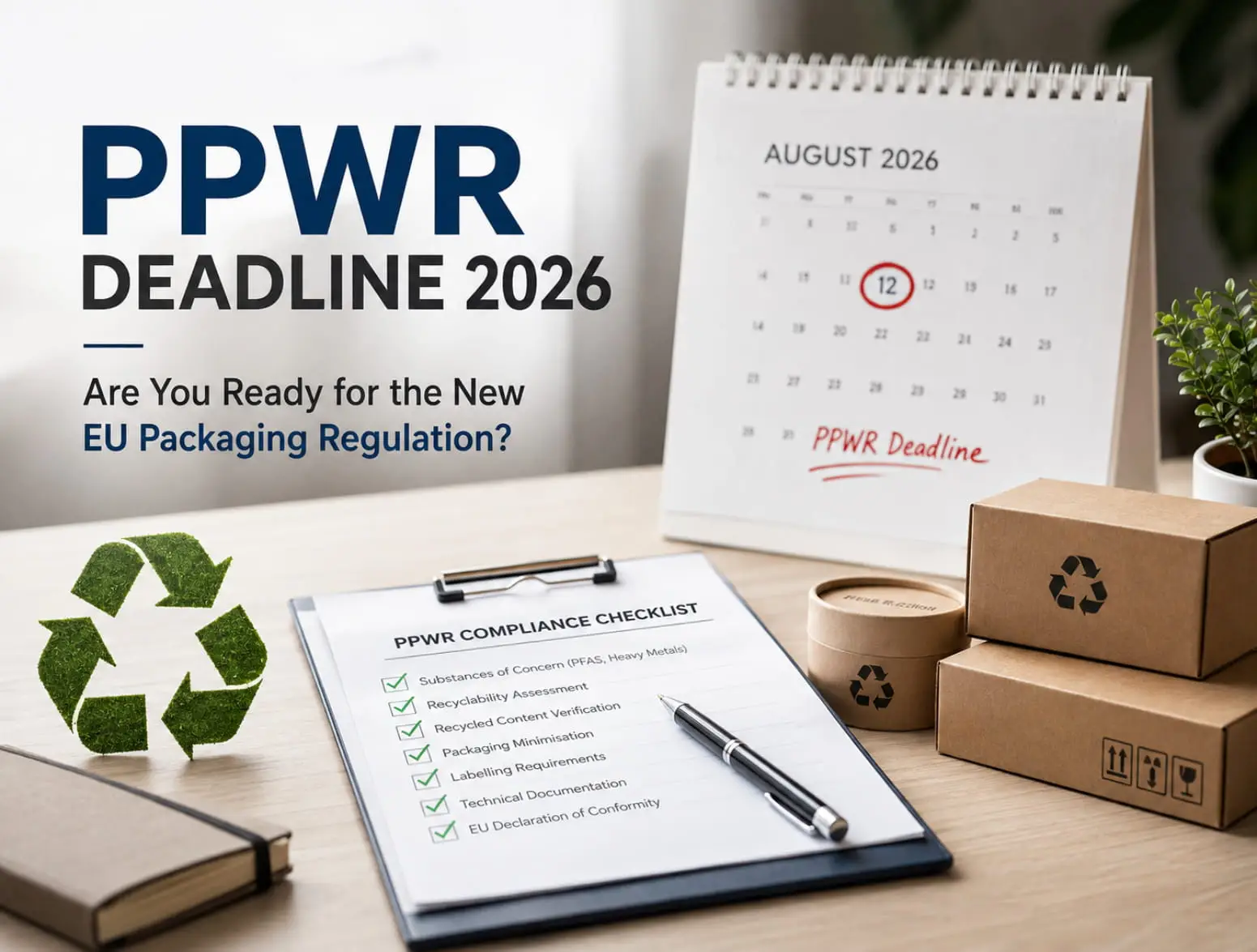
The PPWR deadline 2026 is approaching quickly, and businesses placing packaging on the EU market have limited time to prepare for one of the most significant changes to European packaging legislation in decades. The Packaging and Packaging Waste Regulation (PPWR) introduces new obligations covering substances of concern, recyclability, recycled content, compostability, packaging minimisation, reusability, labelling, technical documentation, and the EU Declaration of Conformity.
For many organisations, the challenge is not understanding that the regulation is coming, but identifying what must be completed before 12 August 2026. Manufacturers, importers, brand owners, distributors, and packaging suppliers all need to review their packaging portfolios, collect supplier data, organise technical documentation, and establish compliance processes.
This guide provides a practical PPWR checklist of the most important actions businesses should complete before the deadline to reduce compliance risks and maintain access to the EU market.
Click here for a Free PPWR Test!

Why the PPWR Deadline 2026 Matters?
Unlike a directive, the PPWR is an EU packaging regulation that applies directly across all Member States. Businesses cannot rely on waiting for national transposition before taking action. The regulation introduces mandatory requirements that must be supported by technical documentation and made available to market surveillance authorities when requested.
The first wave of obligations begins on 12 August 2026, making early preparation essential. Companies that delay implementation may face documentation gaps, supplier information shortages, packaging redesign pressures, and increased administrative effort.
Preparing now also supports broader sustainable packaging compliance objectives by improving packaging transparency, recyclability, and circular economy performance.
Understand Your Role Under PPWR
The first step in any PPWR compliance project is identifying your role in the packaging value chain.
Different obligations apply to:
- Manufacturers
- Importers
- Distributors
- Suppliers of packaging or packaging materials
- Fulfilment service providers
For example, manufacturers are primarily responsible for conformity assessment, technical documentation, and the EU Declaration of Conformity, while importers must verify that these documents exist before placing packaging on the EU market.
Without correctly identifying your role, it is impossible to determine which PPWR requirements apply to your business.
Review Your Entire Packaging Portfolio
A complete packaging portfolio review is one of the most important activities before the PPWR deadline 2026.
You should identify:
- All packaging formats
- Packaging materials
- Components such as labels, adhesives, caps, and inserts
- Single-use and reusable packaging
- Food-contact packaging
- Packaging supplied by third parties
This review helps determine which packaging types may require additional testing, redesign, supplier information, or technical documentation.
Many businesses discover during this step that they have limited visibility into certain packaging components, particularly those sourced through multiple suppliers.
Check Substances of Concern (Article 5)
Article 5 focuses on substances of concern in packaging, including heavy metals and PFAS.
Before August 2026, businesses should:
- Review packaging materials for PFAS use
- Verify heavy metal concentrations
- Collect supplier declarations
- Obtain supporting laboratory evidence where necessary
- Include substance information in technical documentation
For food-contact packaging, PFAS limits become particularly important from 12 August 2026.
Substance compliance is not only a legal requirement but also a key element of sustainable packaging compliance and future market expectations.
Assess Recyclability Readiness (Article 6)
Although major recyclability performance obligations become increasingly relevant towards 2030, businesses should begin preparing now.
Evaluate whether packaging is:
- Designed for recycling
- Compatible with existing recycling systems
- Free from unnecessary problematic components
- Supported by recyclability evidence
Design choices such as mixed materials, difficult-to-remove labels, incompatible adhesives, and certain barrier structures can affect future compliance.
Early recyclability assessments reduce the risk of costly redesign projects later.
Verify Recycled Content Data (Article 7)
If your packaging contains plastic components, start collecting recycled content information from suppliers.
You should verify:
- Percentage of recycled content
- Source of recycled material
- Supplier certifications
- Traceability of recycled inputs
- Supporting documentation for technical files
Even where future targets apply from 2030, businesses need time to build reliable data collection processes across the supply chain.
Review Compostable Packaging (Article 9)
For businesses using compostable packaging, check whether the packaging falls within the mandatory compostability categories or is marketed as compostable in specific Member States.
Confirm that:
- Appropriate standards are met
- Supporting certificates are available
- Claims are accurate
- Technical documentation includes relevant evidence
Compostability and recyclability requirements interact closely under the PPWR, so packaging should be assessed carefully against both sets of obligations.
Check Packaging Minimisation (Article 10)
Article 10 requires packaging volume and weight to be reduced to the minimum necessary for functionality.
Before the deadline, review:
- Empty space in packaging
- Decorative or unnecessary components
- Oversized secondary packaging
- Packaging layers that do not contribute to protection or transport
Packaging designed only to increase perceived product volume may create future compliance risks.
Prepare Reusable Packaging Documentation (Article 11)
If you place reusable packaging on the market, ensure that it is designed for multiple rotations and that compliance can be demonstrated through technical information.
Review:
- Durability
- Hygiene performance
- Reuse objective
- Number of expected rotations
- Supporting technical evidence
Reusable packaging requires a different documentation approach than single-use packaging.
Prepare for Harmonised Labelling (Article 12)
Labelling requirements will become increasingly important as implementing acts are adopted.
Start reviewing:
- Material identification
- Compostable claims
- Reusable packaging information
- Digital data carrier readiness
- Label visibility and durability
Avoid creating proprietary sustainability labels that may conflict with the future harmonised system.
Build Your Technical Documentation
Technical documentation is the backbone of PPWR compliance.
For each packaging type, organise:
- Packaging specifications
- Material composition
- Supplier declarations
- Test reports
- Recyclability evidence
- Recycled content information
- Substance compliance evidence
- Labelling information
Documentation should be structured, version-controlled, and easily accessible for inspections.
Prepare the EU Declaration of Conformity
The EU Declaration of Conformity (DoC) becomes a critical legal document under the PPWR.
Ensure that:
- A DoC exists for each packaging type
- It references the relevant PPWR articles
- It is supported by technical documentation
- It is kept up to date
- It is available to authorities when requested
Without a valid DoC, packaging cannot be legally placed on the EU market.
Strengthen Supplier Collaboration
Supplier data is one of the biggest implementation challenges.
Establish a structured process to collect:
- Material declarations
- PFAS information
- Heavy metal data
- Recycled content data
- Recyclability information
- Certifications
- Technical specifications
Supplier training may be necessary to ensure consistent and complete documentation.
Move from Spreadsheets to Digital Compliance
Managing packaging regulations through disconnected spreadsheets and email folders becomes increasingly difficult as requirements expand.
Consider centralising:
- Packaging data
- Supplier documents
- Technical files
- EU DoCs
- Compliance status
- Audit records
Digital workflows improve traceability, reduce manual effort, and support long-term PPWR compliance.
PPWR Checklist Before 12 August 2026
PPWR Checklist
Priority actions before the deadline are listed below:
- Identify your PPWR role
- Review all packaging formats
- Collect supplier declarations
- Check PFAS and heavy metals
- Assess recyclability
- Verify recycled content data
- Review compostable packaging
- Check packaging minimisation
- Prepare reusable packaging records
- Review labelling readiness
- Organise technical documentation
- Prepare EU Declarations of Conformity
- Implement digital compliance management
Priority actions before 12 August 2026
Before the PPWR implementation date arrives, businesses should focus on the most critical compliance activities. The following checklist highlights the priority actions that should be completed before 12 August 2026.
| Compliance Area | What to Prepare Before 12 Aug 2026 |
| Economic operator role | Identify whether your business acts as a manufacturer, importer, distributor, supplier, or fulfilment service provider under PPWR. |
| Packaging portfolio | Map all packaging formats, materials, components, food-contact packaging, and reusable packaging. |
| Article 5 – Substances of concern | Collect PFAS and heavy metal information, supplier declarations, and supporting laboratory evidence where required. |
| Article 6 – Recyclability | Assess whether packaging is designed for recycling and compatible with existing collection and recycling systems. |
| Article 7 – Recycled content | Verify recycled content percentages, traceability, supplier certifications, and supporting technical records. |
| Article 9 – Compostability | Confirm applicable compostability standards, certificates, and supporting technical documentation. |
| Article 10 – Packaging minimisation | Review empty space, decorative elements, oversized packaging, and unnecessary packaging layers. |
| Article 11 – Reusable packaging | Prepare durability, hygiene, reuse, and rotation evidence for reusable packaging formats. |
| Article 12 – Labelling | Check material identification, compostable claims, reusable information, and digital labelling readiness. |
| Technical documentation | Organise packaging specifications, supplier data, test reports, recyclability evidence, and labelling information. |
| EU Declaration of Conformity | Prepare a DoC for each packaging type and ensure it is supported by complete technical documentation. |
| Supplier collaboration | Establish a structured process for collecting declarations, certifications, material data, and compliance evidence. |
| Digital compliance management | Centralise packaging data, supplier documents, technical files, EU DoCs, and audit records in a digital system. |
Common Mistakes Before the Deadline
Businesses often underestimate the time required for documentation and supplier coordination.
Common mistakes include:
- Treating PPWR as only a sustainability project
- Waiting for national guidance before acting
- Ignoring packaging components
- Relying on outdated supplier declarations
- Missing technical evidence
- Preparing a generic EU DoC
- Managing compliance manually across multiple teams
Avoiding these issues can significantly reduce implementation delays.
The PPWR deadline 2026 is approaching rapidly, and businesses should use the remaining time to build a structured compliance foundation. Reviewing packaging portfolios, collecting supplier evidence, organising technical documentation, preparing EU Declarations of Conformity, and implementing digital compliance processes are the most important actions before 12 August 2026.
Early preparation is not only about avoiding regulatory risks. It also helps organisations improve packaging transparency, strengthen supplier collaboration, and advance their broader sustainable packaging compliance goals.
With August 2026 already underway, businesses should accelerate their PPWR preparations. PackIntelX supports this journey through PPWR Workshops, PPWR Check, technical documentation support, supplier onboarding, recyclability analysis, and digital compliance solutions designed to help organisations prepare confidently for the evolving EU packaging regulation.
Reach out to PackIntelX today to avoid last-minute PPWR compliance gaps and implementation delays.
FAQs
1. What is the PPWR deadline 2026?
The first major implementation date for the Packaging and Packaging Waste Regulation is 12 August 2026, when key compliance obligations begin to apply across the European Union.
2. What should businesses prepare before the PPWR deadline?
Businesses should review packaging portfolios, collect supplier data, assess substances of concern, organise technical documentation, prepare EU Declarations of Conformity, and establish digital compliance processes.
3. Who is affected by PPWR?
Manufacturers, importers, distributors, suppliers, fulfilment service providers, and brand owners placing packaging or packaged products on the EU market are affected.
4. Is technical documentation mandatory under PPWR?
Yes. Technical documentation supporting compliance with the applicable PPWR requirements must be maintained and made available to market surveillance authorities when requested.
5. How can businesses improve sustainable packaging compliance?
Businesses can improve sustainable packaging compliance by reducing substances of concern, improving recyclability, verifying recycled content, minimising packaging, and maintaining accurate compliance documentation.